
Schools
By Ronnie Read
Education Officer
Like the children they bring, the schools that visit us here at the
Schools come from all over; east and west
And we offer all of them, the Park, the river, the coast and the forest for the day.
As we stand, in our yellow florescent jackets, waiting in the car park for the school coaches to arrive, I am sure I am not alone in sometimes believing that I know what to expect from the group we are about to meet. Many are repeat visits who come every year often with the same staff. That aside, we all carry preconceptions about the children based on where they come from. If it is an inner city school with a large number of children on free school meals then there is a strong possibility that the day is going to be hard work. Behaviour is not going to be brilliant, the children are going to be outside their comfort zone, they are going to hate the walking, some may not be well prepared for the trip and some might have two heads (!)
So it was a couple of weeks ago I met a group from
Then we were outside, health and safety rules behind us, and heading down to the coast.
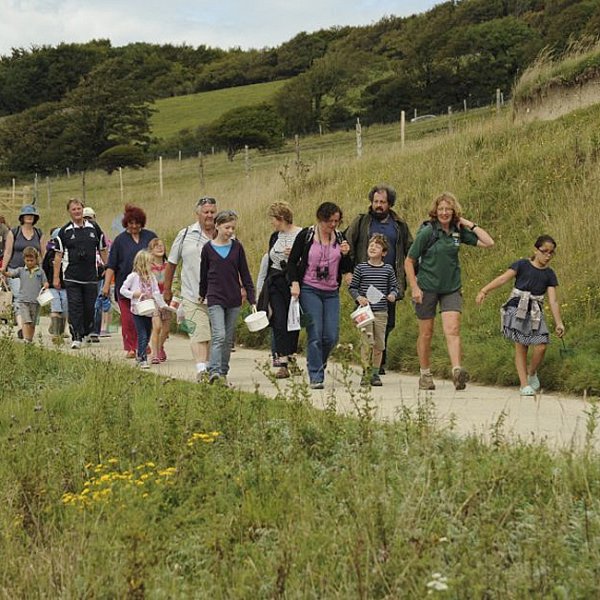
Suddenly, something shifted in the group. They were asking lots of questions and pointing things out and importantly they were listening to answers. We paused to look at the rabbit holes dug into the chalk outcrop that overhangs the path as it starts down the meanders. I pointed out the unripe horse chestnuts on the tree beside the Pill box and although no one knew what sort of tree it was other than conker, miraculously they were all interested. We talked about elderflower cordial, chalk and flint and I won them over when I produced a piece of flint and a striker and managed a spark. Then the wildlife kicked in. There was an obliging kestrel hovering over the field beside the river and a grey heron deftly caught a fish in front of us. Two little egrets completed the picture.
But it was the spider’s webs that clinched it for the group. They listened politely to me talking about the flowers; the bird’s foot trefoil and lady’s bedstraw, and the pyramidal orchid but it was when I showed them the funnel shaped spiders’ webs, complete with lurking predators, that festoon the chalk bank that rises up into the clear sky above the Innings that I knew the group were with me; engaged, engrossed and happy.
We stopped half way down the valley to lie in the grass and listen to the sound of skylarks singing and crickets talking to each other and they closed their eyes to the soft touch of the breeze blowing off the beach across a moving sea of grass.
And then we were down onto the beach and the rock pools filled up their lives. There were shore crabs, edible crabs, a hermit crab, feisty crabs, dead crabs, crab claws, crab shells and oh yes a huge number of different but potentially boring other creatures!!
As we walked back to the centre at the end of the day, I reflected on the visit and how wrong I had been about my initial feelings about the group. It was not perfect, not everyone had listened all the time, not everyone had enjoyed the walk, not everyone had learnt something new but on the whole they had enjoyed their adventure.
They all had something, a memory, to take away with them. Some of them might remember some of the things they were shown, a few wanted to stay or come back again; they had all done something different.
Maybe some of them dreamed that night of feisty crabs in the bottom of a net, or glaring white cliffs reaching up in a clear blue sky, or wheeling seagulls, or black spiders curled unseen at the bottom of funnel-shaped webs spun out across a chalk face covered in flowers.
I would like to think so.
Find out more about Sussex Wildlife Trust's Environmental Education Centres