
Quercus robur and Friends
By Ronnie Reed
Volunteer
It is head down, collar up weather as the wind chases the rain down the western slope of the Downs. The oak tree stands with its back to the wind at the junction of the footpath. The branches stretch up into the heavy grey sky and the last of this season’s yellow and green leaves dance in tune to the weather.It has stood strong and true to its name: Quercus robur. (Robur = strength in Latin) pedunculate oak, english oak. for many years. The heart wood has gone; the tree is hollow and dark within, a space for spiders, woodlice and beetles. Three of the lower limbs have been lost and the hollow scars left behind look down with a lopsided smile at those who pass beneath. Outstretched branches offer shelter to those who pause for a second to admire this tree. And stop and admire you do because there is something about oak trees.
Maybe it goes back to our druid roots and the rituals practised beneath their branches. Maybe it is because they were sacred to so many gods; Greek, Roman, Celtic. Or is it the stories of royalty on the run? In times past, we have tied the matrimonial knot beneath these spreading boughs, and cut our Yule Logs at Christmas. Oak has featured on our coins, on natty logos, and we follow its fruit on sign posts here in Sussex as we walk the South Downs Way.
Do we touch its bark because once it was used for leather tanning and in dying? Do we treasure acorns because we once turned them into flour and fed them to our livestock? Do we pick up the lobed leaves and finger them because once we used them for medicinal purposes? Do we get excited (or I do!) when we find the hard, round oak apple galls because once we made black ink from them?
Maybe.
This gnarled old oak tree is a wildlife supermarket, its shelves stocked with food. In the autumn, on special offer are the starchy acorns for birds like the brazen jays you briefly glimpse disappearing into the trees, for raucous rooks, soft grey pigeons and small mammals like squirrels and mice. Deer moving softly through the woods pick over the fallen nuts and mid-night shoppers like badgers feast on the acorns. Great spotted woodpeckers go for the insects in the bark.
Others go for shelter. Owls and bats roost in the hollow trunks.
The oak is host to a myriad of invertebrates. The larva of several hundred moth species feed on its leaves including the green oak moth which having lunched on the leaves rolls itself up in a leaf to pupate into an adult. The poor defenceless pupa can, in turn, be parasitised by at least four species of ichneumon wasps which lay their eggs inside the body of the pupa. Life can be tough!
The purple hairstreak butterfly lives in the tree tops from June to August feeding on the oak leaves, its life cycle and name (Quercusia quercus) intrinsically tied to the tree of its choice.
And then there are the gall wasps. More than thirty species in fact.
They lay their eggs on different parts of the tree depending on the species of wasp and the stage of its life cycle and the larvae secrete a chemical which causes the tree to mutate and form a gall or oak apple which provides the larvae with protection and shelter.
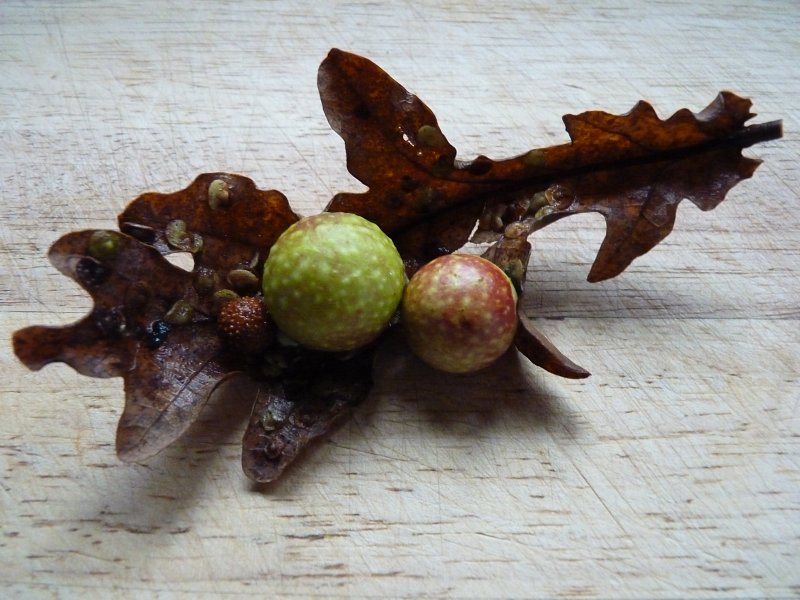
If you look carefully at the tree or search through fallen leaves you can find oak apples. They come in all shapes and sizes. There are flattened rounded galls with a spongy texture on twigs in the spring caused by the oak apple gall wasp. You can find quite spectacular spangle galls; the common ones are yellow-ginger brown discs on the underside of leaves in the late summer, early autumn, while the smooth galls are saucer shaped and yellow-green or pinkish red. The silk button gall wasp leaves behind tiny brown discs with a depression in the centre while the knopper gall wasp which became established in the UK in the 1970s lays its eggs in the acorns and turns them ridged and woody.
Beneath our oak tree lies a fallen twig. Carefully attached to it are two round mottled green galls with a red tinge that looked exactly like their name; marble galls, blown down by the wind.
Looking up into the branches there are mosses and lichens and fungi flourishes. The orange oak bolete snuggles up to the roots of the oak in a symbiotic relationship which helps the tree extract nutrients from the soil in exchange for sugar. Mushroom foragers look for brackets of large edible beef steak fungi growing out from the trunks of old oaks.
Food, shelter, support oaks provide it all for hundreds of living creatures. For us they are a thing of beauty that makes us stop for a second, take a breath and admire and then move on into the misty rain.
Comments
Just wondered what is key to telling a Marble Gall from an Oak Apple? (FYI Left a Ramshorn Gall picture in the website box)
30 Nov 2015 10:26:40