
Q&A: Ten bees and the stories they tell

There were lots of questions at the end of James Power's excellent recent Bees webinar, Ten Bees and the Stories They Tell. Some were answered after the talk, here are the ones he didn't have time to answer. For a link to the webinar -see bottom of post.
Can you tell us a little more about the nesting and feeding behaviour of the Downland Furrow bee?
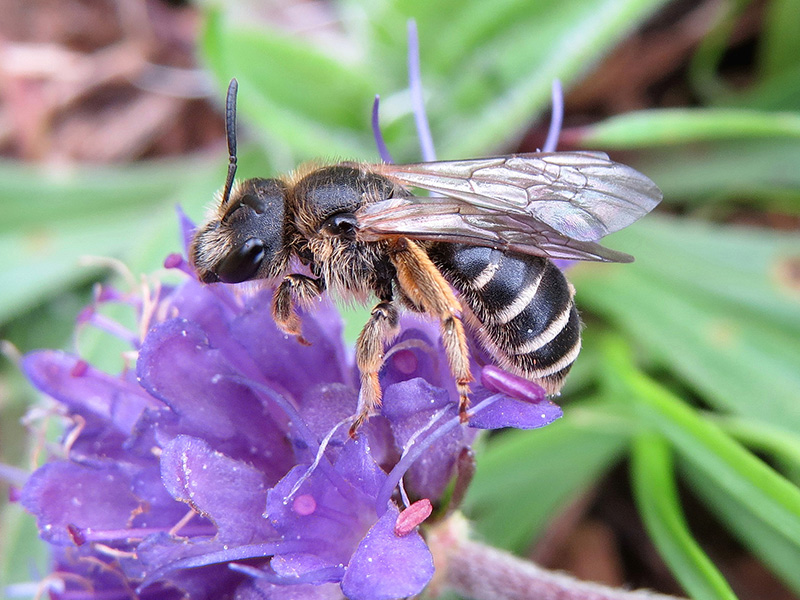
We'd love to know more about the nests of this bee. We know that each female excavates her own nest and that this in the ground, but otherwise information is very sketchy. As for feeding, they are very often seen on Greater Knapweed and Field Scabious, but also visit plants such as dandelion, Harebell and Clustered Bellflower.
I understand most wild bees will feed on wildflowers but are there any garden flowers that could be grown to help any of the bees mentioned to thrive?
There lots of garden plants that wild bees visit so, for example, if you want to see one of our smallest bees, plant bellflowers. As a general rule, my advice is to look for seeds and plants that have been labelled 'pollinator friendly' - growing these does really work.
We often get told about "invasive species" as a problem, do you feel like these new bees we are seeing as just a natural part of nature filling in the new niches we are creating by changing the environment (and we should welcome it?)
The mix of species in Sussex has always ebbed and flowed as our countryside and climate have changed - we've never had a static suite of species here in the county. The rate of change, however, has accelerated recently. We should welcome these new arrivals.
We move to Bexhill in May. What should we grow?
Amongst my guiding principles are to look for plants that are pollinator-friendly, choose plants with different flower shapes (not all bees are the same) and choose plants to give you as long a flowering season as possible. The bees will come!
How does this big influx of new bees relating to climate change sit alongside the reduced number of bees in general? Are we seeing new species or are they seriously endangered?
Not all species are affected by changes to the countryside or the climate in the same way and some are as abundant today as they were in the past - some species are able to adapt to better than others. Overall though, there are many fewer individual bees and a number of species are endangered.
We have bumble bees on honeysuckle pretty much every January - amazing creatures
That's wonderful. These will almost certainly be Buff-tailed Bumblebees - some queens try to establish new colonies in the autumn, rather than going into hibernation. Its further evidence of climate change.
How can I make my garden more of a bee sanctuary?
It would be great, if you can introduce some wildflowers to the garden (eg leave part of the lawn uncut over the summer). I've also drilled some holes in some fence posts and these are used by lots of bees as nest sites.
Mahonia is in flower and is good to save a few winter bees
This plant can be a magnet for Buff-tailed Bumblebee workers in January when there isn't a lot of other forage available for the bees - it’s a great plant to grow.
How worried are you about the effect of the arrival of the Asian Hornet on native species?
The Asian Hornet is, sadly, here in Sussex (there were three sightings last year) and appears to have established itself in Kent. It's likely to be an ever-present in Sussex soon as well. We don’t really know what impact it will have and assessing that impact won't be straightforward.
Are the Ivy bees the same as Ivy mining bees featured on the Field Study Council leaflet?
Yes, they are. The Field Studies Council leaflet captures the colour of the hairs on the abdomen very well.
How many native bees still exist in the south-east?
I can't say exactly (there aren't recent figures for most adjoining counties), but its likely to be approaching 240 species.
I saw some bees on the walk up from Seaford towards the Head, emerging from sandy burrows in the morning. They had very yellow hairs on their legs. When we came back in the afternoon there was no trace of them. Do you know what species it might be?
The patches of bare sand on top of the chalk as you walk towards Seaford Head from the town are fantastic for bees and wasps. What you saw is almost certainly a nesting aggregation for the Pantaloon Bee (the hairs on the hind legs are very long and it does look as though the bee is wearing a pair of baggy trousers). This bee nests in sandy soils and collects pollen mostly from yellow-flowered plants in the Daisy family - many of these close up around mid-day, which means that the females stop foraging and remain in their nests.
I am a forest school practitioner and would like to know if you have info packs to encourage children to learn about bees and not be afraid
You could try the Bumblebee Conservation Trust who I know produce lots of resources including great fold out charts for bumblebees which could be used for kids.
When you said at the beginning "we mustn't forget the wasps", how do wasps interact with the environment that we should be aware of?
There are more species of wasp in Sussex than there are bees, although I can't give you an exact figure. They have a hugely positive impact on the environment, principally as predators but also as pollinators. Most are solitary-nesting species that take advantage of all sorts of places for nesting.
We made a Red-mason Bee box, could you tell us more about them.
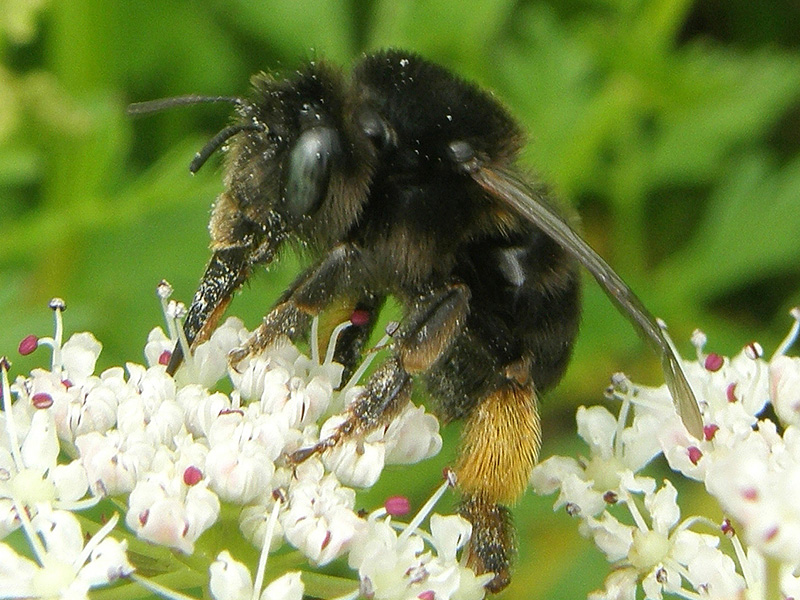
Red-mason Bees are found throughout Sussex and establish their nests in pre-existing cavities such as hollow bamboo canes. Once a female has found a good spot to nest in, she'll line the cells with damp mud and you can readily see this behaviour by creating a muddy puddle close to the nest. If you do have a nest site, do keep an eye out for the European Orchard Bee. We haven't see this species in Sussex yet, but its coming! Its bigger and has black and red hairs with (in females) a pair of horns on the front of the face (like the Red Mason Bee). It also nests in pre-existing cavities like bamboo canes.
How do you tell a Downland Furrow Bee apart from a ‘normal’ Furrow Bee?
The different species of Furrow Bee do all resemble each other, so aren't easy to separate - often identification means checking a specimen with the aid of a microscope. The males are unique, however, in that the underside of the head is hollowed out - there's nothing else quite like it!
Comments
Thank you for posting those answers, they were very interesting. I’m going to watch the webinar now!
24 Jan 2024 17:53:00
Sussex Wildlife Trust:
Excellent!