
Our community projects - their value to wider society and the planet
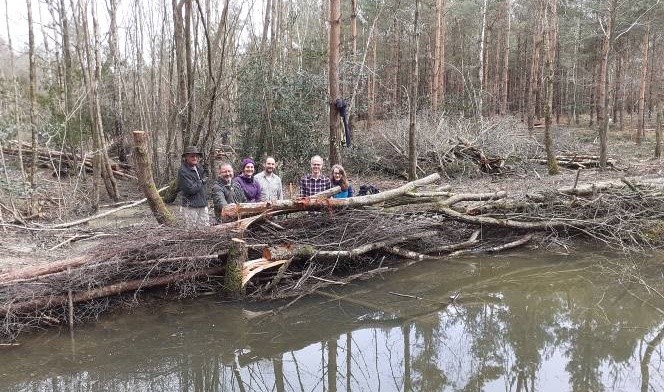
Every year, Sussex Wildlife Trust runs a huge range of different community and environment based projects. Some are long running, and others are one offs. Each one brings its own unique blend of benefits to people and nature, usually at a very low cost to society.
It’s easy to be clear about the direct benefits of our projects to nature, and to the people that we engage and influence. But there are a multitude of subsidiary ‘natural and social capital benefits’ that we have historically struggled to tell people the true value of. Things like the mental, physical and motivational benefits of taking part in a positive and pro-active environmental project, where you can be involved in delivering tangible benefits to your local area, meeting like minded people, and knowing that you’ve helped to create something good. These are vital to societal wellbeing, but hard to pinpoint a tangible value for.
You may have heard us speak about our Natural Flood Management (NFM) project, the Sussex Flow Initiative (SFI) before? It’s a community based project, set up to see if we can bring value to the lives and livelihoods of the people in the Ouse River Valley, by engaging local people in helping to reduce flooding. The project was set up in 2012, and now that it is well established, it is an opportune time to articulate to funders and local communities the extent to which our work brings benefits (or disbenefits) to the local area.
We teamed up with the New Economics Foundation, and had a good first attempt at documenting the true societal value of the partnership project work that we do, in our report on The social and natural capital benefits of the SFI project. Social capital is the benefits that our projects bring to human health and wellbeing, and natural capital is the additional benefits we bring to nature and wider society, such as carbon storage for climate regulation, pollination for food production, and water purification.
Using bespoke surveys and spreadsheets, we found some really interesting insights into the true societal value of this project. We found that :-
- SFI is really effective at improving the technical NFM skills of the people it involves, with an increase from a low starting point of 28.8% to 65.2%.
- People are more likely to take further action for nature and the environment as a result of their contact with SFI.
- There is a link between how people felt their practical skills had improved and their desire to take further action – Suggesting that SFI’s approach to improving people’s skills as a way of promoting positive environmental behaviour change is effective.
- The biggest gains came from increasing people’s connection with nature. People who attended one-off events felt more connected to nature after engaging with SFI.
- People had a high ‘satisfaction rate’ with how and why they are involved with SFI.
We also used the UK government’s Ecosystem Services Databook (ESD),[i] to help calculate the wider natural capital benefits that the SFI project brings to society. The results were fascinating – even though we didn’t have the information to calculate all the multiple societal benefits of all the work we do (such as pollination services), we can still see a huge contribution to wider society through our work. We showed that :-
- The SFI project generates significant public and natural capital benefits of around £125,000 p.a. or nearly £1 million in 8 years. This is for just seven key ecosystem services (timber provision, air pollution removal, carbon sequestration, flood regulation, water quality improvements, biodiversity, and volunteering).
- This means that for every £1 spent, SFI generates at least £2.14 of additional ecosystem value for the public good.
- The volunteering, water quality, and flood mitigation aspects of SFI generate the most societal value.
- A number of these benefits are incremental and will accrue greater value the longer the project is in place i.e. carbon storage will accrue over the lifetime of trees planted.
The values returned on investment in local projects by government and other stakeholders, and the extent to which we bring multiple benefits to society, helps to justify why continuing to support local community initiatives is so important. When arguments for whether we should or should not protect the environment continue to be fought on a political and economic stage, it is vital for small eNGO’s like Sussex Wildlife Trust to be able to hold our ground on how, and why the work we do is so important for wider society.
Although we would argue that the value of nature is intrinsic (and should not be financial), providing this kind of evidence will be a useful tool to help protect our wildlife and climate in the coming years. This is a first step in showing you all the real value of the work that we do, and we hope that we can adapt this study to help show the wider value to society and the planet of all our community project work.
[i] Defra. (2020). Enabling a natural capital approach. Retrieved from https://data.gov.uk/dataset/3930b9ca-26c3-489f-900f-6b9eec2602c6/enabling-a-natural-capital-approach