
Orange-tip butterfly
By Charlotte Owen
WildCall Officer
Have you ever wondered where butterflies go to during the winter? They have a variety of survival strategies to sit out the cold. Some species hibernate as adults in a dry and sheltered spot until warmer weather arrives. Most overwinter as caterpillars, tucked up in the leaves of their food plant or in grass tussocks, while others spend the winter as eggs.
The orange-tip is among the butterflies that survive as a chrysalis, which is formed when the caterpillar completes its final moult and turns into an immobile protective case. The orange-tip caterpillar forms its chrysalis on a plant stem or twig, where it closely resembles a thorn and provides excellent camouflage for its inhabitant. It may look like nothing much is going on but inside, the caterpillar is undergoing an amazing transformation into an adult butterfly. Choosing this winter survival strategy gives it a head start over species that are still eggs or caterpillars, and the orange-tip is one of the earliest-flying butterflies.
Spotting one is a sure sign of spring. Adults can be on the wing from early April but the date of emergence varies greatly depending on the weather and temperature, and can be as late as the end of May. By monitoring the date of their first emergence each year, we can learn a lot about the timing of spring and impacts of climate change. The orange-tip is a good ‘indicator species’ for such studies because it is common, widespread and easy to identify.
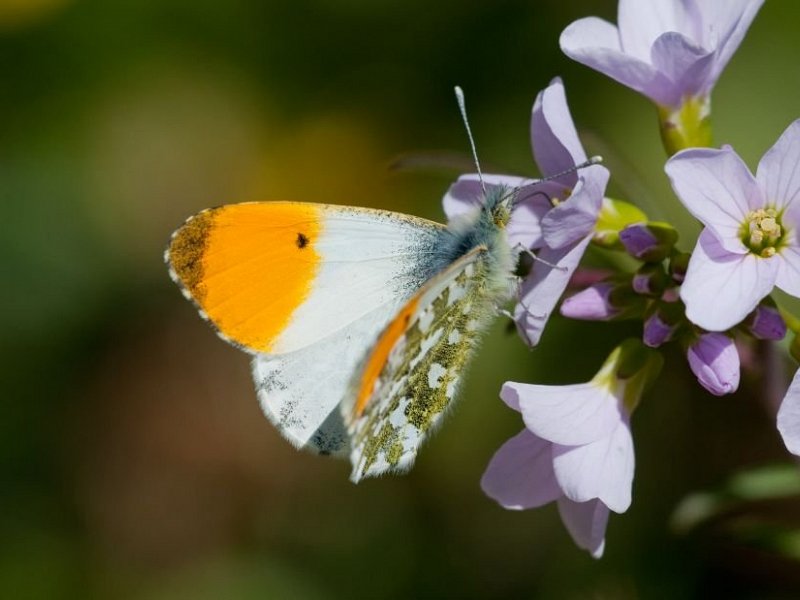
Only the males have distinctive orange tips to their white wings. They are active fliers, constantly patrolling the hedgerows and riverbanks in search of a mate, and this makes them conspicuous. A flash of bright orange warns potential predators not to eat them, and they do taste foul thanks to a build-up of mustard oils from the plants consumed whilst a caterpillar. In contrast, females are focused on laying eggs so are better camouflaged amongst the foliage of cuckooflower and garlic mustard, and have less need of warning colouration. Their wingtips are black but both sexes have a beautiful mottled pattern on the underside of their wings, making them almost invisible against flowers and leaves when resting with their wings closed.