
Nudibranchs AKA Seaslugs
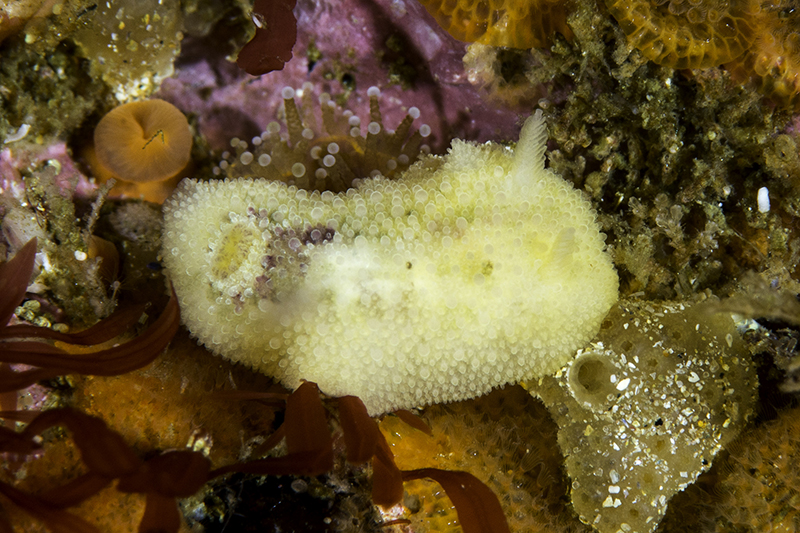
One thing that has kept me going through lockdown is being able to walk down to the sea for my daily exercise. Sadly, with all Shoresearch surveys on hold until further notice, I am really missing rockpooling. I find myself sitting at home, looking through my ID books and imagining what might be going in those fascinating watery pools at this very moment.
Some of my favourite species to find while rockpooling are nudibranchs. Nudibranchs, or seaslugs, are a type of mollusc in the class Gastropoda which typically have no shell and are, in my opinion, much more exciting than their terrestrial counterparts (though they are actually not that closely related to the slugs you find in your garden).
Nudibranch means ‘naked gills’, which comes from the fact their gills are exposed by the animals’ lack of shell. All nudibranchs also have a pair of rhinophores which are sensory organs they use to find food, and can retract into a pocket beneath their skin. They are often brightly coloured, which is a warning to predators that they’re poisonous and it would be a bad idea to eat them. Some in fact do excrete toxins and irritants produced by skin glands, while other species are simply pretending by being brightly coloured, in the hope that will be enough to protect them from being eaten.
Another incredible adaptation some species have developed, is the ability to ingest stinging cells from the animals they feed on and use them for their own defence. One such species that does this and can be found in Sussex is Coryphella browni. This striking nudibranch feeds on hydroid polyps and passes the hydroid’s stinging cells through its digestive system and into its cerata tips (the many, elongated respiratory organs along its back). Now if a hungry predator attacks, the stinging cells will discharge and sting the predator, deterring the attack.
Other species you are more likely to find along Sussex shores are Sea Lemons (Archidoris pseudoargus) and Grey Sea Slugs (Aeolidia paoillosa). Spring and summer is a great time to see seaslugs, or their egg masses, which vary in colour and form, from coiled flat ribbons to strings that look a bit like Silly Sting!
All nudibranchs are hermaphroditic, meaning they have both female and male sex organs. They cannot self-fertilise however, so still have to find a mate. When this happens, each individual will mate with the other, both of them donating eggs and receiving sperm.
So, for now I will just have to imagine what all the intertidal creatures are getting up to in lockdown and just know they will still be there when things start to return to normality.
Comments
Lovely article Ella!
05 May 2020 20:15:00
We have an encyclopedia page about Nudibranch! Fascinating creatures they are…
10 Oct 2022 16:43:00