
Nature's Engineers
By Fran Southgate
Living Landscape Advisor
How wildlife shapes our landscapes
Planet earth is a fascinating and ever-changing place. Day by day it is shaped as much by what lives on its surface, as it is by other natural processes like wind, waves and fire. Each living organism alters its environment in its own special way, both when it is living, and when it dies.
We call the species which are good at creating, modifying, maintaining or destroying their environment "ecosystem engineers". Ecosystem engineers can have major impacts on the richness and diversity of a landscape and can be important for maintaining the health and stability of our countryside. Humans are of course, one of the most notable examples of ecosystem engineers, although in our case, our impacts are often more negative than positive.
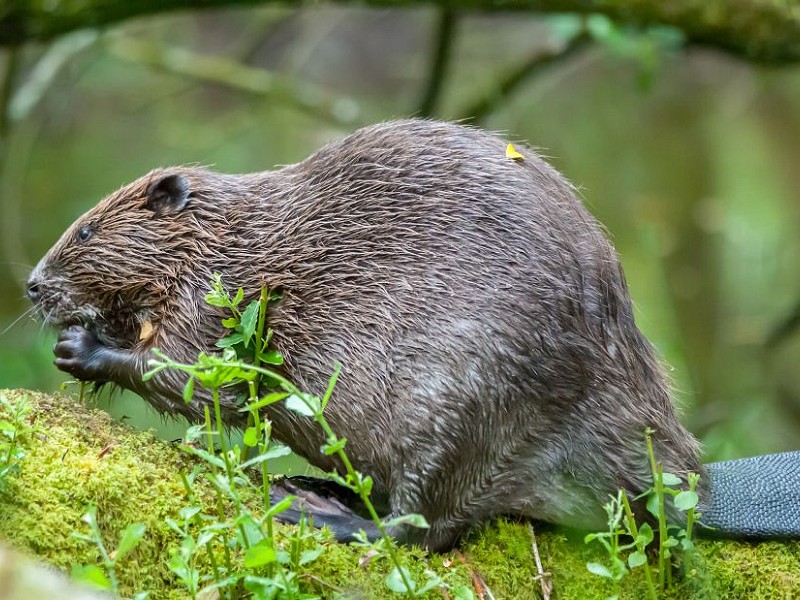
One of the best examples of a species positively modifying its environment for other wildlife is beavers. Beavers naturally manipulate woodland and wetlands, often increasing how diverse the habitats are and how many species are in them, as well as creating more flood storage, water purification and sediment capture/soil formation.
Earthworms are also fantastic. They are one of our most useful ecosystem engineers because of how they influence soil formation, and its health and structure. They help to mineralise plant litter by breaking down organic matter and producing large amounts of faeces. They mix dead plant litter with mineral soil which is used by plants and other organisms as ‘food’, as well as aerating soil and helping to increase its water retention capacity. They are therefore good indicators of soil quality – their absence often being an indicator of exploited and unhealthy land - the same could be argued for the beaver.
Earthworms aren’t the only creatures that help to create the soils that we grow our food in. There are amazing things like rock-eating snails in the Negev Desert! as well as some of the more ignored species like fungi. Fungi are the unsung heroes which maintain healthy landscapes. Mycorrhizal fungi (the ‘roots’ of the fungi that we don’t tend to see) can connect landscapes which are a long way from each other, and amazingly they can redistribute nutrients and carbon across these huge distances. They create nutrition for insects and other organisms, supply trees with nutrients translocated from dying plant and animal matter, and even form an underground communication network between trees. Thus fungi are natural engineers quietly supporting whole swathes of our countryside.
One of the more obvious ways that birds and animals alter their environment is when they move around.They eat fruit and seeds, which is then dispersed on their fur and in their droppings. Sometimes, the digestive process inside the animal is even essential for a plant seed to germinate. Many animals also graze, rub against or break plants, which in turn alters how they grow, flower and propagate. Even when a woodpecker is making a hole in a tree, it is inadvertently, creating shelters for other creatures. A study of shelter-building caterpillars on white oak (Quercus alba) found that caterpillar leaf shelters (little ‘tents’ or curls of leaves) increased biodiversity on the entire plant (Lill and Marquis 2003).
It’s the same in the sea too. Filter feeders like mussels, and plankton clean the water and alter the amount of light penetrating into the water. The light controls the depth at which photosynthesis can occur, which in turn influences how much food and warmth there is available for all the other sea creatures in the food chain. Mussels are also important because they aggregate into beds, which modify the sea floor. Research has shown that some mussel beds are essential in maintaining species richness at the landscape-level, showing how important it is to recognise ecosystem engineers in conservation targets for maintaining healthy environments. Even shell production creates physical changes - as mussels and other shell forming creatures die, their shells break down and become part of the sand, and even chalk or flint.
Coral reefs are a spectacular architectural example of an ecosystem engineer in action, and coral reefs hold some of the highest abundances of species in the world. The corals which form them are what we call ‘autogenic’ engineers – things which modify the environment by modifying themselves - creating the framework for the habitat most coral-reef organisms depend on. There are often also positive feedback loops between different ecosystem engineers. For example, parrotfish help to maintain healthy coral reefs by feeding on macro-algae that otherwise competes with the coral. Trees are another good example, because as they grow, their trunks and branches create habitats for other living things like birds and bats. Epiphyte plants grow on tree trunks or branches rather than in the ground and the animals associated with them form unique tree canopy communities.
Introduced species, which can include invasive species, can also be quite significant ecosystem engineers. Kudzu, a leguminous plant introduced to the U.S.A, changes the distribution and number of animal and bird species in the areas it invades and crowds out native plant species. In contrast to the benefits that some ecosystem engineers can cause, invasive species in the wrong place often have the reverse effect.
So why are we interested in ecosystem engineers for the conservation of our wildlife? For me, beavers and other ecosystem engineers offer an opportunity for humans to step back and enable the natural instincts of wild creatures to positively influence the landscape, whilst reducing human intervention. We often talk about restoring ‘natural processes’, and ecosystem engineers can contribute significantly to meeting common landscape restoration goals through the restoration of these natural processes. If we look at the effects of ecosystem engineers at the landscape scale, overall, ecosystem engineers make the ecological landscape more diverse if we give them the space to do so. When we are searching for innovative solutions to the problems of habitat loss and restoration, promoting ‘self willed wildlife’ through natural ecosystem engineers is a great start.
Of course, as I mentioned, one of the most efficient natural organisms which makes changes to its habitat in a multitude of different ways is humans. For example, both beavers and the Army Corps of Engineers build dams
… but that’s a whole different blog.