
Mythically rare and painfully beautiful
By Graeme Lyons
Senior Ecologist
OK. I'm about nine miles into one of my farm surveys somewhere near Bishopstone in East Sussex and have had a good day with arable plants including one lifer. That all seems so tedious now, I'm going to have to write a separate blog about this. I'm keeping one eye on the ground for arable plants when this happened in my head.
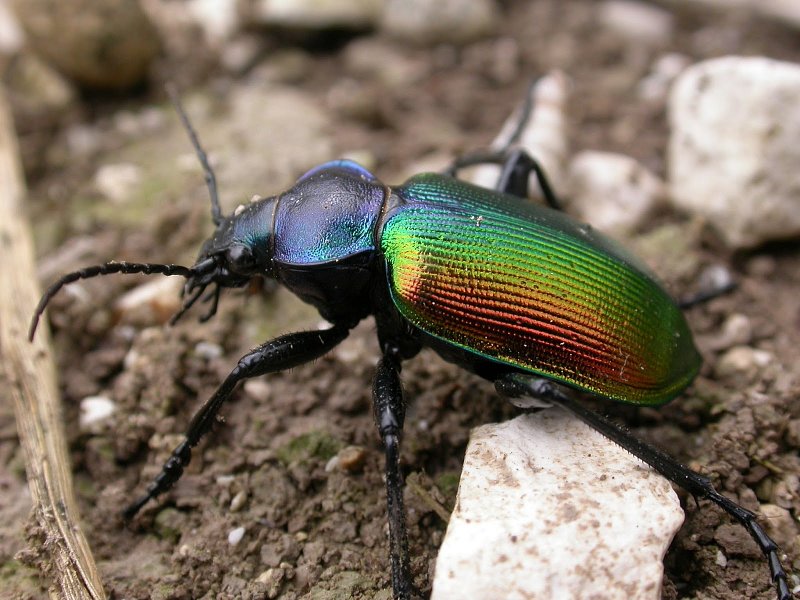
"What's that rose chafer doing scrabbling around on the floor? Rainbow-coloured rose chafer?. No carabid, wait, that's the Sycophant Calosoma sycophanta, SYCOPHANT! AAAGGGHHHHHH!!!"Aaaagghhhhhhh!!!!! was emitted rather loudly as I scrambled to get a pot out of my bag. That was unexpected, my heart's still beating like a big clock. Thanks to Mark Telfer for his pretty instant help on this species' recent records. The following is derived from Mark's notes: It was last seen alive in the UK 23 years ago at Thursley in Surrey and last recorded as fragments representing a breeding population 19 years ago near Thetford. There were only two other records in the 19th Century but it is stated that it was much more frequent as a vagrant in the 18th Century where it was recorded from East Sussex. So it's not a county first but it is the first in Sussex since the 18th Century. Pretty damn cool indeed. Especially as it featured in a blog I wrote about three years ago which makes for interesting reading in the context of how few people have actually seen this alive in the last 100 years or more. I mean, how many people have written a blog about seeing this and then actually seen it three years later? Kind of freaks me out thinking about it. And also asks the question, "which family member DID I trade in?".
Enjoy some more photos of the beast.

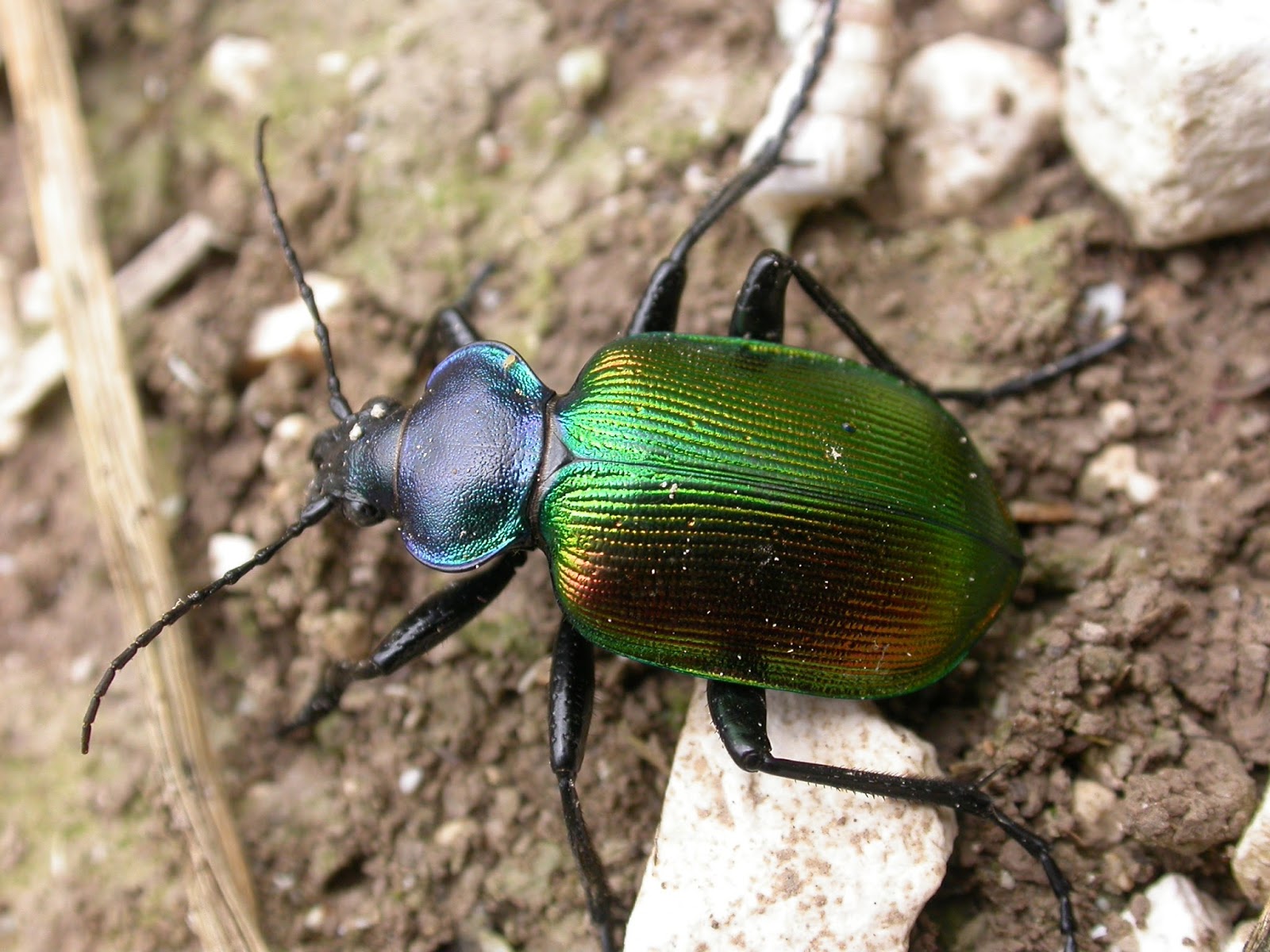

I found it walking along the 50 cm or so gap of bare ground between a winter wheat field and a set-aside margin, it wasn't a particularly interesting part of the site, just at the bottom of a chalk grassland slope with scrub. I think it's very unlikely that this represents a population, I didn't see any more and in it's home territory, it is more of a woodland species preying on the larvae of processionary and tussock moth larvae. Not something at all represented on the site I'd think. It was very fresh and Mark thinks this suggests it's more likely to be a vagrant. In fact, as the crow flies, it was only 1.5 miles from the coast. So, was this just amazing luck or are there more out there? It's hard to miss, about the size of Carabus violaceus. It just goes to show, that if you walk around anywhere long enough, eventually something amazing appears. I was also really pleased to bump into the farmer at just the right time to show him. Amazing. I'm not so gutted that I had to miss the Pan-species Listing recording weekend in Norfolk now due to work commitments. The find of the decade?!
Comments
So which family member did you trade in for this wonderful experience.
20 Jun 2016 17:20:22
Congratulations, what a beautiful beetle
30 Jun 2016 11:24:05
I know how you must have felt! A few years ago, also in East Sussex, I was out and about with my metal detector and found a pot of Roman silver coins of the 3rd Century AD, 3000 of them. They’re now at the Pavilion Museum in Brighton.
I shall keep an eye open for that beetle! Incidentally, do you know whether the elytra reflect UV light?
30 Jun 2016 11:30:43
I think I may have seen this beetle too at my home in Battle a few years ago. It was on tansy, and I thought it may have been a tansy beetle. Maybe not. I recognise the bronze on the shoulders and the squareness of it. Sorry no photo.
30 Jun 2016 11:33:04
Brilliant report, many thanks for sharing. This highlights the huge importance of keeping field margins. Lets hope there will be support from Defra to keep these small but vital habitats.
30 Jun 2016 11:46:24
Wow, lucky you. I love beetles, often such beautiful and (to me) mysterious creatures. We need beetle day safaris on offer from SWT!
30 Jun 2016 12:03:47
Nice one! I’m trusting that after he or she was briefly ‘potted’, this handsome arthropod was released at the same site. It makes one wonder how many untrained eyes have missed similar specimens in the south-east.
30 Jun 2016 14:59:02
Hi, I think I may have seen one of these too. Although I really am no expert. Spotted at brunswick square bumbling about near the Rosa rugosas.
How fabulous.
30 Jun 2016 17:25:07
What a brilliantly wonderful thing!
01 Jul 2016 12:05:28
That is truly truly extraordinary and your excitement justifiably infectious. I will now investigate more about this beetle and keep my old eyes as sharp as I can manage!
01 Jul 2016 20:11:52
I saw 2 of those in my garden in Seaford last week. They had buried themselves inside some roses in the border.
04 Jul 2016 08:13:00
How wonderful. It pays to keep your eyes open. I like the metallic sheen.
04 Jul 2016 10:27:35
What a beautiful beetle! Are they making a comeback in Sussex?
08 Jul 2016 07:07:44
Hello. What beautiful pictures, What did you use to take them phone or camera? Wicked beetle.
04 Nov 2025 16:18:00
Why is it called the sycophant beetle? ‘Because it crawls’ surely can’t be the answer.
22 Apr 2026 10:22:00
Sussex Wildlife Trust:
Hi Keith. The name is derived from the Latin name, Calosoma sycophanta, and the origins of these names are not often straightforward or known! Our Biodiversity Data Specialist had this theory, which we like -
The species was originally described by Linnaeus in 1758 and he was a great admirer of all thing classical Greek and drew on it heavily for naming inspiration. One possible origin of the word sycophant is from the ancient Greek for 'fig-shower', basically someone who snitched on Athenian fig-smugglers (fig-smuggling was apparently illegal in ancient Athens). I wonder whether Mr Linnaeus felt that this particular beetle was in some way giving something away (its vicious predatory nature?) because of its rainbow-coloured wing cases?