
Meet our members - Christopher Passmore OBE
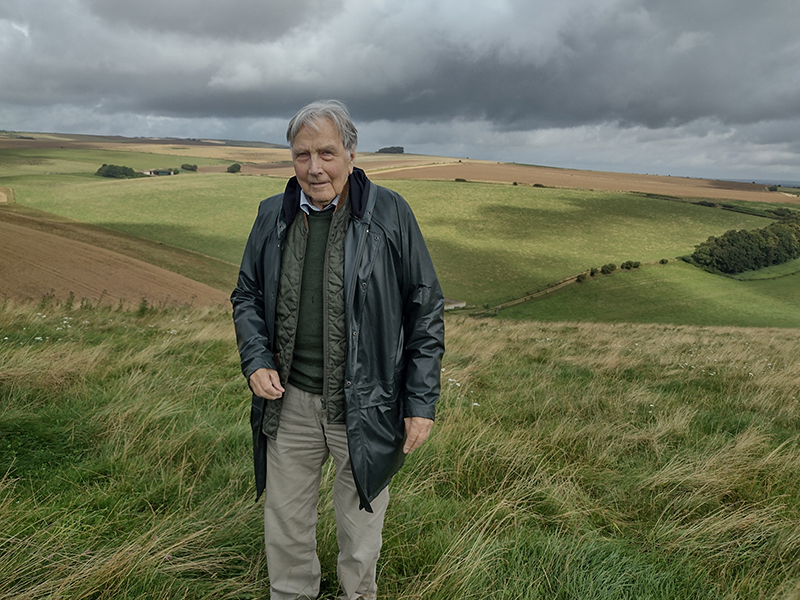
On a wet, blustery August morning, just as the sky starts to clear, I arrive at Applesham Farm, nestled in the downs, partly abutting Lancing College land. I have come to meet Christopher Passmore, who has been a member of Sussex Wildlife Trust for over 30 years. In recent years, his nephew Hugh has taken over the running of the farm, but Christopher still knows every inch of every field.
"I remember the weather being like this in 1942," Christopher tells me. He is showing me round the farm in his 4x4, and we've just driven up to the top of Cow Bottom so he can show me the simply stunning sight of the farm's patchwork fields with steep escarpments around the edge. He explains how the seven year crop rotation works that supports so much wildlife on the farm. Three years of grass and clover leys, two years of wheat and two years of barley. The last cereal crop is undersown with grass and clovers.

Sheep and cattle graze on the new grass leys (or temporary grass) once the cereal crop has been harvested. The manure from the sheep and cattle then replenishes the chalk soil. They don't use insecticides in the summer, instead relying on natural pest control.
What this approach means is that there are lots of wildflowers, butterflies, insects and birds, many of which we see as we travel around the farm. Over the years, studies have been undertaken on Applesham Farm, which demonstrate the diversity of wildlife that the farm supports. The aim has always been for crop improvement with no damage to the environment, and these methods have been learnt by observation, understanding the land Christopher and family have always lived and worked on. Christopher has been awarded an OBE for services to nature conservation and agriculture.
Applesham Farm comprises beef cattle, sheep, wheat, barley, winter berries and 'catch' crops of rape and mustard (these are quick to grow and can fill a gap after harvesting). Plus, several of the very old barn buildings have been converted into workshops for small businesses including a cycle company and a stained glass maker.

In 1901, Christopher's grandfather William became the tenant farmer of Applesham Farm with his four sons. He bought 850 acres of the farm, and one of the sons, also William, ended up running it, alongside his wife Doris, before his son Christopher took over.
As we tour round, Christopher explains how the farm is run in such a way as to be sustainable "and designed to support the land in the long term. If you asked me, is the land still as fertile as it was - I'd say yes".
As well as monitoring how wet the crops are so they can decide when is the best time to harvest (as anyone who knows their Thomas Hardy will be aware - damp crops will go mouldy and won't last the winter), they also monitor the organic matter in the soil, the levels of potash, phosphorous and nitrogen as well as other nutrients.
I ask what the greatest challenges he has faced as a farmer: "Weather. And prices - what the value of a crop will be".

What is his earliest farming memory: "Age four, feeding the chickens and collecting the eggs, helping my mother. I'd walk around the farm with my father and brothers and perhaps a student, looking at everything, learning about it. Not thinking anything of walking so far at such a young age."
And his favourite season? "Spring. Lambing, everything growing. Every day there is something different, interesting and exciting."
We head back at the farm house, discussing the visits he hosts from pupils from the local St Nicholas and St Mary's Primary School in Shoreham three times a year. "I give each child a map of the farm and get them to figure out what's where, and they make a note of it. We talk about everything as we go around, from wildlife, seed dispersal to lambing. Then next time they come they have to figure out what's changed, field by field. I enjoy helping them learn about the land around them.
My final question to Christopher: "What would you have been if you hadn't been a farmer?" He replies: "I'd have been a model maker. I'd really have enjoyed that."
Comments
Sounds like an obvious and perfect way to farm and a great example for other farms to follow.
14 Aug 2021 11:06:00
I was fortunate to be hosted by the Passmore family in 1967 as a n Australian exchangee and returned with my wife in 2010 ,some wonderful memories of a great dynasty. Thank you so much for the opportunity.
12 Dec 2025 00:47:00