
Marvellous mustelids

Mammal expert Stuart Edmunds introduces this incredible collection of carnivores.
What is a mustelid?
Mustelid probably isn’t a word that most people use very often. Everyone has heard of Stoats and Weasels, but you might be unaware that these carnivorous animals belong to a group of mammals called the mustelids. Other members of the mustelid family in the UK are Badger, Polecat, Pine Marten and Otter. They are joined by the American Mink, which is a non-native mammal that has established itself in Britain, and the occasional escaped domestic ferret.
With the exception of Badgers, our mustelids are characteristically long, thin animals with distinctively sharp teeth and black eyes. They share similar character traits, being opportunistic and adaptable, with a naturally inquisitive nature. Most will try their best to avoid contact with humans unless absolutely necessary, though they can all adapt when their survival instincts kick in.
Smaller mustelids can develop a bad reputation amongst those that keep poultry. A free meal is not just appealing to us humans. If they develop a taste for captive birds, outwitting them is essential. But by having a better understanding of their behaviour and ability, it is perfectly possible for us all to live alongside our native predators… and by watching them during a chance encounter, it is very difficult not to admire them as determined, clever characters.
Meet the mustelids
Badger
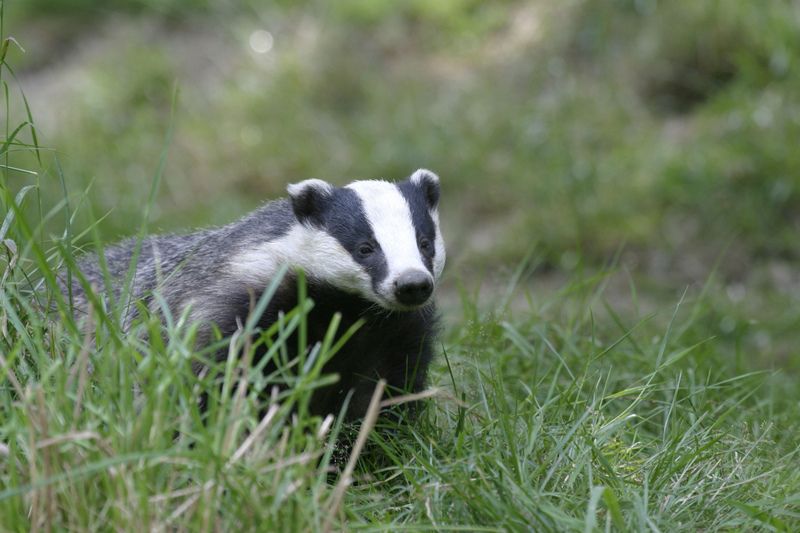
Britain’s most unmistakable mustelid! With a stocky build, long grey and white fur, a long snout and black stripes across their eyes, Badgers look very different to the other mustelids. They are quite big, measuring between 60 and 85 cm in length. They are mainly active from dusk until dawn and usually head to open ground to sniff out worms and grubs in fields and meadows. Badger groups use the same trails for many years, sometimes for many generations, so there is a good chance of spotting one by scanning along woodland edges at dusk if there is a sett nearby. Roadside verges also make useful foraging grounds, so drive slowly and keep an eye out for them when driving at night.
Weasel
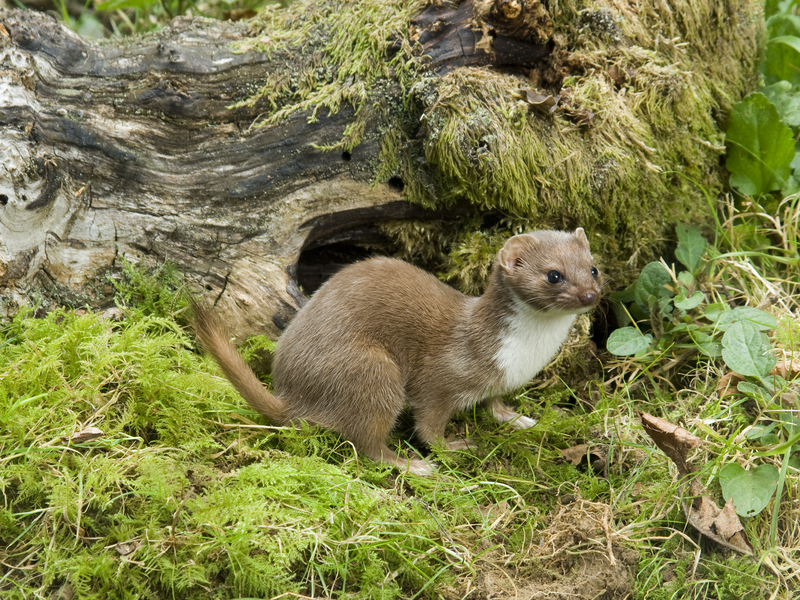
Our smallest mustelid is just an average length of around 20 cm, which makes them a challenge to spot. Weasels have a chestnut-brown back, side and face, and a whitish underside. They also have a short, straight chestnut-brown tail. They are often only encountered unexpectedly, when they pop out of a patch of long grass or hedgerow, which could happen at any time of the day. Like the Stoat, Weasel coats can actually change colour to white during colder winters. This allows them to blend in with snowy surroundings, making them less vulnerable to predation from hawks and owls.
Stoat
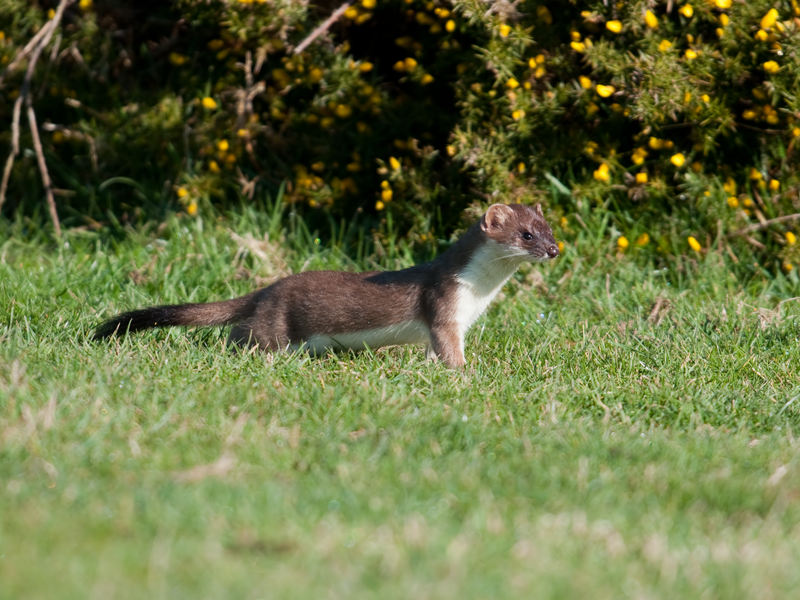
Easily misidentified as a Weasel at a glance, Stoats are actually much larger – 30 cm or more from nose to tail. Although they have the same coloring as Weasels, Stoats have a longer tail, which always has a black “paint brush” tip. Like Weasels, Stoats can be active during the day, particularly when hunting for Rabbits and voles: they are feisty and will attempt to hunt animals that are three times their size. They inhabit a wide range of habitats, from woodland to moorland, or even hedgerows. But, like Weasels, Stoats love areas with old dry-stone walls and mounds of rocks, which provide good cover for them and the prey they need to hunt to survive.
Polecat
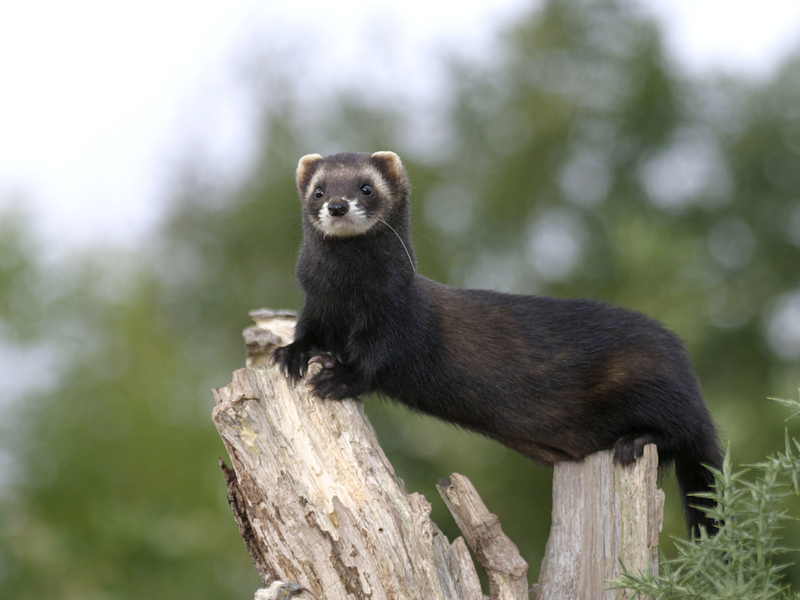
Polecats were sadly eradicated from large areas of the UK as they gained a reputation for being vermin due to their habit of raiding chicken pens and pheasant farms. Polecats are another size up from Stoats, averaging a length of 35-50 cm. They have dark brown coats with lighter guard hairs (the finer hairs against the skin), but their most distinctive feature is their bandit mask – a dark band across their eyes. Fortunately, our Polecat population is in recovery. Polecats have spread east from their strongholds in Wales and can be spotted on moors, farmland and even bogs. Occasionally, they will show up in suburban gardens too, particularly where there are good populations of small rodents.
Domestic Ferret
Domestic ferrets were bred from wild polecats to be used for hunting rabbits. They also became increasingly popular pets, largely due to their inquisitive and intelligent manners. Many escapees spread across the English countryside over the latter half of the 20th century, and it was thought that most reported polecat sightings were actually feral ferrets. The ferrets have now been displaced by the slightly bulkier and darker wild polecat in most western parts of England.
Pine Marten
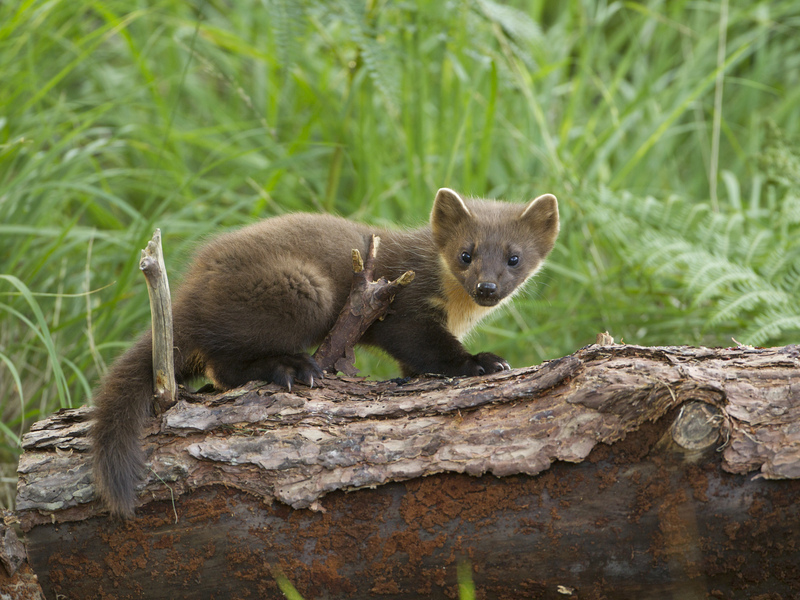
A tree-climbing master, the Pine Marten, like other mustelids, was once persecuted to the point of extinction in England and Wales. A population held on in the Caledonian forests of central Scotland and has slowly spread to other parts of the country. Pine Martens have been the subject of translocation projects, with small numbers officially being released in west Wales and the Forest of Dean, but other small populations have also been discovered in other parts of England, including Hampshire and Shropshire. Pine Martens are around the same length as the average house cat, have a chocolate brown coat, pointy ears and a long bushy tail. They also have a cream patch on their chest and neck known as a bib. They’re mainly active at dusk and until dawn. Pine Martens are more easily spotted during the summer months, when they become more active during daylight hours as they venture down from trees and other hiding places to patrol territories and hunt for a meal.
Read more about the South East Pine Marten Restoration Project
Otter
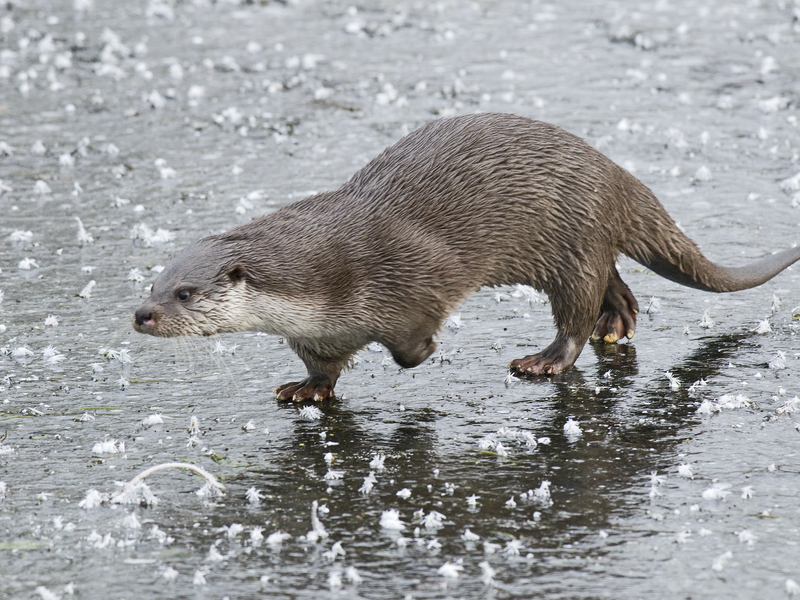
Otters are bigger than you might think, growing up to a metre in length from their nose to the end of their long, pointed tail. They have made a comeback in recent years and are now present in all counties of the UK, which is an impressive turnaround for a creature that was approaching England-wide extinction in the 1970s. Otters require a large amount of riparian (rivers and streams) habitat, which must have plenty of safe places to rest, rear young, and to find fish, amphibians, small mammals, and birds to feed on. Like the other native mustelids, Otters aren’t always easy to spot – unless you are lucky enough to spend time on the sea lochs of the Scottish West Coast, where they are regularly seen feeding in kelp beds during the day. But further south, they are being seen more often on rivers in surprisingly urban areas, particularly around small weirs, which make excellent hunting grounds. Occasionally, Otters venture into garden ponds where ornamental fish are kept; often a long distance from rivers and other watercourses.
American Mink
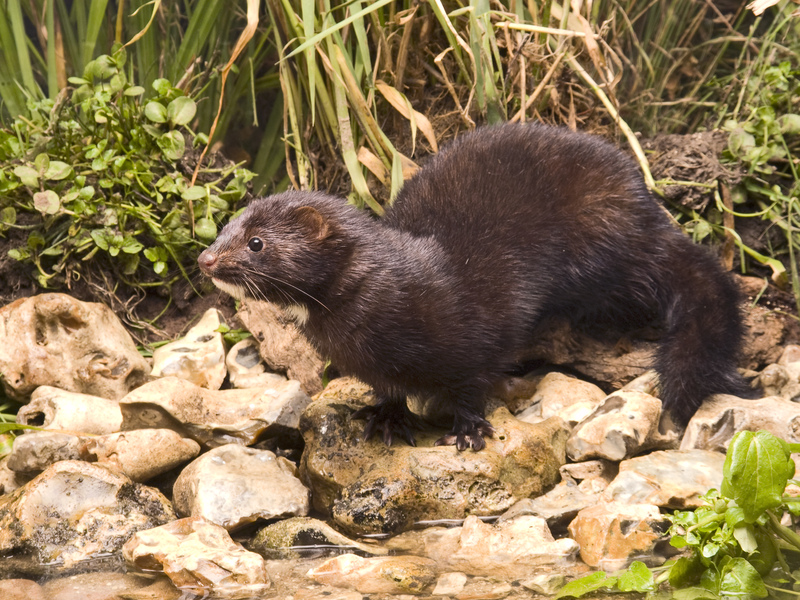
This invasive mustelid is present on rivers across much of the UK after many escaped, or were released, from fur farms in the 1960s and 1970s. Much smaller than an Otter and closer to a Polecat in size, Mink have a dark brown to black coat, small ears and a floppy black tail (unlike an otter’s tail, which is always very pointed). Active during the day and night, they can show up anywhere, but it is usual to see them when exploring canals and small streams. Mink can have a devastating impact on local wildlife in the places they establish themselves and contribute to the reduction of river birds like Kingfishers and small mammals such as Water Voles. Nationwide efforts are regularly made to control Mink numbers, but they are intelligent and adaptable mammals, so it is likely that they are here to stay.
Enjoying mustelids responsibly
Badgers and their setts are protected, so care should always be taken to avoid disturbing a Badger sett. Polecats, Pine Martens and Otters and their dens are also protected under the Wildlife and Countryside Act 1981, which means that it is an offence to disturb them unless a license has been issued in special circumstances.
Comments
Very interesting and informative.
15 Dec 2022 11:38:00
Thank you. Very helpful because I always get stoats and weasels mixed up.
Also is there any numerical data on the impact of badgers on hedgehogs?
15 Dec 2022 12:46:00
Sussex Wildlife Trust:
Re: Hedgehogs & badgers
Badger populations have increased over the last 30 years and there is some concern that this is the cause of the Hedgehog decline. It is true that Hedgehogs are preyed upon by Badgers and that Badgers will compete with Hedgehogs for food, however the People’s Trust for Endangered Species and the British Hedgehog Preservation Society have found no evidence that Badgers are an important factor affecting Hedgehogs. Hedgehogs are declining just as severely in urban areas, where they rarely encounter Badgers, as they are in the wider countryside. Also in areas where there are low Badger numbers, such as East Anglia, Hedgehogs are declining as much as in areas with lots of Badgers. Whilst it is true that Hedgehogs will avoid areas with high numbers of Badgers, it is the lack of suitable habitat and availability of insect food that is having the biggest effect. Bigger, better and more joined up Hedgehog-friendly habitat is the best way to help them.
Thank you for the interesting info about mustelids. A new word for me.
15 Dec 2022 14:22:00
Thank you for an intersting article. A question: have there been any attempts to introduce pine martensin Sussex to control grey squirrels?
15 Dec 2022 15:53:00
Sussex Wildlife Trust:
Kent Wildlife Trust and Wildwood Trust, in collaboration with Sussex Wildlife Trust, are assessing the possibility of restoring Pine Martens to the South East of England. Read more on our website here.
Just loved this nourishing insightful tribute to the mustelids family x thank ypu
15 Dec 2022 17:32:00
An excellent article with much fascinating information & some lovely photos – I love the polecat. How may we most sensibly encourage them, apart from the obvious do not disturb. Delighted to hear that consideration is being given to ways of reducing the American tree rat in West Sussex. I remember a ‘shilling a dead grey squirrel campaign just after WWII’.
15 Dec 2022 18:47:00
Thank you for this really interesting information
15 Dec 2022 19:14:00
It’s a shame that our native mustelids are still persecuted by indiscriminate snaring / trapping by the game shooting community.
16 Dec 2022 09:38:00
Very interesting article. Particularly interested after having a stoat wander across my garden.
18 Dec 2022 20:41:00
Very interesting and educational. Will keep a sharper eye on them.
20 Dec 2022 15:40:00
Mink are ever present on Riverside Caravan Park Bognor Regis.
20 Dec 2022 20:06:00
Mink are ever present on Riverside Caravan Park Bognor Regis.
22 Dec 2022 18:21:00
Mink are ever present on Riverside Caravan Park Bognor Regis.
24 Dec 2022 18:11:00