
Leave it to Beaver
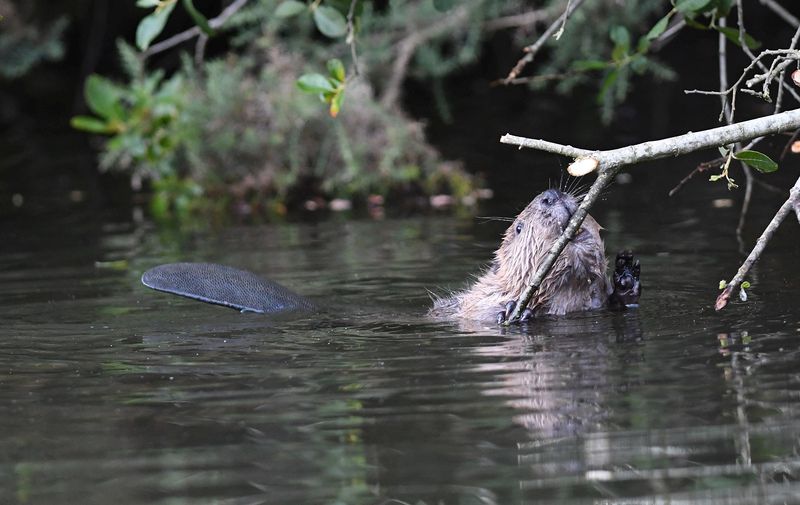
Beavers became extinct in Britain in the 16th century because of the action of humans - hunting them for their fur, meat and scent glands. Now, in various locations across the country, under licence and mainly within enclosures, they are being reintroduced, because of their incredibly positive impact on the environment due to their actions as hard-working and extremely effective water engineers, known as a keystone species, their watery activities restore and create amazing wetland habitat that benefits people and wildlife.
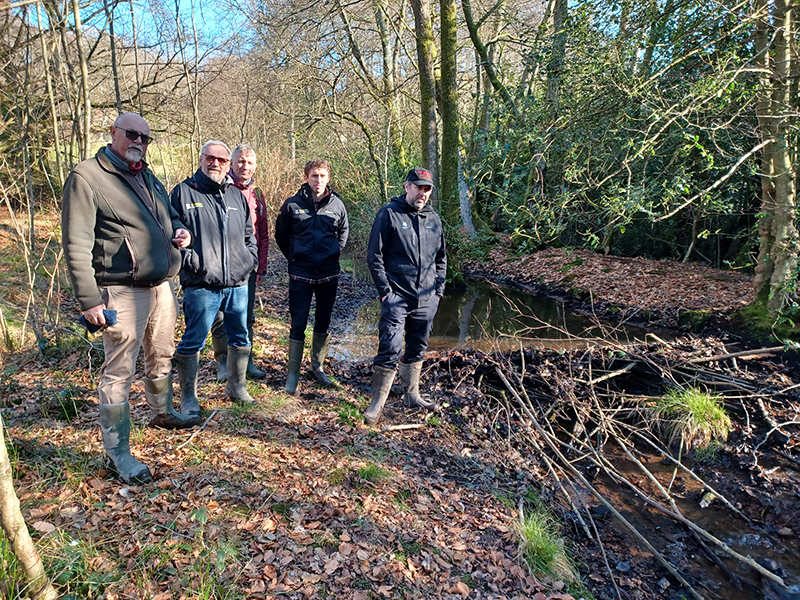
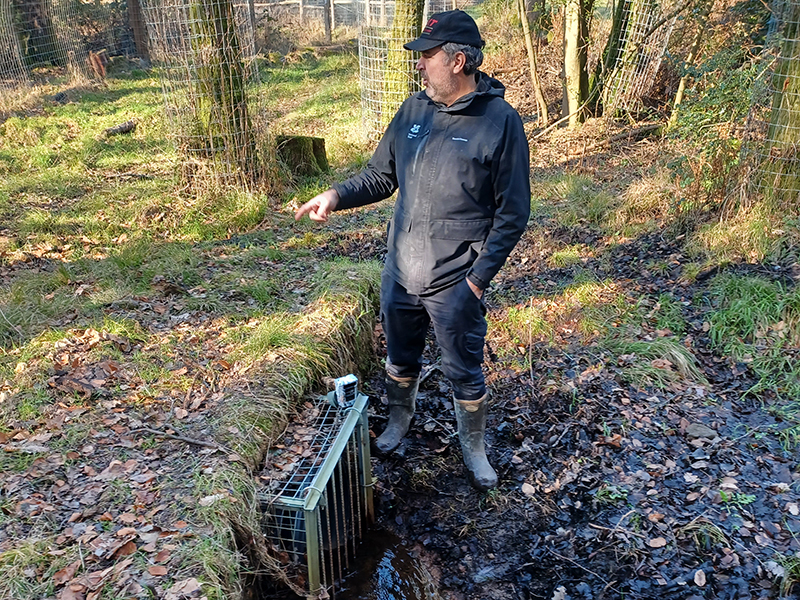
A group of Trust staff recently visited a hidden valley in the South Downs to meet National Trust Lead Ranger David Elliott for a tour of a Beaver enclosure. The 44 acre site currently hosts two Beavers. Each has their own lodge. Beavers have been living there since spring 2021. The enclosure is boundaried by a fence similar to a rabbit-proof fence, with concrete under the gate. Also, extra precautions are in place where the stream enters and exits the site (see below). Some trees are protected (one due to its value as a bat habitat, and others that are near to the enclosure fence - if the Beavers cut them down, they could use the fallen tree as an escape route).
The visit took us along what had started as one stream and two ponds and is now a braided stream with many dams and multiple ponds - with the original ponds now much larger.
We didn't see either resident Beaver (they are crepuscular, so mostly active at dawn and dusk - and would stay away from humans in any case) but we did see lots of Beaver activity.
As we walked we noted the extraordinary range of signs of these industrious mammals along the way. Bark stripping, coppicing and the presence of lots of different kinds of dam-building activity. For one of the dams, they had even used old fence posts, and done it very neatly too.
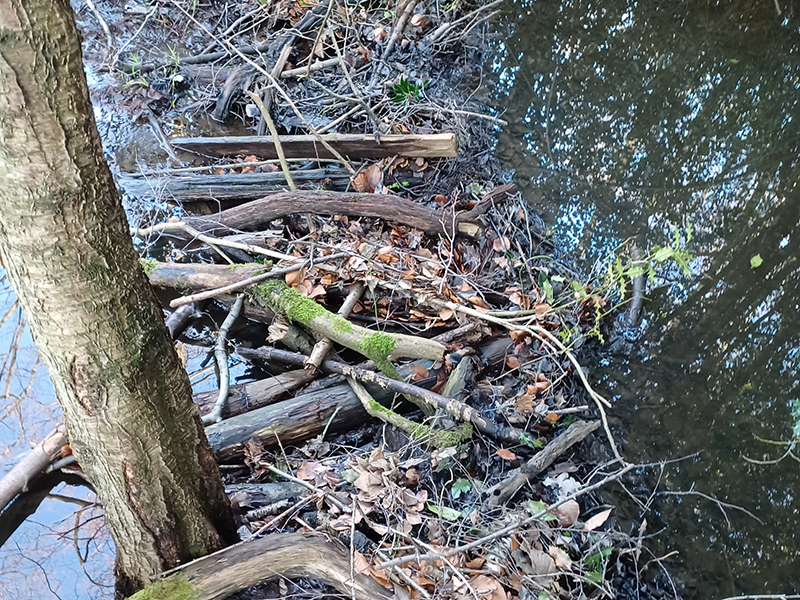
Dave explained that the Beavers are so active, the landscape and flow of water on it changes constantly. The purpose of their engineering is to provide themselves with food. But the benefits to other wildlife of this activity are tremendous. And this has an amazingly positive impact on the environment, on multiple levels. Slowing the flow of the water mitigates against climate change because the area stays wet during periods of drought and water is less likely to run off and cause flooding because it is moving so much more slowly through the landscape. Wildlife benefits because the pond and braids create a wetland environment that is good for many species. Beavers effectively manage the woodland around them by coppicing it. The ponds which they create trap tonnes of silt, which keeps the river cleaner especially during storms. They use mud in their dams, which means you get wildflowers growing on them.
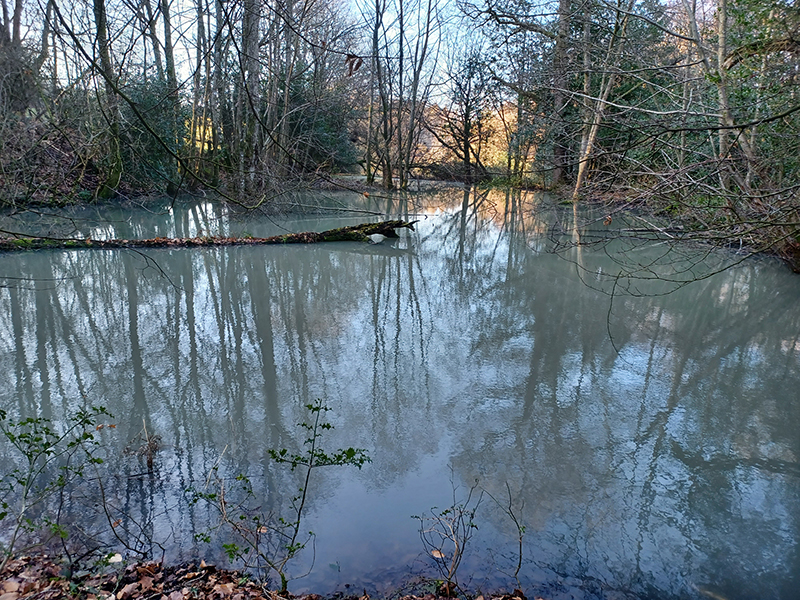
Dave told us they are now seeing Kingfisher, Woodcock and Snipe that they'd not seen in the area before, as a result of the habitats being created by the activity of the Beavers. It is early days for this project, but there will be many more species benefitting from their presence as well.
In an ideal world, and one that we will hopefully see in the future - we will get a lot more groups of Beavers living and breeding in the wild, and not restricted to enclosures, creating the incredible dams that deliver natural flood management (NFM), not dissimilar to the leaky-dam building carried out by Natural Flood Management Officers, but actually the work of Beavers is on a different level in terms of scale and complexity. Building the fencing around this enclosure wasn't cheap, but Dave said 'The project has paid for itself in terms of the habitats that have been created. The cost of building ponds like they have created here would be enormous.'
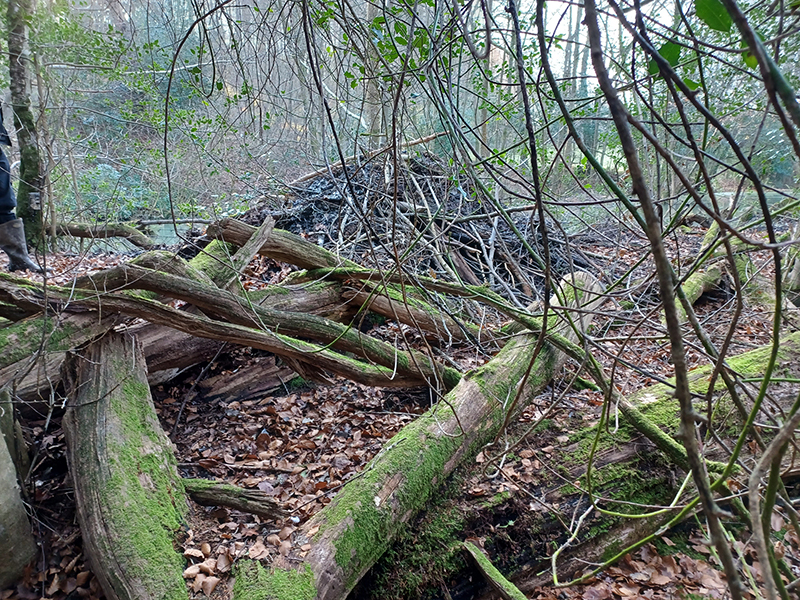
But what, you might ask, are the disadvantages of Beavers? Well, only location and how this interacts with humans really. Natural Flood Management Officers will put leaky dams and ponds where they are wanted by humans. Beavers obviously aren't configured to work around human structures such as roads. So in order to co-exist, there needs to be some mitigation of Beaver activity when needed. Beavers can be relocated, but being territorial it is likely that new Beavers will move in soon after. And if you remove something a Beaver has created, it will just build it again. And fast. They really are Eager Beavers. But ways of mitigating their activity are available. For example - the use of tree protectors and beaver deceivers when required. A beaver deceiver is a tunnel that can be placed under a dam which stops the water level rising beyond a certain point, without removing the dam itself. You use it if a Beaver-created pond is going to cause flooding where it isn't wanted (by humans).
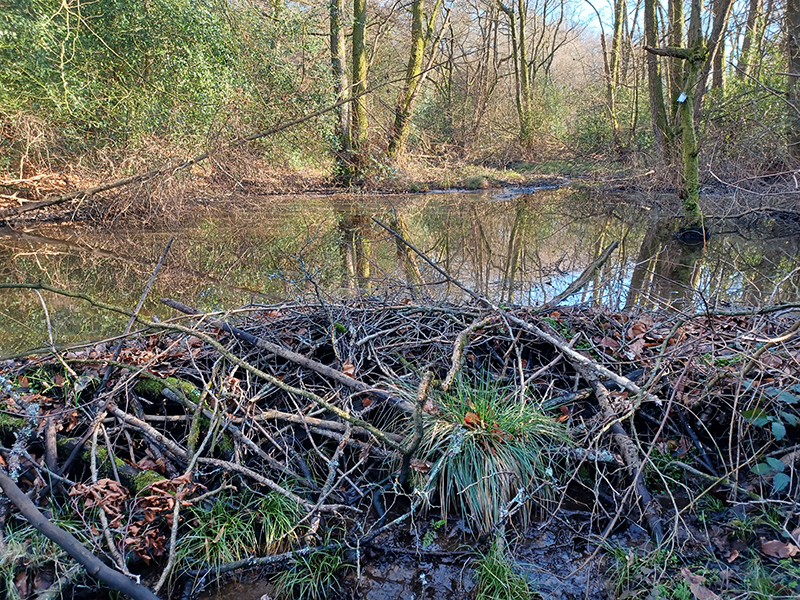
Important points to note - it's likely to be the case that conservationists in the UK don't know what Beavers can do, in general, because they've never seen them. And there are lots of myths.
For example - some worry that Beavers will 'eat all the fish'. Beavers don't eat fish! They are vegetarian. They don't 'eat' trees either. They do a lot of grazing and eat bark, leaves, shoots, small twigs and a range of herbaceous plants. They plant and regenerate more trees than they cut down (though they have their favourites, which are Apple, Willow, Aspen and Poplar).
Their dam building doesn't impact breeding Brown Trout or Salmon because these fish are capable of leaping over dams. People worry Beavers will destroy swathes of trees, but, so long as they are happy in their territory, they rarely stray more than five metres from their watercourse (90% of their activity is within 30m of the water's edge), so they would not be chopping down trees everywhere even if they weren't enclosed.
Natural Flood Management Officers do tremendously important work. But it's mimicking a natural process. Hopefully, in the future, much of this can be carried out by Beavers themselves!
Beavers were protected by the Government under UK law in October 2022. Which means that it is now illegal to damage or disturb them or their habitat unless you are trained and licensed to do so. But there is a system in place for beaver management which has been approved nationally and is signed up to by all those involved in beaver restoration. Beavers: how to manage them and when you need a licence - GOV.UK (www.gov.uk)
And here's a link to our Beaver FAQ page
Comments
Lovely. Fantastic project. Great pictures. Have the two just quarrelled or have they never been friends?
I particularly like the ‘beaver deceivers’. I imagine that when beavers get together they plot ‘people perplexers’.
16 Feb 2023 14:49:00
This is a lovely and uplifting read. Great to hear about such fantastic work. Thank you.
21 Feb 2023 11:18:00
Sussex Wildlife Trust:
Thank you Caroline
Thank you for a very informative, but also uplifting, article.
21 Feb 2023 12:48:00
Amazing! Thank you for this insight.
21 Feb 2023 15:34:00
This is such a wonderful project and hopefully it’ll become a great success and lead to other projects. I actually find it quite sad they they have to be reintroduced. We have a lot to answer for.
21 Feb 2023 16:09:00
Wonderful news! Thank you for sharing this with us all. Long may the beavers stay and we must be happy they are doing so much to help mitigate climate change.
03 Mar 2023 11:43:00
Tremendous to have the facts set out so clearly – thank you. We’ve just moved to Dorset near the River Hooke where there are plans for Beavers. I will forward this to neighbours.
03 Mar 2023 11:57:00
Wonderful to hear about the positive effects of beavers in Natural Flood Management. Sounds like an intelligent and credible approach to the problems of global warming. Thank you for the interesting article.
03 Mar 2023 12:21:00
Hi, great article and so good to see beavers getting across the U.K. I am in the process of a trial in testing some software with NT and GTA for projects in Purbeck. Hopefully this will enable modelling to show the impact of beaver activity on a given watercourse to help with management and future landowner concerns / opportunities. As we are both based in Sussex it would be good to engage with any future plans nearer home as well. KR. David
03 Mar 2023 12:23:00
Great news. Are the two beavers same sex? Just wondering why two lodges.
03 Mar 2023 12:29:00
Realy pleased to hear of the sucess with these Beavers after the dissapointment at Knep.
I have a Willow hedge that requires regular pruning , if this could be useful to supplement their diet please contact me.
03 Mar 2023 15:14:00
Nice article, thank you. I am very much pro the re-introduction of beavers but believe there are three important areas where some caution would be wise:
1. It is, I believe, too simplistic to dismiss dams being an issue for migratory salmonids (sea trout and salmon), saying the fish can ‘leap’ over the dams. Salmon and sea trout need a strong flowing current to be encouraged to leap forward in the process of migration; clearly not a situation always associated with beaver dams. Dams may also be too large and dry to be leapt over? (It is a greater worry to me that the FAQs suggest science recommends we adopt a ‘the benefits from beavers outweigh any risks to fish’ approach.) Time will tell, but I suspect the right argument is that beavers and migratory salmonids successfully co-habited rivers before man, and the dams were damaged in autumn floods, so opening up the upper reaches of rivers for spawning. Who knows? I just believe everyone needs to be open minded in this regard, and prepared to take action if it turns out there is a conflict between our migratory fish and beavers.
2. I was fortunate enough to travel around Ushuaia in 2000, where it was truly astonishing to witness the incredible devastation caused by the descendants of the 50 beavers which were released after a 1940’s failed pelt farming experiment (it wasn’t cold enough, compared to Canada). The population exploded to c200,000 mainly because, unlike Canada, there were no bears. True, the Tierra del Fuego trees were not one’s that would coppice so accentuating the eyesore, but I promise you the implication of the statement about ’90% of activity being within 30m’ was not close to what we witnessed; since the boundary of the 30m had moved miles and miles. Beware, if you google ‘beavers and Ushuaia’ now, it is all about the eradication programme! Notwithstanding what the FAQs say regarding natural population control, we need to be wary of what will happen if the population explodes as it did in Tierra del Fuego. I hope I am wrong, but I suspect beavers at some stage in the future will need to be treated in the same way as deer, with selective re-location or culling necessary to protect our woodlands.
3. 85% of the world’s chalk streams are in the UK, and as such they are described as ‘England’s rainforests’. Presumably there was a beautiful co-existence between beavers and chalk streams in pre-human times, but we do, I think, also need to be consider ‘special rules’ to protect our chalk streams if they become threatened.
In short, bring on the beaver, and particularly good luck to those in Sussex. However, amidst the exciting ‘Beaver Fever’ and looking forward 10 years or so to when there are hopefully wild beavers exploring the whole of Great Britain, if not all of the UK, I believe we must all remain sufficiently open minded to accept there may be negative side effects which may require action. I believe we would all be wise to consider this as an acceptable risk to any recommended, future watering down of protected status.
Thanks again and keep up the great work!
03 Mar 2023 15:24:00
Sussex Wildlife Trust:
Thanks for your comment Hugh,
Having a house in Devon, I was involved with the highly successful beaver trial on the River Otter two years ago. The government agreed to make it legal for beavers to live in England (following in the footsteps of Scotland.) I didn’t see a beaver in Devon but I did in British Columbia in 2010 – what a special experience!
03 Mar 2023 18:10:00
Fantastic to finally hear these amazing engineers are being appreciated and protected. As usual, nature has the answers !
03 Mar 2023 19:52:00
Wonderful news! Thank you for sharing this with us all. Long may the beavers stay and we must be happy they are doing so much to help mitigate climate change.
03 Mar 2023 22:27:00
How exciting to have beavers in this area. Are these two single, male, female or do they have families?
Love the photos too.
04 Mar 2023 10:18:00
Sussex Wildlife Trust:
The Beavers at this location comprise one male and one female. They are not a pair, however, hence two lodges.
Thank you very much for all that really interesting information. It’s fascinating and encouraging. I will look forward to hearing more news as things progress.
04 Mar 2023 11:02:00
Thank you Sussex Wildlife! Uplifting and informative Beaver article. Thanks too for the serious and intelligent comments provided by members.
04 Mar 2023 16:32:00
Realistically beavers will only live in compounds in the south east. So aren’t you just creating a zoo? Population density and all that brings will necessitate this and there is no mitigation for the liability of adverse human and traffic interaction. Also as the national food security issue escalates and food production intensifies they will take crops, just see the experience in the Tay valley.
I am an environmentalist/conservationist, the number of humans are definitely the problem and until you control our numbers it is unreasonable to try and re introduce species such as the beaver, Lynx, wolf etc.
06 Mar 2023 08:08:00
Sussex Wildlife Trust:
The UK Government’s policy on Beavers is to support initiatives working towards catchment scale release. The Defra approved England Beaver Management Strategy clearly sets out how they propose to do this, and to manage any potential impacts of beavers on the wider landscape. It is widely acknowledged that the impacts of beavers on our landscapes is positive – and that where potential conflicts arise with human activity, this is manageable. Beavers are now a UK listed protected species, and any activity which could potentially damage beavers or their habitat is now licenced. Defra / NE are rolling out a programme of licence training, for regional or local bodies involved with potential beaver management or release.
Beavers are innately territorial, and if released into a river catchment with no existing beavers in it, will naturally explore the whole catchment in order to find their preferred habitat/territory. This is particularly true of lowland river catchments such as those in the South East. With beavers having been absent from our river catchments for so long, it will therefore be necessary to put them in fenced enclosures initially, to settle them into a catchment, help them to establish a territory and breed in a ‘managed’ capacity. It is also likely better for their welfare, saving them a great deal of time, stress and energy exploring large river catchments which have largely sub-optimal habitat.
Beavers are slow to breed, and it will be some time (10 – 20 years) before we anticipate beavers being widely released in river catchments in Sussex. It will take a significant amount of time for beaver populations to reach full carrying capacity in Sussex rivers, and therefore we have time to plan for, or mitigate for, any potential conflicts. National policy now recognizes the need for the creation of river buffers, to support clean water, reduce pollution, reduce sedimentation, increase carbon capture and increase the resilience of the Nature Recovery Network, particularly in light of climate change. River buffers will also help to create space for beavers and to mitigate any potential future conflicts. Whilst true that there is evidence for occasional beaver foraging in arable fields, their preference for food is to eat naturally occurring wetland herbs and young wetland trees. If we provide them with suitable habitat, their need to find food in arable fields will be negligible. Their impacts on UK food production would never be significant. Beavers are a keystone species, and their positive impacts on water supply, sediment capture, biodiversity etc. will far outweigh any dis-benefits. You can download a copy of the River Otter Science and Evidence Report on Beavers here.
Sussex Wildlife Trust have been provided with Beaver suitability modelling for the County by national experts, Exeter University. We will be working with the Sussex Beaver Partnership (which includes a large number of key stakeholders) to identify a prioritized list of key locations in Sussex for beaver restoration. Releases have already occurred in enclosures on the Adur, the Wey and a licence has been approved on a private site in the Ouse. Private landowners are able to apply for individual licences to release beavers on their land.
Sussex Wildlife Trust believes that it is possible for humans and wildlife to co-exist. We are all species, and each species has a right to exist. We work towards creating a resilient landscape which can support both abundant humans and wildlife.
Very interesting article, fascinating and very valuable work. Well done Beavers !
08 Mar 2023 10:54:00
What are the main reasons for the extinction of beavers in Britain during the 16th century, and what factors have led to their reintroduction in various locations across the country? Additionally, what ecological benefits do beavers provide as keystone species, particularly in terms of their role as water engineers and the creation of wetland habitats?
27 May 2023 02:19:00
Sussex Wildlife Trust:
Beavers were hunted to extinction in the UK in the 16th Century. Beavers are a great example of how keystone wildlife species help to reverse other declines in wildlife, as well as helping to reduce pollution and siltation, increase natural fish stocks and more. Beavers play an integral part in buffering our landscapes from flooding and drought, and creating thriving wetland habitats for a whole range of other wildlife.
Read more at https://sussexwildlifetrust.or...