
Leaky Dams at Chailey Common

By Emma Chaplin, Communications Officer
Many people have heard of leaky dams, but might not be sure of what they are exactly or what they do. I went to meet Sam Buckland of the Sussex Flow Initiative to find out more about them in relation to a successful, ongoing project with a local school as part of the Lost Woods of the Low Weald and Downs initiative.
We meet at Romany Ridge, part of Chailey Common. Sam explains that this area has been designated a SSSI (Site of Special Scientific Interest) for wet heathland plants such as Sphagnum Moss, Sundews and Bog Asphodel and it is managed by East Sussex County Council.
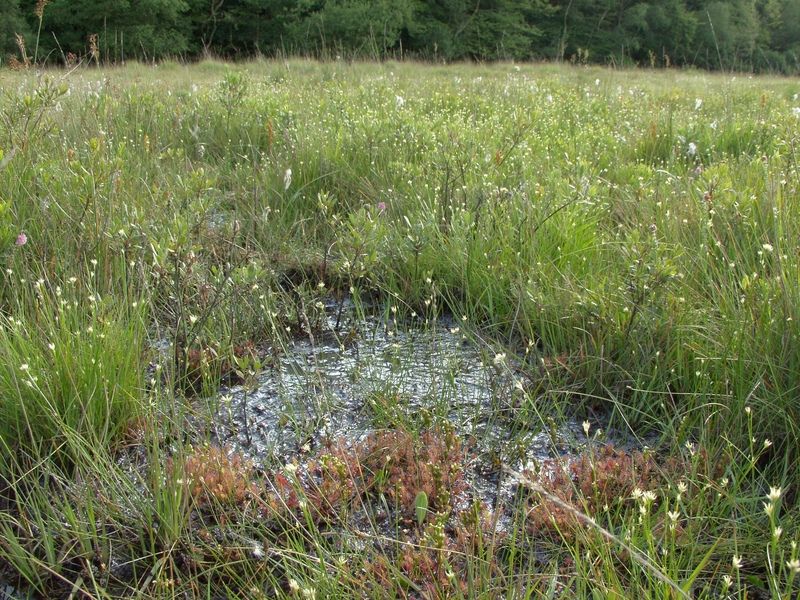
He tells me that the dry summers caused by climate change are causing problems for plants that need wet heathland to survive. To help alleviate this - Sussex Wildlife Trust has been working with a group of students age 13-16 from Chailey School, with Mike Murphy running sessions with the aim of 'mimicking Beavers' to create leaky dams.

There are multiple benefits of leaky dams.' Sam tells me, as we squelch through wet ground in our wellies. 'They keep water on the site longer, which helps counteract the impact of dry summers. Where we are is upstream of Lewes, so during periods of heavy rain, they benefit Lewes by reducing flood risk. They also create a better variety of habitats and these habitats are better managed for wildlife.'
We find the series of leaky dams built by the young people, across what was once a roughly two foot wide water course.
I've seen photos of various leaky dams in Sussex just after they were built - but seeing them in action is different. We can see how they have changed the course of the water and indeed the landscape. The dams back water up and push it to go wider. There are pools created in the same way that Beavers create pools. As a consequence, water is pushed into a wider habitat. The dams also act as trash screen for leaf litter, sediment and rubbish.
The width of the water flow is now around eight feet wide, and we can see there are different speeds and heights of the water flow, with some of it cascading over the dams. There are meanders now too, which leads to more moisture going sideways. All of this helps invertebrates, such as Dragonflies as well as Mayfly and Caddis Fly larvae. Some wildlife can nest in parts of the dam that sits above the water, especially in dry summer weather. Sam recalls a Wren nesting in the dense twigs of a leaky dam last year. Introducing wood into the water, and its subsequent decay creates more important habitat/food for species, such as some Crane flies. Toads have been seen nestled into the moisture within the twigs. The leaky dams are dynamic, changing throughout the seasons. During autumn and winter, when there are lots of leaves, the dams are less leaky. When these get washed away, the dams are more leaky.

In terms of engineering, a leaky dam is essentially a hydro dead hedge. Sam explains how the dams were built, using hand tools, bow saws and axes. The pupils coppiced local Silver Birch (this is done as part of the common’s habitat management, so that the heather isn’t out shaded) then used those branches to make the leaky dams. The young people create bundles of brash, and using thicker wood, tree trunks or cord wood, made upright posts to weave the brash between across the stream. Upside down forked branches (nicknamed pinch sticks by volunteers) form a V-shape that clamp and pin the dam down. Where these ‘pinch sticks’ aren’t used, two stakes form a triangle over the leaky dam - which makes the dam secure and ensures it doesn't lift when the water backs up (because wood is naturally buoyant).
The dams are roughly 10 metres apart and are all a bit different - and that's both deliberate and important, Sam explains. 'You don't want them all to work exactly the same. You want variation. This results in variation in the flow, and therefore creates lots of micro habitats that benefit a wide range of wildlife.'
To build leaky dams, you do need to get permission from the landowner and consent depending on type of watercourse you are building the leaky dams are on. In this case it is East Sussex County Council for both. For rivers, it is usually consented by the Environment Agency (who are concerned to make sure does not increase flood risk or impact wildlife). The trust has created over 600 leaky dams, and Sam tells me about dams built on a farm near Ardingly, where full grown trees where used to create the dams on a river, which were secured in place by steel bars.
A video showing the students in action:
The Chailey project means that the students learn about their local wildlife, local wild space and also about climate action. The scheme has been running for two years, funded by Lewes District Council, so students can return in successive years and see the impact of their work.
Creating the leaky dams has been a challenge but also a great experience for the Chailey students, as you can see from their own words:
'We worked on Chailey Common and learnt how to build leaky ‘beaver’ dams. I learned that Beaver’s have orange teeth because they have iron in their teeth to be able to treat the wood. The dams help to keep water back in drought or dry conditions and reduce flooding in heavy rain. They also filter the water. We coppiced lots of Silver Birch so that the Sphagnum Moss can grow more. We use lap lander saws to cut the trees.'
Shiv
'I really enjoyed going to Chailey Common because of all the interesting skills I learned like a step cut and how to make a stake with an axe. It was really fun to be with friends and enjoy their company whilst doing important work for the environment. I would love to do it again so I can make even more dams and look at how they have progressed. It was really cool to learn about the sphagnum moss and why we are doing it and how it affects the future of the land because of climate change. Cutting down trees and building the curved dam was amazing and something I’d love to do again.'
Jakob
'I made some dams and we learnt the importance of Sphagnum Moss to keep water in and that the tiny streams eventually lead to the Ouse. I’m proud of the dam we made because it curved and covered a lot of ground. I will bring outdoor clothes next time 😊'
Leo
Support Sussex Wildlife Trust's Save Our Wetlands Appeal
Beavers are slowly being reintroduced back to Sussex - their actions create the natural flood management techniques that are being mimicked here. More information here
Find out more about the Sussex Flow Initiative