
Kind of blue
By James Duncan
Communities and Wildlife Officer
Run a survey and ask people to pick their favourite colour - it's likely one will come out the surefire winner - blue. It's all around us. Our landscape is dominated by it. When admiring the vivid blue of a cloudless sky, or endless expanse of a blue ocean, it seems wholly natural to assume it's abundant in the natural world. But, there's something distinctly fascinating about the colour blue; it's unusual, really unusual. In fact, it isn't just unusual, it's the rarest occurring colour pigment in nature - it's thought that less than 1% of the animal kingdom are 'truly blue', that is, their bodies contain blue pigment.
Of course, that begs the question - if blue's so rare, why do we see it quite so often?

Sky from Rye Harbour Discovery Centre © Barry Yates
Essentially, colour is an illusion of reflection and absorption. Take the sky; a process called Rayleigh Scattering increases as the wavelength of light decreases. Violet and blue have the shortest wavelength, so the blue wavelengths of the white light get scattered into the atmosphere - et voilà, blue sky. But what about blue animals? Here in Britain for example, we have the Kingfisher, the Blue Tit, the 'Blue' Butterflies, the 'Blue' Damselflies and a number of 'blue' flowers. So, are they blue, or aren't they?

Holly Blue © Neil Fletcher
To start, there's a real separation between the plant and animal kingdom. Plants are able to utilise some rather intricate chemistry to create blue flowers thanks to the modification of 'red' anthocyanins (pigments whose appearance can be changed by varying acidity). The reason plant foliage is (almost) exclusively 'not blue' stems from the fact that plants are hungry for it - put simply, the short wavelength blue lights pack huge amounts of growth-enhancing energy. Should plant leaves reflect blue light, they'd be relegating themselves to to poorer quality light that limits growth. Blue flowers, on the other hand, reflect light very strongly in the ultraviolet part of the spectrum, enhancing their visibility to essential pollinating insects - a vital evolutionary advantage. However, to create a blue appearance, the overwhelming majority of the animal kingdom has to rely on another branch of science entirely; physics. Plus a bit of trickery.
This is because blue isn't within the naturally occurring range of chemical pigments that cause colour in animals. In a prime case of 'you are what you eat,' many pigments in fact come from an animal's diet. Flamingos, for example, aren't born pink. The carotenoid pigments common in plants and algae quite literally move up the food chain, colouring the animals that consume them. Blue food, of course, isn't exactly abundant.

Blue Tit © Bob Eade
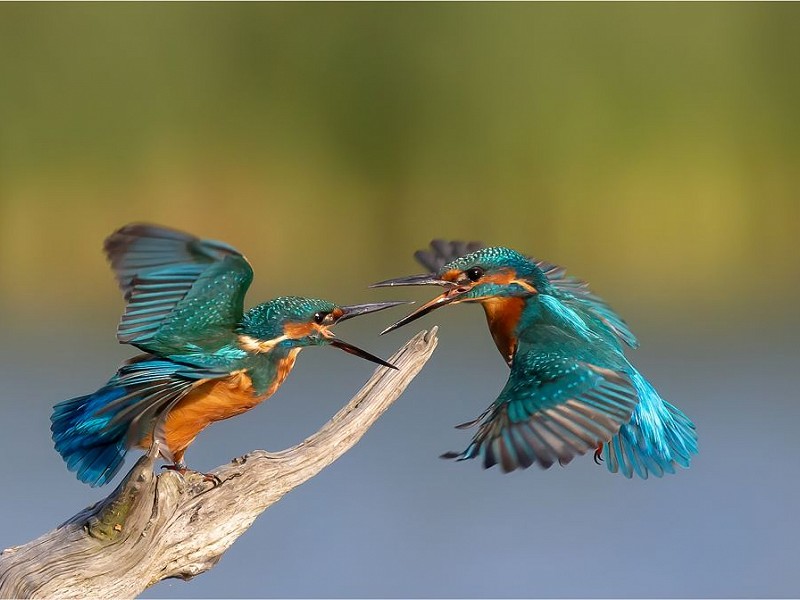
When we marvel at the striking blue plumage of a Kingfisher or Blue Tit, we're actually being deceived by our perception of the reflection of light. Paradoxically, neither bird has any truly blue feathers at all. The blue is created entirely by the way light interacts with colourless submicroscopic structures known as 'schemochromes.' Most butterflies employ a similar method, the precise shape of their wing scales causing the same effect - this is known as 'structual' colour, formed by quite literally 'shining a light upon them.' If feathers and wings become damaged, blue may quickly disappear as the light scattering is disrupted.
Moving back to an earlier point, it's worth considering the evolutionary reasons for 'making blue.' Is it beneficial and can it be received in a useful manner? If it's likely to attract predators and little more, there's clearly not a huge evolutionary advantage. But if it serves as a warning for toxicity, or helps to attract a mate, it may well be advantageous. Feathers, for example, that appear blue to us reflect even more light in the ultraviolet range. Whilst us humans have three light-sensing colour receptors in our eyes, birds have a fourth receptor for the detection of UV light. Given the choice, Blue Tits may well consider themselves 'Ultraviolet' Tits, an interesting thought the next time you spot one in your garden.
Comments
Thank you for the brief but fascinating article.
18 Nov 2021 16:01:00