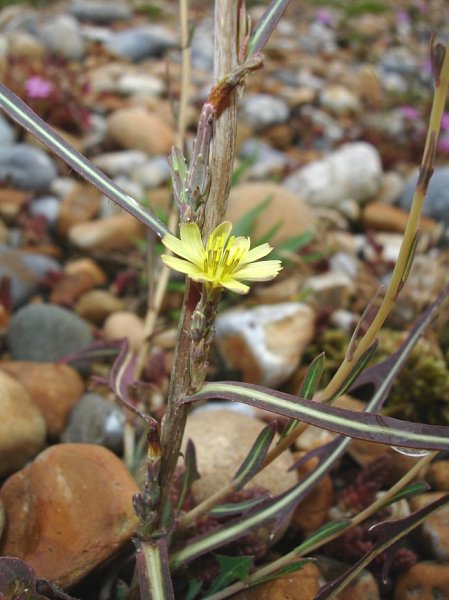
One of the rarest species that we have at RyeHarbour is the least lettuce. This delicate plant, growing up to about 1m in ideal conditions, is only found in two or three places in England, usually on disturbed sandy shingle or old sea walls. While never a common species it used to be more widespread in the south-east before suffering severe declines due particularly to sea wall refurbishment and river engineering, and it is now included in schedule 8 of the Wildlife & Countryside Act which protects our rarest plants. At RyeHarbour this species has suffered in the past from overgrazing by rabbits, so the construction of fenced areas on the Beach Reserve has benefited them greatly, and the best place to see them on the reserve is in the exclosure just south of the Parkes and Denny Hide.
For some of our most ‘high profile’ birds the breeding season for 2015 came to a close during July. Black-headed gull seem to have had a decent year with many fledged young present on the reserve, while after several years of almost zero productivity it was good to see over 100 fledged Sandwich tern (above) with adults at Ternery Pool early in the month. Our avocet have had a bit of a strange year, with good hatching success but a lower than normal fledging rate, perhaps due to a combination of poor weather and predation pressure. For other species however, proceedings were still ongoing. On FlatBeach the little tern produced their first fledgling mid-month, with at least three present on the 29th, though bad weather later on appears to have done for some of the smaller chicks, while many ringed plover have produced a second brood. The common tern on the Quarry were soldiering on, producing a few fledglings though they seem to have suffered badly from the depredations of herring gulls. On Harbour Farm two pairs of little ringed plover hatched chicks early in the month, though these did not appear to survive long. A good range of migrant waders during July included green sandpiper, common sandpiper, greenshank and whimbrel, with good counts including 100 lapwing, 95 curlew, 40 dunlin and 14 black-tailed godwit, while a flock of nine golden plover on FlatBeach on the 16th was a sign of the advancing year. The highlights were two little stint on Harbour Farm on the 16th. Notable passerine sightings during July included three raven in flight over Harbour Farm on the 9th, small groups of yellow wagtail on the Beach Reserve on the 10th and 16th, and 150 swift and 18 sand martin over the Beach Reserve on the 10th. Other notable sightings during July included two garganey at Castle Water on the 6th and an Arctic tern on Ternery Pool on the 4th.
Some good species in the moth trap at Lime Kiln Cottage this month, including the micros bordered ermel, starry pearl, horehound plume and rosy-streaked knot-horn and the macros crescent striped, white satin (not rare nationally but not recorded here since 1999), and the migrant small marbled. Butterflies have been quite poor this year, though again a few painted lady, clouded yellow and red admiral were of interest, as were the first records of marbled white for the year at their colony near the viewpoint, while the best of the bunch for the dragonflies were records of brown hawker and emperor at Castle Water. Other notable invertebrates included the rare saltmarsh horsefly (below) and the even rarer four-lined horsefly, only the second reserve record, as well as bee-wolf and hornet hoverfly. Plants in flower during July included least lettuce, red hemp-nettle, red clover, marshmallow, marsh helleborine, stinking hawksbeard and the very rare saltmarsh grass sea barley.
Cookie settings
We use cookies to collect and analyse information on site performance and usage, to improve your browsing experience and show personalised content. You are free to manage this via your browser settings at any time. To learn more about how we use the cookies, please see our cookie policy.