
John Muir Summer Holiday Scheme for Young People

The John Muir holiday scheme ran for five days during August 2022. The programme is aimed at young people aged 10-16 years old and provides the opportunity to work towards a John Muir Discovery conservation award.
Each day included practical conservation tasks alongside activities that enabled the young people to build relationships whilst exploring and enjoying the variety of habitats at Rye Harbour Nature Reserve. The following article was written by two of the participants, Oriana and Xavier Marrs, in September 2022
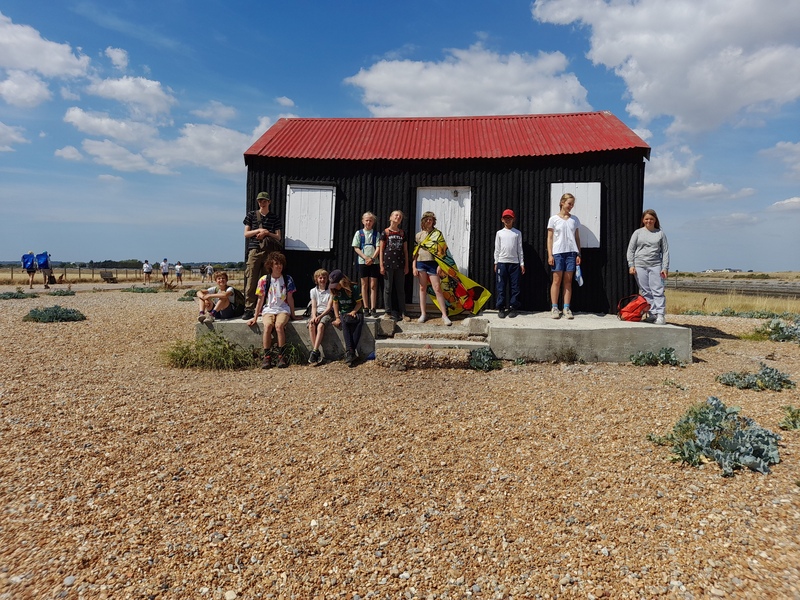
At the beginning of the week-long John Muir Award course, offered by the Rye Harbour Nature Reserve and John Muir Foundation, we went investigating for wild places around the Reserve.
We found a secret cove in a clump of trees within the nature reserve, where clear activity of Sparrowhawk was displayed and various mammal tracks in the close surrounding area. It was apart from the main footpath, and undisturbed by members of the public coming in and out. Therefore, there was no clear path directly to the area and insects such as ants and spiders had taken over the floor.
We also went to the reed beds viewing platform, a structure built in the middle of a reed bed. We were surrounded by trees full of birds, and the reeds in front of us provided a haven of activity from waders and smaller buntings or warblers.
There was a field area, which had been managed to maintain the grass at a consistent height, without hawthorns or brambles taking over the landscape, which we enjoyed searching in for beetles, butterflies, spiders, bugs, reptiles, moths, and rodents. The field also linked to a saltmarsh area covered with birds and interesting halophyte plants. Again, this place is set aside from the path, and the public have restricted access unless on a nature course, meaning that pollution contamination is kept to a minimum in this wild area.
We liked the range of species that we could find within each place, for example, the species we found in the reed bed area differed greatly to those in the saltmarsh area, and they all had different abilities to withstand and cooperate with the environment they thrived in. We also liked how we could observe the animals in their natural habitats, instead of visiting a zoo, or observing them in cages or boxes. We could see how they behaved without interrupting their lifestyle and could learn a lot about them without having to put them into a situation where they were not happy or were restrained.
All the areas we visited were set apart from the main footpath or track, so that they were not frequently disturbed nor had clear evidence of detrimental human involvement. This meant that we were privileged to see them and lucky to experience the areas which we wouldn’t have normally been able to access.
We visited many of the areas frequently and explored the surrounding habitats to gain more knowledge about how the ecosystems cooperate within the main area. An example is when we went to the reed beds, we didn’t only go to the viewing platform to look for birds, we also went around the back of the beds to do some pond-dipping. When we did that trip, we found huge medicinal leeches, lots of tiny frogs and tadpoles, water snails and water beetles within the water, which taught us about the diet of the predators in the habitat, and how they are adapted to the environment around them.
We learnt many more things about plants which we hadn’t previously known, and lots about the species that we came across. By being able to physically see, and sometimes touch the species, meant that we could find out a lot more about them because we could get close to nature and understand it better. This was the case with many of the animals and organisms we looked at over the week.
We took care with the wild places that we went to by minimising any damage or impact that we could create by using the land. We wouldn’t break tree branches or deliberately damage any habitats, and we made sure to leave the area as we left it, so no litter, and any species we moved to observe we made sure to put back where we found them. We also did litter picking when we went down to explore the beach.
We also did things like recording the reptiles we saw – in number and species, so that we could help build a database where we can measure whether the number of a certain species has reduced in the area, or we get a new species coming in. Both activities help us to understand and protect the nature in the area.
Since the course, we have thought about ways in which we can keep other wild places we come across safe. Now, if we find another wild place whilst out on a trip, we make sure to leave it as we found it, remove any detrimental impact from humans, such as rubbish, as much as we can, and look at how the area benefits different species and organisms for habitats or food.
We want to protect the wild places we had seen, looked after, and enjoyed, to keep them wild, and also spread the word about things to do when you find a wild place, and how to enjoy it without damaging it, and then maybe more people would take care of and want to look after wild places, and enjoy the richness of nature too.
John Muir once said: “When we try to pick out anything by itself, we find it hitched to everything else in the Universe”.
Oriana and Xavier Marrs
John Muir was an adventurer, explorer, botanist, inventor, writer and conservationist. You can find out more about John Muir here