
Insect Wings

By Charlotte Owen
WildCall Officer
Insects are the only invertebrates that can fly. They were the first creatures on earth to evolve the power of flight, and this led to their subsequent global success.
Except for the true flies (Diptera) all insects have two pairs of wings - the forewings and hindwings. Some insects, including bees and moths, couple their wings by hooking them together with tiny hairs so that they act as a single pair during flight.
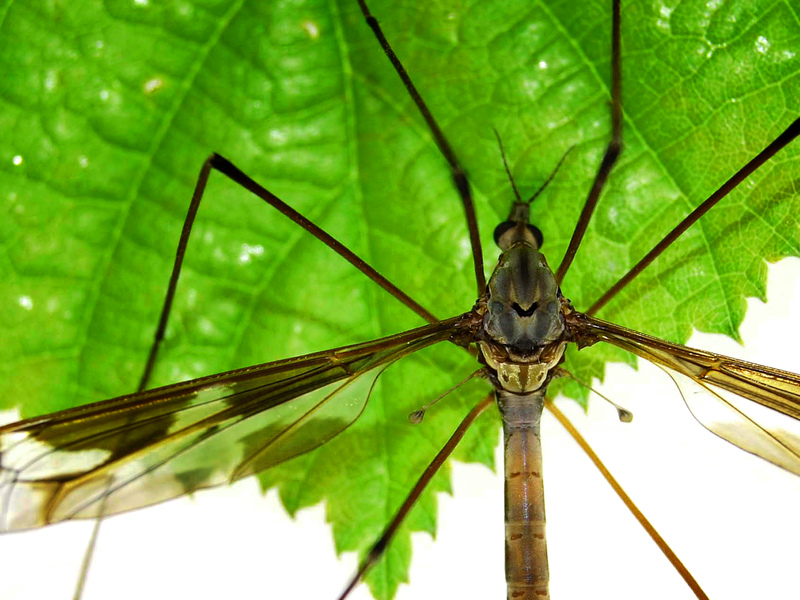
Craneflies seem to have just two wings but this is because the hindwings have been highly modified into a pair of rod-like structures with a ‘ball’ on the end. These are called halteres, and they act like balancing rods to keep the cranefly stable as it flies.
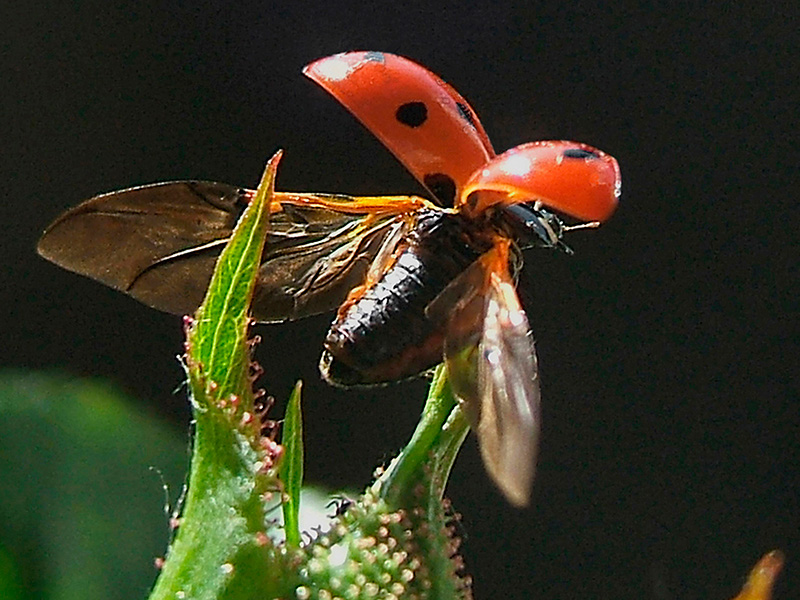
Beetles like the ladybirds retain a single pair of functional wings, with their forewings modified into a specialised hardened casing (elytra). When not in use, their wings are folded away safely and protected by the elytra. Ladybirds can deploy their wings within 1/10 of a second – faster than the blink of an eye.
Insect wings come in a variety of shapes and forms. Most are made up of two thin membranes with a network of veins sandwiched between them. The pattern of veins varies by species and is so unique it can be used to identify them.
The veins provide strength and structure while remaining flexible. They also form part of the insect’s circulatory system to transport haemolymph (the insect equivalent of blood) and oxygen around the body, and nervous system to transmit sensory information from the wings, detected by bristles and other sensors on the wing’s surface.
The veins in butterfly and moth wings are less visible because their wings are covered in thousands of microscopic scales, which are modified hairs. When they first emerge from their pupa as adults, butterfly wings seem to be crumpled and useless. They gradually expand as air and fluids are pumped through the network of veins, until they reach their full size. This can take several hours.
Veins are usually thicker and stronger near the body and along the front (leading) edge of the wing, and thinner and more flexible near the tip and along the trailing edge. This helps to produce lift and forward propulsion while minimising drag.
The physics of insect flight
For a long time scientists thought that insect flight broke the laws of physics, all because of the mistaken assumption that insect wings would function in the same way as bird and aeroplane wings.
Whereas birds flap their wings up and down, most insects flap in a flattened figure-of-eight pattern. This motion means their wings are always ‘attacking’ the oncoming air at a high angle, which maximises the lift they can generate. However, it also means they are always on the edge of stalling. Luckily, insects have an ingenious answer to this problem, too.
As they flap, a leading edge vortex of air is generated above the wing like a tiny tornado, which creates lower pressure above the wing and essentially sucks it upwards. Stalling would occur if this vortex grew in size and eventually detached from the wing. To avoid this, insect wings create a pressure gradient as they flap so that the vortex is stabilised and spirals out along the wing towards the tip, where it is safely shed. As it leaves the wing tip, the vortex creates a burst of even greater lift and insects can even control the direction of this boost, allowing them to steer at incredible speeds.
The fastest insect on the planet is a horsefly, Hybomitra hinei wrighti, nicknamed the “bullet fly.” It is specifically the male of this species that holds the record. During courtship he will chase a female and catch her in mid-air, with the pair then dropping to the ground while mating. An entomologist in Florida once managed to entice a male horsefly to chase a pellet fired from an air rifle. The fly caught it in mid-air, travelling at least 90 mph.
The muscles that control flight in insects account for 10-30% of their total body mass.
Mayflies, dragonflies and damselflies use direct flight: their flight muscles are attached directly to their wings, which limits the frequency of their wing beats – they can only flap as fast as the rate at which nerve impulses can be sent to their flight muscles.
All other insects utilise indirect flight, which works by vibrating the thorax (body) and allows the wings to beat at a much faster rate. Some insects are able to beat their wings so rapidly they can hover with expert precision.
Hoverflies have the most flexible wings of any flying insect. They twist by 45 degrees more than 300 times per second to maintain lift.
The Hummingbird Hawk-moth’s wings beat 70-80 times per second, emitting an audible hum.
Fine-tuning
Some insects, including dragonflies, lacewings, true bugs and bees, have a coloured spot near their wing tips, which is called a pterostigma. This spot is a group of specialised cells, which are often thickened as well as pigmented, and it serves to add mass to the wing to aid gliding. It only accounts for about 0.1% of total body mass but can increase maximum gliding speed by 10-25%, in a fantastic example of precision engineering.
Some insect wings, including hoverflies, house flies and fruit flies, have a hinged flap at the base called an alula. This allows the wings to be swept back and held over the body at rest. In some species the alula can also be used to fine-tune direction and speed during flight.
Comments
Good info!
28 Jan 2026 15:29:00