How to identify birds of prey

, 13 August 2021
How to identify birds of prey
Buzzard © Jon Hawkins Surrey Hills Photography

Few birds inspire awe as often as birds of prey, those athletic aerial predators that rule the roost when it comes to avian (bird) food chains. People traipse cross-country to see clouds of kites, or to catch a glimpse of a golden eagle in its highland home, and webcams fixed on the nests of ospreys, owls and peregrine falcons draw huge numbers of viewers every year.

But you don’t have to travel far to see many of our more common species. Some can be seen in parks and gardens, or even found amongst the glass and steel of city centres. We’ve put together a short introduction to five of the species you’re most likely to spot.

Sparrowhawk

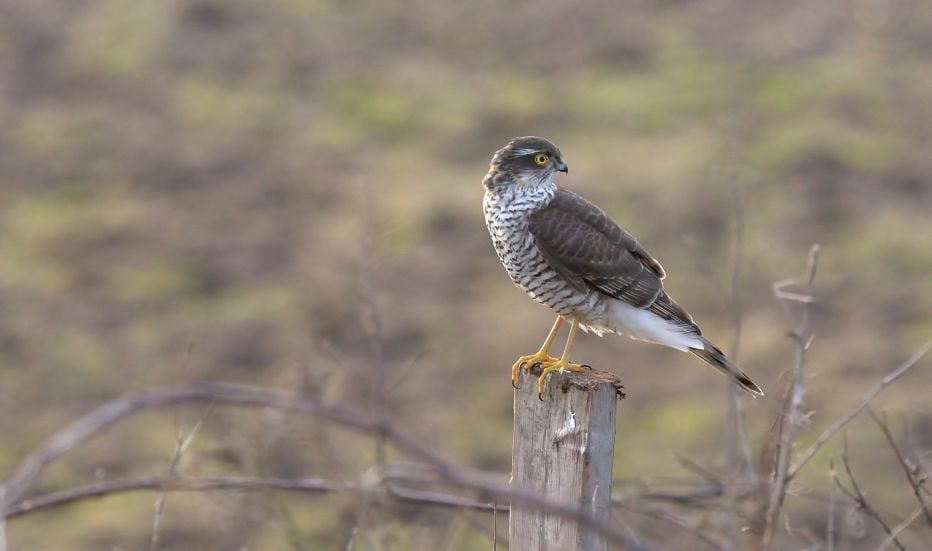
This is the bird of prey you’re most likely to see in your garden, and probably the one here at The Wildlife Trusts’ we’re most frequently asked to identify. Sparrowhawks are fairly small compared to many other UK birds of prey, with the largest females roughly the length of a woodpigeon, whilst males are smaller. They have grey backs (brown in young birds) and a barred breast, belly and underwing – grey barring in females and orange in males, which also have an orange flush to the cheeks. Their legs are slender and yellow, and they have fierce orange-yellow eyes.

In flight, they show short, broad and fairly blunt-tipped wings and a long, square-ended tail – longer than the width of the wing. They usually fly with a flap-flap-glide motion, with a few rapid wingbeats followed by a short glide. Sparrowhawks hunt smaller birds with surprise attacks, often flying fast and low through bushes and around buildings to catch their prey unawares. As well as gardens, they can be seen in parks, forests and other areas with some tree cover.

Sparrowhawks are often confused with goshawks, which are larger and much rarer. The size difference isn’t always obvious on lone birds, but goshawks have much thicker legs, bulkier bodies and in flight show slower wingbeats, a rounded tail and more protruding head. It’s extremely unlikely for a goshawk to turn up in a garden; most views are distant birds over large areas of woodland, which can be hard to identify without experience.
IL037202

Kestrel

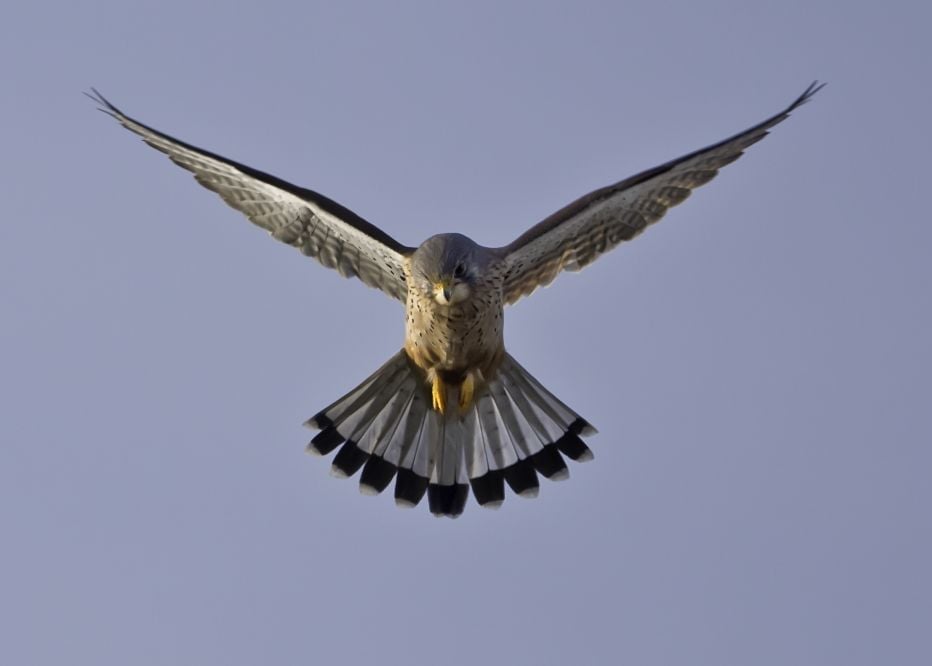
A common sight along roadsides and over farms, grasslands, and other open areas, kestrels are usually easily recognised by their habit of hovering on the spot. They seem to defy physics as they hang in the air, tail spread out like a fan, wings fluttering but their head fixed in place as they scan for small mammals on the ground below. 

Kestrels are a similar length to a sparrowhawk but with longer wings, and they glide less frequently. Their reddish-brown backs are speckled with black spots and their buffy breasts and bellies have rows of bold, black spots running down them, unlike the horizontal bars of a sparrowhawk. Males have a blueish head and females have a brown head, but both have a dark moustache-like strip running down from the base of the beak.
IL036167

Buzzard

Buzzards are another bird regularly seen along roadsides, often perched on posts or in trees. On warm days they can be see soaring high in the sky, flying in lazy circles on stiff wings. Numbers of buzzards declined dramatically following years of poisoning and persecution, but happily the population has since recovered and buzzards are now our most common bird of prey.

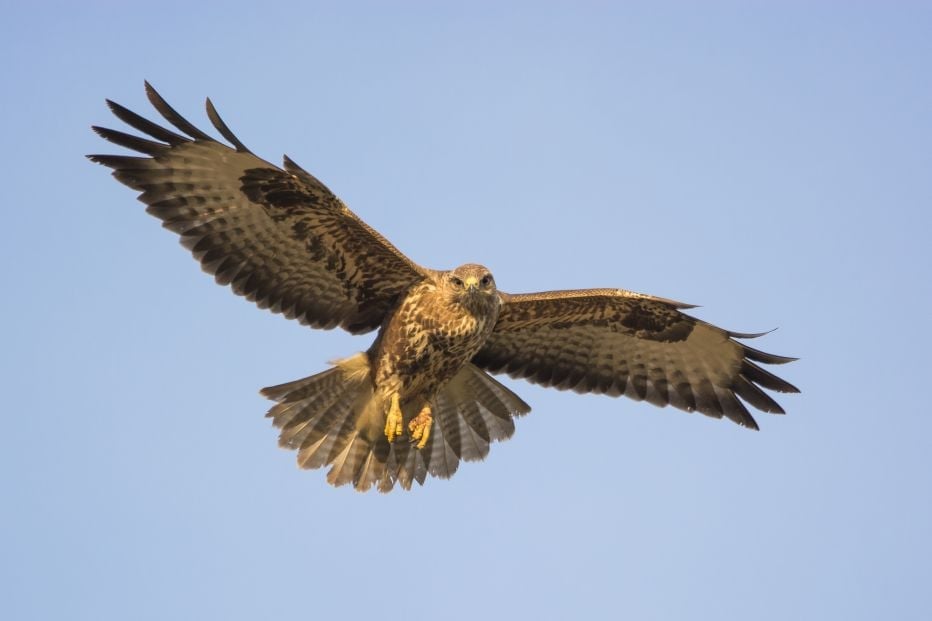
Buzzards are medium-sized, stocky raptors, with a compact body, short neck and relatively small, black-tipped yellow beak. Their plumage is incredibly variable, ranging from dark brown all over to almost white on the underside. They usually have a pale band across the lower breast, between the darker upper breast and belly sides. 

In flight they appear broad-winged with a short, broad tail. They’re most often seen soaring quite high in the sky, with the tail spread like a fan and the wings stiff, rarely flapping, as they glide in wide circles. Because size can be so hard to judge on a flying bird, soaring buzzards are sometimes mistaken for the much larger eagles, but golden eagles are less compact, with longer wings and tail; and white-tailed eagles are front-heavy, with a huge beak and a short tail, as well as having huge wings – they’re often described as flying barn doors! You’re unlikely to see eagles away from northern and northwest Scotland, or near one of the more recent white-tailed eagle reintroduction sites.
IL040816

Red Kite

Red kites were once driven to extinction in most of the UK, with just a few birds hanging on in mid-Wales by the early 1900s. Following several reintroduction projects and greater protections afforded to them, red kites have now spread across Wales and returned to England, Scotland and Northern Ireland. In some places, they are one of the most commonly seen birds of prey. They scavenge for much of their food, so can often be seen flying over roads searching out roadkill – the unlucky victim becoming the red kites version of ‘fast food’. 

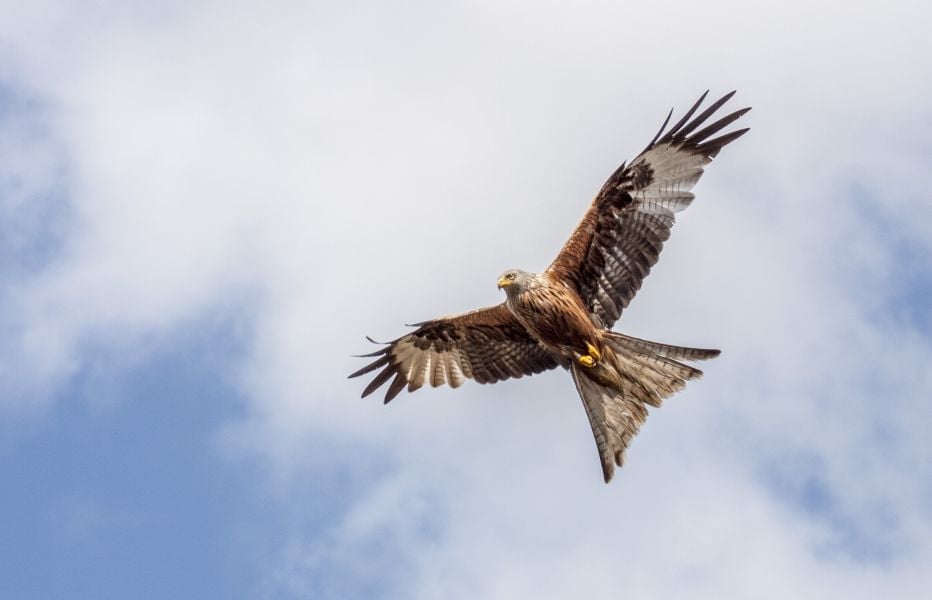
They’re very distinctive birds, larger than a buzzard, with a mostly rich red-brown plumage with a paler head and a large, black-tipped yellow beak. In flight they show long, narrow wings with five clear ‘fingers’ of longer feathers at the tips. The undersides of their wings have a prominent pale patch just before the black tips. They have a very long, deeply forked tail that makes them instantly recognisable, which is regularly twisted from side to side as they fly.
IL032650

Peregrine Falcon

Peregrine falcons have moved into many of our cities, hunting pigeons and even parakeets: the ledges of tall buildings filling the role of the cliffsides they would normally nest on. Away from urban areas, they nest in rocky places including coasts and quarries. 

Peregrines are heavily built but a little smaller than a buzzard, with a dark back that reaches up onto the head to form a hood, with a broad ‘moustache’ stripe extending from the base of the beak on each side. They have a white throat, cheeks, and underparts, with dark barring across the breast and belly. Young birds are buff-white below, with dark vertical streaks instead of barring. 

In flight they cut a sharp silhouette, with pointed wings that are usually slightly flexed backwards, creating an angle in the leading edge. They look powerful and chest-heavy, flying with fast, shallow wingbeats. When they spot prey, they put on a burst of speed and often hunt by diving down on their quarry from above. This behaviour is known as stooping, and the falcons can reach speeds of around 200 miles per hour.
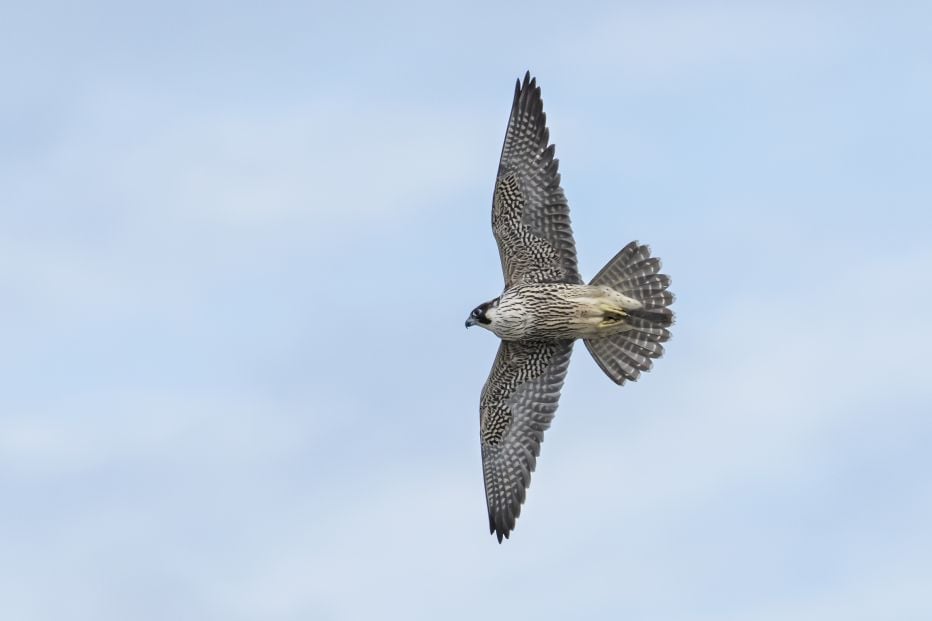
IL040613

We've been asked a number of questions arising from this blog - James Duncan has a go at answering them here

Hobbys

More on Hobbys here

Comparative sizes

Sparrowhawk - 29-34cm (male) 35-41cm (female). Wingspan range from 58-80cm. Male Sparrowhawk is approximately the size of a Jackdaw. Female is approximately the size of a Woodpigeon. Bear in mind that the proportions/build of the comparison birds is extremely different though. 

Kestrel - 31-37cm. Wingspan range from 68-78cm. Just a little smaller than a Woodpigeon, but with a similar wingspan.

Peregrine - 38-45cm (male) 46-51cm (female). Wingspan range from 89-113cm. Male Sparrowhawk approx. the size of a Black-headed Gull. Female similar in size to a Common Gull (by that, I don't mean a Herring Gull!)

Buzzard -  48-56cm. Wingspan range from 110-130cm. Looks big, approx. the size of a Herring Gull.

Red Kite - 61-72cm. Wingspan range from 140-165cm. Even bigger, the size of a Great Black-backed Gull.

Calls

In terms of calls, Buzzard and Red Kite have a lengthy drawn-out call, whereas the other three are often silent, but usually just have a derivative of the "ke ke ke" type. 

We suggest you go to this website to listen for yourselves!


Take Action for Wildlife

With so many species on the red list and at risk of extinction, we need to do all we can to stand up for wildlife. One of the best actions you can take to help is by joining us as a member or making a donation.

Leave a comment

Comments

  • An excellent and helpful guide to birds of prey. Many thanks.
    Thought we saw Buzzards and Peregrines over the high slope near Arundel Castle yesterday and were able today to confirm our sightings.

    19 Aug 2021 11:03:00

  • Robert:

    It is so heartening to see these raptors reappear in our area. Five years ago we never saw buzzards, now I hear their calls almost every day here in Iden, East Sussex.

    19 Aug 2021 11:06:00

  • Barbara Coady:

    Lovely article. Buzzards soar over our garden and we hear them calling. although we have noticed there are fewer of them this year.

    19 Aug 2021 11:40:00

  • June Grindley:

    Good info. But please could you do a collage so we can see relative sizes of the birds?
    Thank you
    June

    19 Aug 2021 12:02:00

  • Paula Baker:

    A really helpful guide, I am often confused between a sparrow hawk and a kestrel. I agree with June a diagram of relative size would also be helpful. Thank you

    19 Aug 2021 13:34:00

  • Dee:

    Thanks. Good info. We are in Wisborough Green, West Sussex and have kites nesting at the bottom of the garden. We feel very honoured.

    19 Aug 2021 13:35:00

  • Sharon Bohane:

    Thanks so much for this. I am always muddling up Kestrels and Sparrowhawks. Now I know. Sparrowhawks – stripes and Kestrels – spots!

    19 Aug 2021 14:43:00

  • Katrina Walker:

    I think we also have hobbies in West Sussex. How can I identify them, please?

    ANSWER Look here https://www.wildlifetrusts.org/wildlife-explorer/birds/birds-prey/hobby

    19 Aug 2021 15:38:00

  • Aaron Ridout:

    Fantastic, but could you add recordings of their calls too?

    19 Aug 2021 15:45:00

  • David Phillips:

    Excellent guide- soon surely we can include marsh harrier also as now relatively common in parts of Sussex. How is the county’s success with hobbies? It would be useful to add these two species also ( marsh harrier and hobby) to this guide.

    19 Aug 2021 15:46:00

  • Steve Walker:

    I saw a Red Kite over Ditchling Common about 3 years ago and last year spotted one over the Downs East of East Brighton Golf Course.

    19 Aug 2021 16:01:00

  • Good images and information. However the image of each bird is situated slap bang above the WRONG bird’s bold Title. It is therefore possible this ‘conjunction’ of title and image could easily cause miss Understanding and inaccurate learning. Hope this is helpful in preventing future unintended ‘wonkey’ communication. Best wishes, Don Faullner.

    ANSWER Hi Don. This is an issue with the current website we have when used on certain platforms only, usually phones. You'll be pleased to hear that we are developing a new website that resolves this issue and hope to have it live in a few months.

    19 Aug 2021 16:43:00

  • Bob Rowland:

    Very informative and easy to follow. This will be
    particularly useful for birding starters. Comparative size display would enhance perhaps as a silhouette

    19 Aug 2021 17:03:00

  • We enjoy spotting birds of prey when we are out driving. When they hover, it’s fascinating watching their heads keeping perfectly still, while their body moves in the air.

    19 Aug 2021 17:15:00

  • Nicky:

    I hear the kestrels and buzzards nearby before I see them – noisy birds ! Can you describe their calls to help us distinguish them.

    19 Aug 2021 17:23:00

  • Mike Davies:

    A really helpful article – thank you!

    19 Aug 2021 17:29:00

  • Lynne James:

    Thanks for the lovely photos of some of my favourite birds. Used to have sparrowhawk in garden regularly when we lived in mid Cheshire but not seen any yet in Sussex.

    19 Aug 2021 18:28:00

  • Brian King:

    Very informative article.

    19 Aug 2021 18:58:00

  • Carolyn:

    Interesting and useful info thank you. Is it only kestrels that hover?

    ANSWER Yes

    19 Aug 2021 19:30:00

  • Dean Burford:

    Love the info and comparisons for easy recognition.
    Ty

    19 Aug 2021 20:35:00

  • Brian King:

    Very informative article.

    20 Aug 2021 08:22:00

  • Susan Taylor:

    Really good overview to use and identify the most common birds of prey – thank you!

    20 Aug 2021 09:03:00

  • Susan Taylor:

    Really good overview to use and identify the most common birds of prey – thank you!

    20 Aug 2021 09:03:00

  • Jeffrey Smith:

    Thanks for the fantastic information on raptors. Will keep eyes open for sparrow hawks , as yet not been lucky enough to see one. Seen many others birds of prey mentioned and some not in your list.

    20 Aug 2021 13:01:00

  • Peter Eastwood:

    We ha Buzzards nesting in our garden in Ditchling this year, with six chicks. The young birds flew around in formation for a while. Our bird feeder was empty, but now the Buzzards have gone and the bird feeder is busy again, although still not many Rabbits or Squirrels.

    20 Aug 2021 16:35:00

  • tracy owen:

    So useful, thank you for sharing.

    21 Aug 2021 19:22:00

  • Sussex Wildlife Trust:

    After your comments, we have added some information to the end of the blog about comparative size, also, calls

    23 Aug 2021 13:38:03

  • Sussex Wildlife Trust:

    After your comments, we have added some information to the end of the blog about comparative size, also, calls

    23 Aug 2021 13:39:17

  • Sussex Wildlife Trust:

    After your comments, we have added some information to the end of the blog about comparative size, also, calls

    23 Aug 2021 13:40:16

  • Sussex Wildlife Trust:

    After your comments, we have added some information to the end of the blog about comparative size, also, calls

    23 Aug 2021 13:40:39

  • Dean Burford:

    Love the info and comparisons for easy recognition.
    Ty

    24 Aug 2021 10:52:00

  • Vivien:

    We saw what we think was a marsh harrier on the Rother Levels last month, can a picture and info be added to this list? Have any red squirrels been spotted in Sussex? If not then what could it have been (red, smaller than a grey, right body shape and tail, ran across a narrow road through mixed woodland).

    ANSWER There are no wild populations of Red Squirrels in Sussex but we do receive occasional sightings - these are usually individuals that have escaped from a private collection.

    25 Aug 2021 16:10:00

  • Dee:

    Thanks. Good info. We are in Wisborough Green, West Sussex and have kites nesting at the bottom of the garden. We feel very honoured.

    29 Aug 2021 19:51:00

  • Pamela Turner:

    I saw a big bird ,bigger than a buzzard ,it didn’t look as thought it had a forked tail for a red kite in my field at Park Road.Banstead on Christmas day,greyish brown in color .wing span 4ft approx.any one else seen it ?

    26 Dec 2022 09:07:00

  • Sussex Wildlife Trust:

    Maybe a Marsh Harrier or Hen Harrier?

  • John:

    Hi I live in Moulescoomb an a pigeon hit my roof l went out to see what was going on, a big bird of pray was sitting on my roof about 10 feet away from me, it was the size of a chicken and a light gray colour with the odd white feather Would you know what bird it is please? Regards John

    19 May 2023 08:15:00

  • Sussex Wildlife Trust:

    It is likely it was a Sparrowhawk, they often take pigeons in a high speed attack. The adult male Sparrowhawk has a distinctive bluish-grey back and wings.

  • Vic Standing:

    Saw a bird of prey just sitting on top of a hedgerow at the roadside as I drove northwards from Herstmonceux across open fields.
    Definitely a bird of prey , medium size , brownish with speckled ‘thrush like’ chest . Was it a Kestrel?

    19 Jan 2024 18:05:00

  • Sussex Wildlife Trust:

    Sounds like a Kestrel

  • Vic Standing:

    Saw a bird of prey just sitting on top of a hedgerow at the roadside as I drove northwards from Herstmonceux across open fields.
    Definitely a bird of prey , medium size , brownish with speckled ‘thrush like’ chest . Was it a Kestrel?

    19 Jan 2024 18:09:00

  • Sussex Wildlife Trust:

    Sounds likely to be a Kestrel

  • Penny Chennell:

    Near to Barcombe my friend and I saw a large dark brown speckled bird .It was sitting on the grass verge and was brown with flecks. Much bigger ,taller than an owl. Could it be a buzzard or might it have been anything else ?

    31 May 2024 00:06:00

  • Sussex Wildlife Trust:

    A Buzzard sounds likely

  • Chris Pattinson:

    Brilliant article.
    I googled this because I drove down a country lane near Hastings, East Sussex this morning, following what I think was a Buzzard for about a quarter of a mile. It was only 10 feet above the ground and landed on a bush of similar height. I stopped and watched it for a while until it flew off! Outstanding!!

    27 Jul 2024 10:43:00

  • David Allman:

    I was on Ashdown Forest this morning, I watched to medium sized birds of prey displaying in flight, flying together, I would like to know what these birds are.

    16 Sep 2024 12:29:00

  • Sussex Wildlife Trust:

    Hi David. Unfortunately it's not possible to tell from this amount of information.

  • Victoria Ramsden:

    Hi there. Such valuable and interesting information on this site, thank you!
    I wondered if you can review the headings for each bird and order of pictures as the pictures seem to relate to different birds and so you need to read very carefully which is not always possible when out walking. Minor point but I think would make a lot impact!

    02 Mar 2025 17:00:00

  • Sussex Wildlife Trust:

    Hi Victoria. This is an old blog. It's a valid point. We will repost with correct labels, so keep an eye out! Thank you

  • Hayley ward:

    Today my husband saw a large Hawk like bird on the roof of the bungalow next door. I showed him a picture of a sparrow hawk but he said it was much larger

    12 Mar 2025 18:58:00

  • Alastair Irons:

    I saw what I believe were two Leucistic Red Kites flying over a farm north of Lewes and have been trying to find out who to tell and whether anybody else can verify this sighting – did anybody else see them?

    06 May 2025 16:40:00

  • Mrs Gerry Forward:

    Well not really sure what i saw but it could be a white headed Eagle or Osprey came down by the side of the road going from Hooe East Sussex to Ninfield just after the Lamb pub today at 12.30pm on Sunday 20th July 2025!

    20 Jul 2025 14:11:00

  • Janet Barker:

    We live in the East Riding of Yorkshire with a well known bites nature reserve in our village. Today whilst driving into the village we were so very lucky to see a large bird with a long wide wingspan it flew very similar to a land gull it had markings under the dark coloured wings a lighter pattern similar to a circle or dome the tail was fanned we have looked online and cannot match the bird Please does anyone have any ideas. Thank you. JB

    17 Mar 2026 15:42:00