
How to ID a winter tree
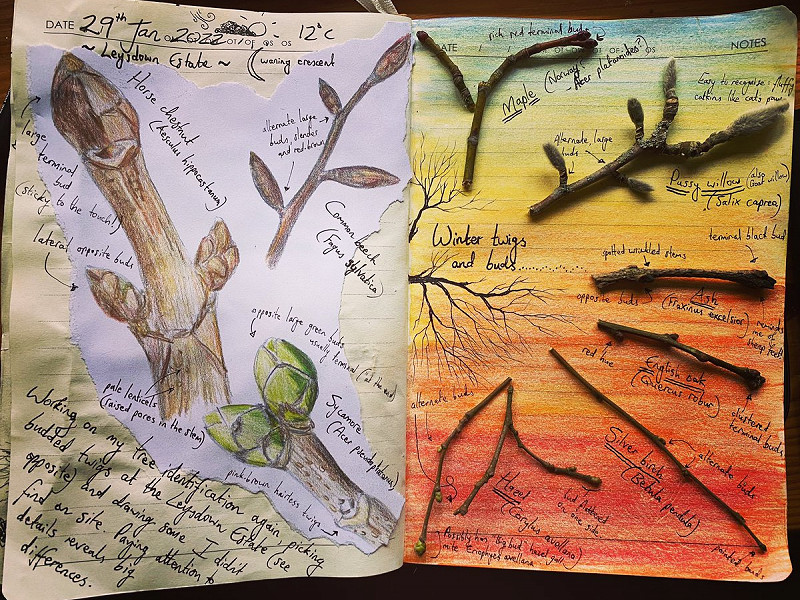
Winter is the season when everything seems to be asleep or even lifeless and identifying trees and shrubs seems to be an impossible task without their leaves, flowers or fruits. A closer look at their skeletal stems can reveal their identity however. Each species has its own structure, colour and pattern in the way they put out their buds. Once you’re familiar with these, knowing your Oak from your Ash is surprisingly easy.
Start with the arrangement of the buds themselves. Are they side by side on the stems and opposite one another, or do they lie at intervals, in alternating rows? If they’re opposite, they could belong to Ash, Horse Chestnut or Sycamore. Oak, Blackthorn, Birch and Hazel on the other hand have alternately situated buds.
Buds at the end of the stems are called “terminal buds” and something to pay attention to is their size. Sycamore and Horse Chestnut buds are large, but the terminal buds of Rowan and Maple are small. The shapes of buds is also a characteristic, like how Oak buds grow round and clustered together, or how single Ash buds appear pointy and short. Then there are Beech buds, which also have pointed shoots but theirs are much longer and rust-coloured.
Speaking of which, colour is also a great species indicator: black for Ash, reddish brown for Oak, green with dark lines for Sycamore, pea-green for Hazel. Each tree has its own palette, even without its leaves.
Many trees also put out flowers and seeds in late winter, such as the furry paw-like flowers of Willow, or the green lamb-tails of Hazel. You might also see old fruits left from the previous autumn, such as the bunches of key-like seeds of Ash, or the two-winged pods of Sycamore.
Using all of these signs in combination is a sure way to identify a tree. Just as a detective uses many clues to find the culprit, as a nature-sleuth you can put the evidence together to get the whole picture. Then it’s a case of matching them up with photographs and descriptions from a good guidebook or website to get their common names.
My final bit of advice is to draw what you see. Observational drawing (no matter the skill) helps to memorise the forms, patterns and colours, and the good thing about ID-ing trees is that you can take a twig home and sketch it indoors on a cold winter’s day.