
Flapping, gliding, soaring - identifying birds by how they move

By James Duncan, Communities and Wildlife Officer
Logic dictates that the typical method of identifying species is either through visual appearance or perhaps through vocalisations. However, the way animals move can often be wholly distinctive in itself. In certain cases, for example; fleeting views, at distance, in poor light or weather - movement may offer a far greater clue than appearance itself. Within 'birding circles' movement, flying style, posture and shape form part of the 'overall impression' that a species gives off. Combine these with where it was spotted and what the habitat was and there's a good chance of a relatively reliable identification. This overall impression is known more widely as the 'Giss' or 'Jizz' of a species.
Birds of Prey (or raptors) can frequently pose an identification conundrum. Mostly spotted in flight, they're often silhouetted and at distance so their flight style can be mighty useful. The way they flap and soar varies extensively between species. For example, Kestrel and Sparrowhawk can appear similar in open flight, but Kestrels (like most Falcons) display powerful and consistent wingbeats. Sparrowhawks on the other hand (when not hunting) have a very distinctive flight pattern - 'flap flap' followed by a long 'glide.' If the short, rounded wings have you thinking it may be a Sparrowhawk, the 'flap flap glide' pattern will confirm it for you. (note. be careful not to confuse this with the territorial display flight of a distant Wood Pigeon!) Another raptor with a very distinctive flight pattern is the Hobby, a summer-visiting Falcon and specialist dragonfly hunter. Long-winged, the Hobby has the habit of sweeping its scythe-like wings back, giving it the appearance of a huge and rather gangly Swift. Compare these 'rapid flappers' to the somewhat ponderous elastic wingbeats of a Common Buzzard and it's easy to spot the difference.
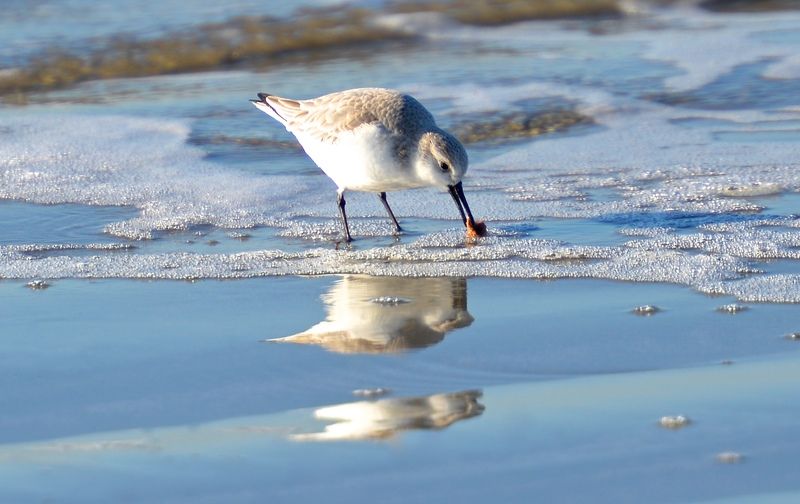
Waders are another group that display some rather defining characteristics of movement. Seen a small pale hyperactive bird relentlessly chasing waves up and down a beach? That's a Sanderling for you. Notice a small bird 'foot-trembling?' (that is, shaking its feet in order to disturb mud-bound invertebrates) You're most likely looking at either a Ringed or Little-ringed Plover.
Flushed a well-camouflaged mottled brown bird from under your feet? It'll probably be a Snipe of some kind. If it typically takes off from a distance, zig-zagging rapidly whilst calling, that's a Common Snipe. If you practically stand on it before it takes off, flying low, quietly and seemingly a bit half-heartedly, that'll be the winter-visiting Jack Snipe. If you're watching a wader nervously and habitually 'bobbing' its rear end, it's highly probable a Common Sandpiper is the culprit. Though not the only 'bobber' amongst the Sandpipers, it's the most consistent in doing so. Should your small wader be swimming in the water, frequently spinning in circles and pecking constantly at the water like an over-wound clockwork toy, you've spotted an Arctic-breeding Phalarope of some kind, either a Red-necked or Grey.
Of course, truly there are a myriad of birds recognisable from their movements, far too many to list. But here's a few easy ones to look out for; a Blackbird-sized species that flies from the upper reaches of the canopy, arrow-straight, losing height in a regular undulating fashion as it tucks its wings in between flaps - it's a Great-spotted Woodpecker. A Sparrow-sized bird that moves jerkily up, down, along and underneath tree branches - it's a Nuthatch. If the bird has similar habits but only moves up the tree, before flying onto the next tree - it's a Treecreeper. If it's Blackbird-sized and dashes low into vegetation (in a manner that suggests fleeing from a Sparrowhawk) it probably is a Blackbird! But then again, it's also quite possibly a Song Thrush. They have similar habits and both dash low into cover when disturbed. In contrast, the larger and bolder Mistle Thrush tends to gain height more rapidly, flying into open space with distinctive Great-spotted Woodpecker style undulations.
Comments
What’s the bird of prey at the top of your email about identifying birds by flight?
09 Feb 2023 11:40:00
Sussex Wildlife Trust:
Hi John, the email image was a Buzzard in flight
Very interesting information.
09 Feb 2023 12:15:00
Very interesting, thank you
09 Feb 2023 12:43:00
It would be lovely to have a video of the different flight patterns?! I have real trouble identifying birds!!!
09 Feb 2023 14:09:00
Lovely information…. I would love a few short videos birds to help firm my knowledge but this article is very helpful. Thank you
09 Feb 2023 14:59:00
Absolutely fascinating, thanks
09 Feb 2023 16:21:00
Very helpful
09 Feb 2023 17:05:00
That was really helpful, James, thank you. I have never been very good with coastal bird identification so next time I will now have a better idea.
09 Feb 2023 17:05:00
Interesting & very informative description to facilitate Bird identification.Thanks James
09 Feb 2023 22:34:00
Very interesting & helpful. Thank you. As others have said videos would indeed be useful.
09 Feb 2023 22:53:00
Very helpful, thanks
10 Feb 2023 08:13:00
Really useful tips that have already helped me to be sure I saw a sparrowhawk the other day. Thank you!
10 Feb 2023 14:53:00
Thank you. I feel you have helped me retrospectively identify some birds I have seen
10 Feb 2023 16:27:00
I enjoyed this article greatly. I’m no expert but this information both taught me something new, and confirmed my instincts regarding local sparrowhawks and kestrels.
10 Feb 2023 17:05:00
Very interesting & helpful. Thank you. As others have said videos would indeed be useful.
10 Feb 2023 17:12:00
Thanks for this, a video of different birds of prey whilst flying would be great to help identify the different species
15 Feb 2023 18:02:00
Very interesting & helpful. Thank you. As others have said videos would indeed be useful.
15 Feb 2023 20:30:00
Very interesting & helpful. Thank you. As others have said videos would indeed be useful.
24 Feb 2023 13:28:00
this is very interesting – where can I find this video?
15 Apr 2024 09:53:00
Sussex Wildlife Trust:
There isn't a video
I witnessed a bird with a silver belly gliding silently along Ferring rife, I think it was hunting, low to the water. Middle sized. What could it be?
19 May 2024 19:22:00
I have seen this bird twice now, flying in front of our vehicle down the same lane. I don’t think it’s a sparrow hawk. It didn’t look big enough or have speckles. It was smooth and a flat brown colour. It flew at the same pace our car was travelling seldom flapped its wings and kind of did a smooth glide all the way up the lane and then veered off into the field and continued to fly parallel to the vehicle. It was very direct in its path like it knew where it was heading. We were in broad Windsor Dorset area. Would love to know if anyone could shed some light on what it could be .
22 May 2025 05:08:00