
February 2016: Rye Harbour Nature Reserve Sightings
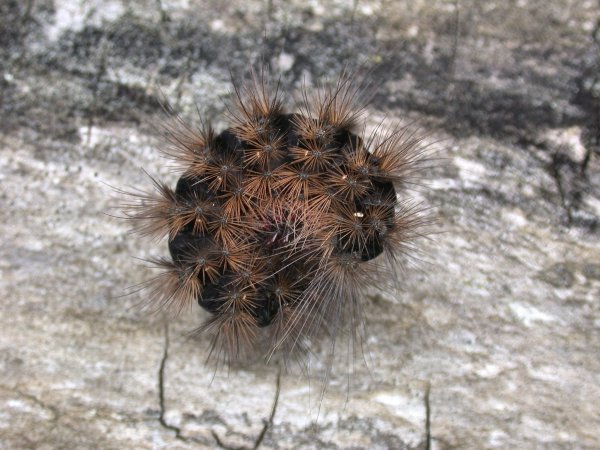
One sign of the approaching spring is the appearance of cream-spot tiger caterpillars on the reserve. In Britain this species occurs south of a line from the Humber to the Wash, largely near the coast, and is probably the most commonly recorded species of tiger moth that we get at Rye Harbour. These late winter larvae will have hatched the previous year and fed up on species such as dandelion, docks and plantain until the end of the season before hibernating in some sheltered spot to pass the winter months, occasionally feeding when the weather is warm enough. Come the longer (and hopefully warmer) days of late winter they vacate their hibernation sites for a further bout of feeding and the larvae will be fully grown by about mid-April. The larvae pupate in the ground with the adults emerging around late May.
Numbers of golden plover, one of the species which provide the bulk of wintering waders at Rye Harbour, showed a decrease during February, with maxima of 800 compared to 3000 in January. Still good numbers of lapwing around though, with at least 1242 on the 21st, while curlew (370) and dunlin (350) numbers also remained high, though all were slightly lower than the January maxima. Other notable counts during the month included 90 knot on the shore on the 11th and 16 ruff on Harbour Farm and 45 snipe at Ternery Pool on the 9th. Late February is the time when avocet generally become more regular leading up to the breeding season and this year was no exception, with up to 22 recorded later in the month. Displaying ringed plover, redshank, lapwing and oystercatcher were also signs of the approaching spring, as were the appearance of the first Mediterranean gull (below) of the year on the 21st.

Numbers of most waterfowl also dropped off during February, though a count of 988 wigeon on the 21st was the highest February total at Rye Harbour since the mid-80s. This month saw also saw several sightings of bittern at Castle Water, regular great white egret here and on Narrow Pit and the Beach Reserve and two black-necked grebe on Long Pit on the 21st. In addition, up to six goldeneye were present on Harbour Farm and Long Pit and up to four pintail on Flat Beach Level.
Raptor sightings included up to four marsh harrier at Castle Water, merlin at Castle Water on the 14th and 21st and peregrine over the Beach Reserve on the 1oth and 29th, while buzzard was seen over Castle Water on the 2nd and Rye Harbour Village on the 10th. In addition, there were regular sightings of barn owl on Harbour Farm and at Castle Water. On Harbour Farm, passerines included up to 35 skylark on the new saltmarsh and up to three rock pipit at the Eastern end of the Beach Reserve, while at Castle Water a blackcap was present on the 11th, several sightings of bearded tit included five from the viewpoint, also on the 11th, a bullfinch was seen at the hide on the 14th and on the 18th, six fieldfare and a firecrest.
In addition to several sightings of cream-spot tiger caterpillars during the month, non-avian sightings during February included both stoat and weasel at the eastern end of the Beach Reserve and Harbour Farm and false widow (below) at Lime Kiln Cottage, the site of a growing colony of this introduced species. Plants in flower included coltsfoot, daisy, common whitlowgrass and gorse, while the first purple sprouts of sea-kale appeared out of the shingle.

Image: Stu's Images