
Ecological Surveys at Brighton Marina
Sarah Ward
Living Seas Officer
Earlier this year, we were asked by our colleagues at the Sussex Biodiversity Record Centre to assist with the Sussex Local Wildlife Sites Initiative. Whilst the vast majority of Local Wildlife Sites are terrestrial, one in Sussex is underwater – Brighton Marina. Local Wildlife Sites are reviewed to ensure that the features they were designated for are still present, and provide up to date species and habitat information that is used to protect them in planning policy and help guide ecological management and advice.
Sites need to be surveyed by qualified experts, so we enlisted the help of Dr Gerald Legg and Ian Tittley, who have a vast amount of experience in identifying marine fauna and flora.
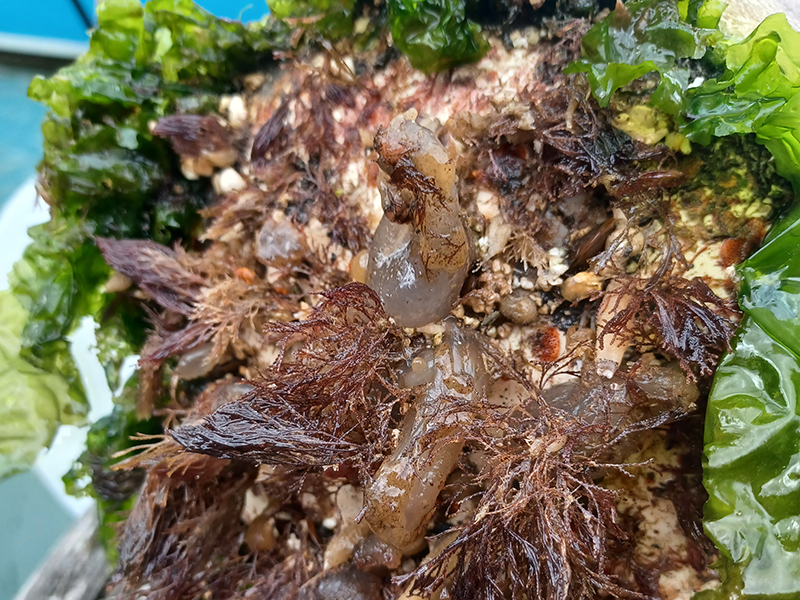
With the support of staff at Brighton Marina, we were able to coordinate surveys in both the inner and outer marina. The principal survey undertaken was looking at the species encrusting on the hard surfaces of the floating pontoons. Underwater cameras were deployed to capture images of the underwater life in situ, and samples were taken so as to identify as much as possible to species level – much of which requires study under a microscope. We surveyed five sites around the outer marina and two sites in the inner marina.
The surfaces surveyed were absolutely covered with marine life – algae dominated at the top, with various species of sea squirts, bryozoans and hydroids forming a carpet of life below. Notably, the Red Ripple Bryozoan, Watersipora subatra, which is non-native originating from the southern hemisphere, is now present across the marina. This species was first recorded in Plymouth in 2008 and has since spread along the south coast.
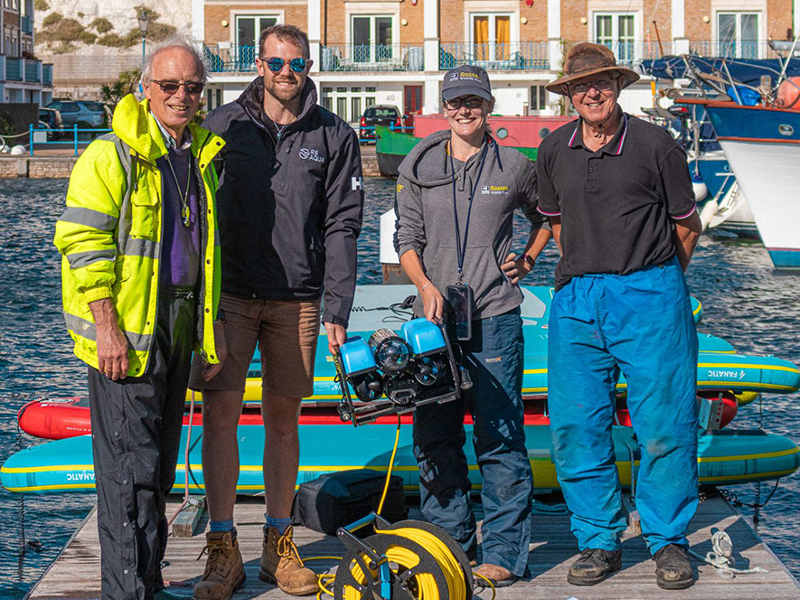
In the inner marina we were also very excited to make use of our underwater Remotely Operated Vehicle (ROV) - that you can see in the main image. Similar to an aerial drone, this is piloted remotely, connecting to a computer with a video stream to allow the pilot to manoeuvre the vehicle. However it is connected by a tether as wireless connections do not work underwater.
As this was the first ‘flight’ for our ROV, we were pleased to welcome our friends from RS Aqua who loaned their expertise in launching, driving and (most importantly!) recovering the vehicle. The footage obtained by the ROV will supplement the other data, hopefully adding some species more likely to be on the move, such as fish.
Once all the post-survey analyses have been completed and the footage reviewed, we will compile a report on the site to contribute to the Sussex Local Wildlife Sites Initiative.