
Eastbourne Group activities - April 2026
David Beer
Walks
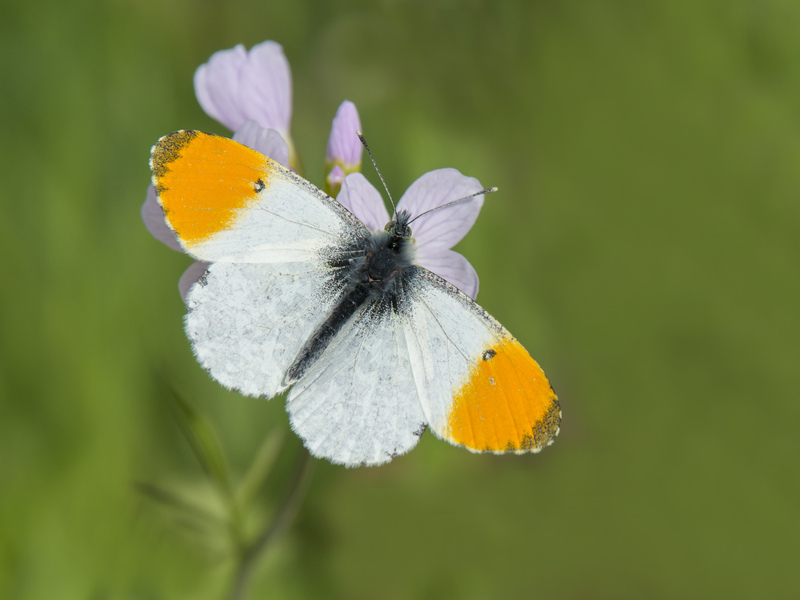
We met outside All Saints Church Herstmonceux In glorious sunshine for the first walk of the month. Following footpaths through the woodland surrounding Herstmonceux Castle we had good views of many woodland birds. The trees seemed to be full of Chiffchaffs, Blackcaps, Nuthatches and Coal Tits. There were dense patches of Wood Anemones, Bluebells, Stitchwort and Celandines; adding colour to the woodland floor. It was warm enough for early spring butterflies and we had good views of Orange Tips, Brimstones, Speckled Woods, Holly Blues and Large Whites. Many of us saw our first Large Red Damselfly of the year amongst the reeds as the footpath ran parallel to the pond. By the time we had completed the three mile circuit there were 28 bird species on the list and we all remarked how beautiful the Sussex countryside is at this time of the year.
Our second walk on the last day of the month was a circuit of Arlington Reservoir. The footpath along the dam at the Eastern end of reservoir was closed for repair, but a well-signposted diversion through fields and woodland added a greater variety of habitats. As we moved out of the car park we were treated to Common Whitethroats singing from the tops of bushes. Those who preferred to scan the reservoir had excellent views of Great Crested Grebes, a Grey Heron and a few Swallows skimming over the surface of the water. The sunny sections of the woodland close to the hide were full of butterflies such as Holly Blue, Brimstone, Green-veined white, Speckled Wood and Peacock. However the insects that caused the most excitement were a pair of Beautiful Demoiselle damselflies. They obligingly settled on the leaves of a Bramble offering excellent opportunities for the keen photographers amongst the group. As we walked along the diversion the hedgerows were full of Hawthorn blossom and the birdsong of Lesser Whitethroat, Chaffinch, Linnet, a Bullfinch and a Redstart. The path took us through a small patch of damp woodland where we we could smell the Wild Garlic and enjoy some stunning Red Campions.
Evening Talk
Following our short AGM, Denis Chanter gave a fascinating talk on insect mimicry. This survival strategy has evolved in some insect species where harmless species have evolved to resemble poisonous ones. Predators then avoid eating the harmless species as it closely resembles its toxic relative. Predation is a strong selection pressure and those individuals that most closely resemble their toxic cousins are less likely to be predated and therefore will survive, breed and pass their genes to the next generation. Denis illustrated his talk with some wonderful photographs indicating in many cases how accurate the mimicry has become. The talk also focused on the nineteenth century scientists, Henry Bates and Fritz Muller, who published scientific papers linking mimicry to Natural Selection. They have given their names to the two different forms of mimicry, Batesian and Mullerian. Batesian mimicry is where a harmless species mimics a dangerous one, whereas Mullerian mimicry is where two or more poisonous species resemble each other and therefore reinforce predator avoidance.