
Dr Barry Yates celebrates 36 years at Rye Harbour Nature Reserve
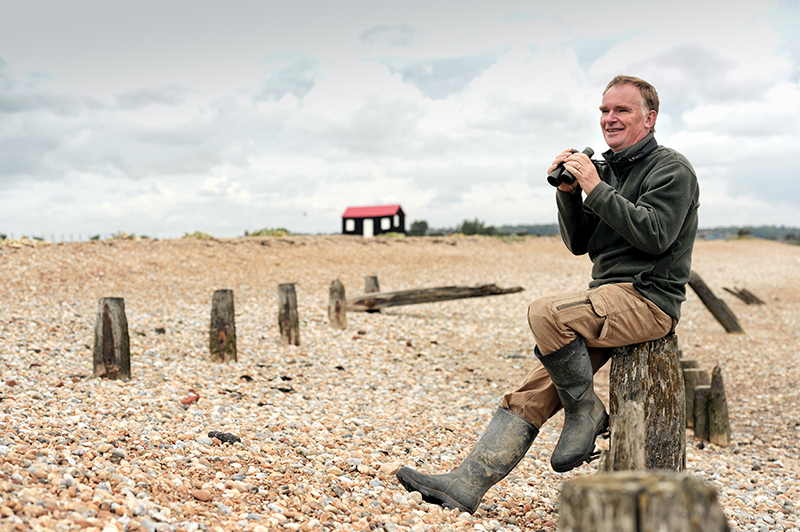
Dr Barry Yates is Sussex Wildlife Trust’s Manager at Rye Harbour Nature Reserve. The reserve has just celebrated its 50th anniversary and Barry has now worked (and lived) on the reserve for 36 years. He talks about the origins of Rye Harbour and what's been happening over the last 50 years:
“In the 1960s there was a realisation that coastal habitats in Sussex were under increasing pressure from tourism and development, so the Sussex Naturalists Trust (now the Sussex Wildlife Trust) and the Sussex Ornithological Society (SOS) worked together to build a case for several coastal nature reserves. The work began under the enthusiastic guidance of Frank Penfold, Chairman of the Trust and Guy Mountford, President of SOS. Jack Harrison, a retired solicitor, on behalf of the Trust, and Tony Marr, the SOS Secretary, worked closely together preparing the submission which went to the County Councils.
In July 1965 East Sussex County Council (ESCC) published a report, "Coastal Preservation and Development", which supported proposals put forward by the Sussex Naturalists Trust for the establishment of a nature reserve at Rye Harbour.
Since 1970, Rye Harbour Nature Reserve has been guided by a Management Committee with representatives from voluntary and statutory bodies. The staff and volunteers recorded the wildlife and managed the special habitats of saltmarsh, saline lagoon, vegetated shingle, wet grassland and reedbed. The committee passed on its direct management function to ESCC in 1995 and then in 2011 this was transferred to Sussex Wildlife Trust The Friends of Rye Harbour Nature Reserve has also generously supported the nature reserve with volunteers and funding since 1973.

Major advances have included the progress from just having a summer Warden to a team of five. After the current health crisis we will double staffing here, with funding from the National Lottery Heritage Fund as part of the Discover Rye Harbour Project. The land area has increased from the original Beach Reserve with the addition of privately owned land, the purchase of Castle Water by Sussex Wildlife Trust and the incorporation of Rye Harbour Farm into the reserve after the Environment Agency bought it in 2002 to build improved sea defences. The number of birdwatching hides has increased from one small, to five large ones that are all accessible to some wheelchairs.

We have protected and managed the coastal habitats here that were once more common in Sussex, with four landscape scale habitat projects that stand out:
- Development of electric fencing to protect the roosting and ground nesting birds.
- Creation of 20 ha. of reedbed habitat adjacent to the Castle Water gravel pit.
- Re-creation of 20 ha. of saltmarsh as part of the sea defence improvements.
- Improvement of new saline lagoons, ponds, scrapes and wet grassland created by the sea defence improvements.
None of this happens without funding and regular contributors have been: Environment Agency, Natural England, ESCC, Rother District Council, Icklesham Parish Council and of course, the Friends of Rye Harbour Nature Reserve.

During the last 50 years there have been so many wildlife highlights, but the top ones include:
- Increasing the number of breeding birds to nearly 100 that includes 6 waders, 6 gulls, 6 ducks, 7 warblers and 3 terns.
- The saltmarsh re-creation project has rapidly matured in a few years to become a productive area for some special wildlife that includes breeding Avocet and Redshank, large flocks of wintering Golden Plover, the flowers Sea Heath and Sea Barley and several scarce invertebrates: Sea Aster Bee, moths - Crescent Striped and Star-wort, spiders - Enoplognatha mordax and Argenna patula, beetles - Dyschirius angustatus and Cassida nobilis.
- The re-establishment of a large population of Stinking Hawksbeard that was declared extinct in UK in 1980s – with more than 30,000 plants last year and it featured on a Royal Mail £1.55 stamp!
- The creation of a large reedbed that has contributed to an amazing recovery of the UK Bittern population (11 booming males in 1997 to more than 200 last year). The reedbeds at Castle Water now have 1-2 booming Bittern plus breeding Marsh Harrier, Bearded Tit, Water Rail, Cettis Warbler, Garganey and Shoveler.
- The recent return of the Sussex Emerald moth to Sussex, several species new to Britain including Euaesthetus superlatus (beetle), Eumerus sogdianus (hoverfly), Neon pictus (jumping spider), Streaked Plusia moth, the first Least Tern recorded in Europe and the discovery of a new species of fly that lives underground in the shingle, Megaselia yatesi (named after me!).

It has been a great privilege to manage the land and its wildlife with so many amazing people and together develop this special place into what it is today – a coastal wetland that is home to hundreds of rare plants and animals that enjoyed by many people.
If we can inspire more people to appreciate and value wildlife, then we have a greater chance of reversing the decline of wildlife that has been going on all around us for decades.
In terms of what I hope for the future, I hope that the reserve is still here, and grown larger, with all our special species still living here, but joined by a few new ones like Beaver and nesting Black-winged Stilts and Great White Egrets.
I would want the reserve to still be funded within a society that values its environment and the international community has managed to slow the warming climate and helped the sea to be much healthier than it is today.
I would hope that Sussex Wildlife Trust is still inspiring people to be more wildlife aware. I hope many people continue to support both the Sussex Wildlife Trust and the Friends of Rye Harbour Nature Reserve, and that my grandchildren bring their grandchildren here to enjoy the coastal landscape… and remember their grandparents.
We are living in difficult times at the moment, but nature continues to be remarkable, and I’d like to thank everyone who has supported the reserve over the decades, and continues to do so.”
Dr Barry Yates, Reserve Manager
Comments
I arrived a year after Barry and Ann an integral partnership in Barry’s work. I admire his faithfulness to the old timers eg Breda and Ernie Burt. It has been a journey of adventure and dedication in the face of s many complexities of management and bringing to-gether so many organizations and developments. Thank you for everything and well done. Keep the wheels turning slow but sure!!
15 Apr 2020 13:31:00
As a Bexhill residents we really only started to visit the reserve and Castle Water 3 years ago and my wife and I are proud to be Friends…we only wish we lived closer!
As a keen but very amateur photographer there have been many occasions when we have turned to Barry for help in identifying species ( you rarely get close enough!) and without fail he has always replied promptly and of course accurately (!). Thanks to you Barry and all your team for your sterling and tireless work and we look forward impatiently to the end of the lockdown.
15 Apr 2020 17:45:00
If I may be so bold as to call you Barry, many years ago I was the local resident Bobby, you have certainly changed the whole area. I am amazed at the changes, in my time Rye Harbour Farm was a working farm and Castle Water a leisure? area.
I remember when you succeeded Richard Knight. I also remember when I saw a Hoopoe and you countered by telling me you had seen a Hobby. The Little Tern was the prominent attraction, now you have a tremendous variety. You and the volunteers must have worked very hard. Thirty two years have passed since I retired. May I wish you well.
22 Apr 2024 18:34:00
Sussex Wildlife Trust:
Thank you so much Edmund - we passed this message on to Barry and he said "How lovely!" He absolutely remembers you too. .
We are staying in Rye Harbour in June, looking forward to walking around the nature reserve. Unfortunately we have no real twitching experience but are keen to learn. Do you have any basic tips for a first timer and his wife…
Thanks Terry
21 Apr 2025 12:11:00
Sussex Wildlife Trust:
Hi Terry.
Thank you for your message about coming to Rye in June. Have you checked out the website?
https://rye.sussexwildlifetrust.org.uk/discovery-centre/plan-your-visit
Here’s a map https://rye.sussexwildlifetrust.org.uk/map
There’s quite a bit of information there – for example – what to look for each month
https://rye.sussexwildlifetrust.org.uk/nature-reserve/wildlife/what-to-see-this-month/june
There are multiple bird hides on the reserve and quite a lot of information boards too – but I’d start off by visiting the Discovery Centre – it has a great shop that sells guides to birds and other species as well as binoculars. There is also lots of information there, a great café and huge picture windows that look over the reserve.
And well-informed volunteers at the help desk too, who are happy to help
You may also find the following helpful. Start looking, noticing, recording - watch the birds in your garden or from your window, and you'll start to see different types of birds. A good field guide such as RSPB Handbook of British Birds: Fifth edition : Holden MBE, Peter, Gregory, Professor Richard: Amazon.co.uk: Books is helpful. Don’t start with one that covers the whole of Europe, it will contain many species you are unlikely to see and cause confusion. This will stand you in good stead for your trip to Rye.
At Rye, start with this guided walking trail: https://rye.sussexwildlifetrust.org.uk/admin/resources/summer-birds-leaflet.pdf. The approximate distance for this trail is 3.3 km (2 miles). This route passes three birdwatching hides and is wheelchair and pushchair friendly with frequent benches along the way to rest.
The only equipment you really need is a half decent pair of binoculars for birdwatching – 8 x 42 is the best option for beginners, and these don’t need to cost more than £50-150.
Set your alarm a little earlier - birds are often most active around dawn, when the temperature is cooler and no one’s been around to disturb them. This is the time of day you’ll find them out in the open, calling, feeding and generally going about their business.
Get to know common birds first - build your confidence by starting with the more easily identified birds. When something unusual flies past, you’ll notice it straight away.
Say hello to other birders – the local birding community are a supportive pool of knowledge of where to look and what has been seen recently. Pop into our visitor centre where you’ll also find recent sightings information, and a café and shop!
I hope this is helpful, and that you enjoy your trip! Paul Tinsley-Marshall, Site Manager