
Creatures of the night

Nighttime is a busy time for some creatures, so we're taking a look at who is nocturnal and why.
Who is nocturnal? And what does this mean?
Nocturnal animals are active at night, in contrast to diurnal animals (including humans) which are active during the day. When daylight fades and our vision starts to struggle, we retreat indoors and get ready to sleep through the darkest hours, and the nocturnal specialists take over: the bats, owls, Foxes, Hedgehogs, Badgers, Toads, slugs, moths and more…
Why be nocturnal?
As with any adaptation in the natural world, being nocturnal can provide a range of advantages.
Nocturnality is a form of 'crypsis' - the ability to avoid being seen or detected by other animals. It works both ways, helping prey animals avoid being eaten; and helping predators avoid being detected by their prey.
By hunting at night, predators gain an advantage over prey animals that don’t have great night vision or might be less alert, so won’t be able to see them coming. Many smaller creatures, which have a wide range of potential daytime predators, have become nocturnal to avoid many of them. There are still predators at night but not as many, so it’s comparatively safer. Frogs spawn at night for the same reason.
Being nocturnal also helps to avoid daytime competitors. For example, Tawny Owls can hunt small mammals at night without competing with Kestrels and other predators hunting during the day in the same location. Nocturnal pollinators, such as moths and beetles, will not be competing with day-flying bees and butterflies, and some plants even flower at night, or create scent at night, specifically to attract nocturnal pollinators.
In hot climates, being active at night is a survival mechanism to avoid the heat of the day, which can lead to dangerous overheating or dehydration. This is less of an issue in the UK but can be apparent here during a heatwave, when many animals may become more crepuscular – coming out at dawn but retreating to shelter to avoid the worst of the daytime heat, before emerging again when it cools off at dusk.
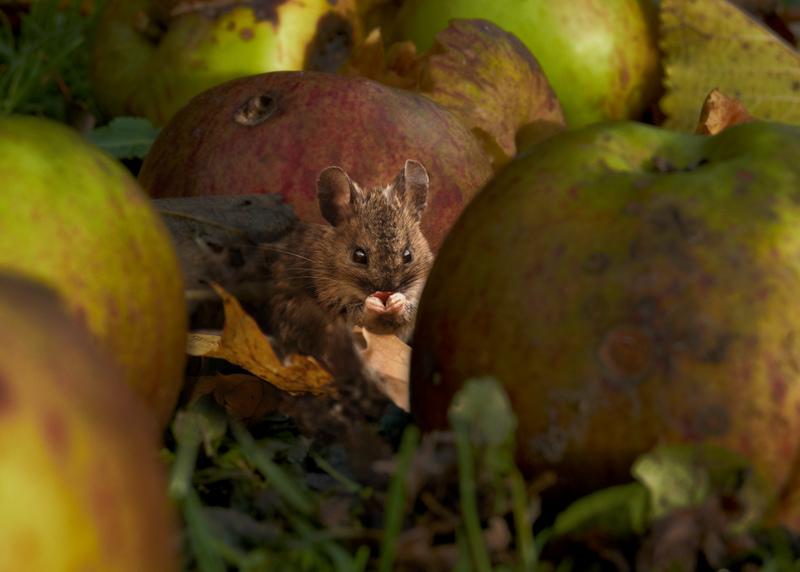
Wood Mouse © Alan Price
Nocturnal adaptations
Creatures of the night have evolved some impressive super-senses to overcome the challenges of life after dark.
Vision
Vision relies on light, so it’s a challenge to see anything in the dark. Nocturnal animals have specialised eyes that are highly efficient at collecting and processing light. This means they can see at light intensities a million times lower than those available during the day. Nocturnal eyes are usually extra-large with wide pupils to maximise light capture. Owls have especially huge eyes, which can account for up to 5% of their total body weight. Owl eyes are so specialised they are shaped more like cylinders than balls. This means they cannot swivel within the socket, and owls must turn their entire head to look at something. Still, it’s a minor price to pay for exceptional night vision.
As well as increasing the size of the eye, nocturnal adaptations extend to the structure within the eye. The retina contains light-sensitive photoreceptors: rods, which are sensitive to light and motion; and cones, which react to colour. Nocturnal animals have specialised retinas containing many more rods than cones to maximise their ability to see in the dark, although this comes at the expense of colour vision. Some nocturnal animals don’t have any cone cells at all. Even the rod cells are specialised, and distinctly different to those found in the eyes of animals active during the day. Their altered structure helps to gather and focus the available light.
Lots of nocturnal animals also have a specialised reflective layer in the eye (the ‘tapetum lucidum’ which translates to ‘bright carpet’) which acts like a mirror to reflect even more light onto the retina. This is why their eyes shine when caught in a torch beam or camera flash.
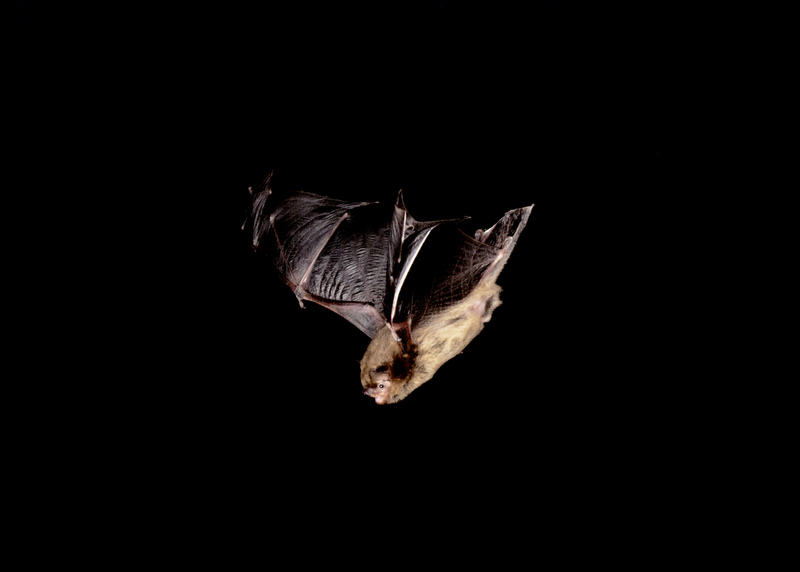
Soprano Pipistrelle Bat © Hugh Clark FRPS
Hearing
Rather than rely primarily on vision, many nocturnal animals have developed an enhanced sense of hearing to help them hunt down prey, or listen out for danger. Their ears are often large and cup-shaped, which helps to funnel in as much sound as possible (try cupping your own ear to see how effective this is). Some animals, including owls, can hear separately with each ear (known as asymmetrical hearing). You can’t see an owl’s ears because they’re hidden under feathers, but they are positioned on the head so that one is slightly higher than the other, allowing the owl to pinpoint exactly where a sound is coming from and detect the slightest hint of a rustle in the grass.
Bats use their ears to navigate the night sky (though they are not blind and can see about as well as we can). They use a sophisticated echolocation system, which works in a similar way to a ship’s sonar by emitting a pulse of sound and listening for its echo. Bats are constantly processing audio signals to create a mental map of their surroundings, detecting how far away an object is as well as its size and shape. They can do this so accurately that they can pinpoint a mosquito in complete darkness.
Comments
Very interesting……thank you
23 Nov 2023 11:34:00
Lovely, interesting article. Thank you
23 Nov 2023 12:02:00
Fantastic read ……..you think you have a fair knowledge of wildlife….then you read an article like this ….brilliant ….more please 🙏
23 Nov 2023 12:12:00
Brilliant observations
23 Nov 2023 12:58:00
Lots of great information tks.
23 Nov 2023 13:20:00
That’s very interesting information thank you! I was particularly interested to hear that bats aren’t actually blind, I’d always thought they were! Yet another myth buster.
23 Nov 2023 14:52:00
Badgers seem to have small eyes and ears – why is this?
23 Nov 2023 15:14:00
Sussex Wildlife Trust:
Badgers do have small eyes for a nocturnal animal and a large nose. Badgers mainly sense through what they can smell, backed up by their hearing and lastly their sight which is quite poor. Small ears would be an advantage in tunnels or when digging, as they are less likely to get in the way.
Interesting and informative. Thank you.
23 Nov 2023 16:10:00
A really interesting blog, thank you
23 Nov 2023 16:36:00
Thank you for your useful information. Very interesting reading.
We get a badger visit our garden most nights. We also have a hedgehog house, but was told we won’t get hedgehogs if there is a badger around. Even if it’s secure? Is this right?
23 Nov 2023 16:40:00
Sussex Wildlife Trust:
Badger populations have increased over the last 30 years and there is some concern that this is the cause of the Hedgehog decline. It is true that Hedgehogs are preyed upon by Badgers and that Badgers will compete with hedgehogs for food, however the People’s Trust for Endangered Species and the British Hedgehog Preservation Society have found no evidence that Badgers are an important factor affecting Hedgehogs. Hedgehogs are declining just as severely in urban areas, where they rarely encounter Badgers, as they are in the wider countryside. Also in areas where there are low badger numbers, such as East Anglia, hedgehogs are declining as much as in areas with lots of Badgers. Whilst it is true that Hedgehogs will avoid areas with high numbers of Badgers, it is the lack of suitable habitat and availability of insect food that is having the biggest effect. Bigger, better and more joined up Hedgehog-friendly habitat is the best way to help them.
I learnt a new word – crypsis. Very interesting and well written blog. Thank you!
23 Nov 2023 16:50:00
Do Badgers make a snorting grunting noise at night?
23 Nov 2023 16:54:00
Sussex Wildlife Trust:
Yes, Badgers make a range of sounds to communicate with others in their clan, but are generally quite quiet animals. A snorting noise is usually associated with startled or surprised Badger
Thank you so much for educating me further on the wonders of nature, we can all learn something new every day and that’s fabulous
23 Nov 2023 20:33:00
fascinating information, thank you
24 Nov 2023 08:44:00
Fascinating. I shall look at slugs in future in a different light!
24 Nov 2023 08:45:00
Extremely interesting, many thanks.
24 Nov 2023 12:54:00
Very informative. 👍
24 Nov 2023 14:10:00
very interesting and ideal for passing on to young children who, in my experience, love to learn about these details.
24 Nov 2023 21:05:00
Good stuff. But suggest you mention the creatures living in perpetual darkness below 300 metres in the sea, as well, to prick imaginations, perhaps with a question.
24 Nov 2023 23:18:00
I enjoyed reading this article, especially the part about night vision and the owls eyes
25 Nov 2023 07:15:00
Brilliant article, full of fascinating facts which I’m trying to commit to memory! Thank you.
26 Nov 2023 22:19:00
Sussex Wildlife Trust:
Thanks Jen!
Great pic’s of the Little Owl and the Wood Mouse !
27 Nov 2023 16:27:00
I love these articles, especially at this time of year when not exploring our beautiful countryside.
28 Nov 2023 08:44:00
Very thoroughly developed. Added substantially to what I knew.
03 Dec 2023 18:57:00