
Corona Wildlife Diary: Day Twenty-eight
I'm taking the day off today (hey, I've been doing this for four weeks straight!) so I thought I'd let my wife / pandemic partner Clare write about some of the more overlooked wildlife we have in the garden. Clare's special interest is fungi. And though her Bank Holiday discovery may have been microscopic, it's just as fascinating and beautiful as the birds and butterflies.
Clare's always been interested in fungi. In fact here's a page from her nature notebook in 1988.

In the last four years though she's become REALLY interested in fungi. She's discovered a whole world of brittlegills, stinkhorns, waxcaps, deceivers, deathcaps, rusts and smuts. She finds even the tiniest fungi fascinating and I lose her for hours on end as she stares down her microscope.
I'll hand you over to Clare...
_______________________________________________________
Day Twenty-eight
Over the past four week it's been a joy to see people sharing stories of life, wild life, continuing on around us. But when the camera turned to my back garden, I confess to a sudden and powerful empathy with Hyacinth Bucket and that matter of 'Keeping Up Appearances'. Because – with time taken up by work and other interests – our wildife garden had become somewhat more unruly than we had originally planned.
So it was that I found myself on the first day of the bank holiday intent on tidying up the 'vegetable patch'.

Last year's Fennel has stood here all winter; its stems now well and truly dead. So I thought I'd start by clearing these away. It took longer than I thought as, while I was chopping them into bits to go in the garden waste bin, I got rather distracted by the tiny bumps and speckles which adorned them.
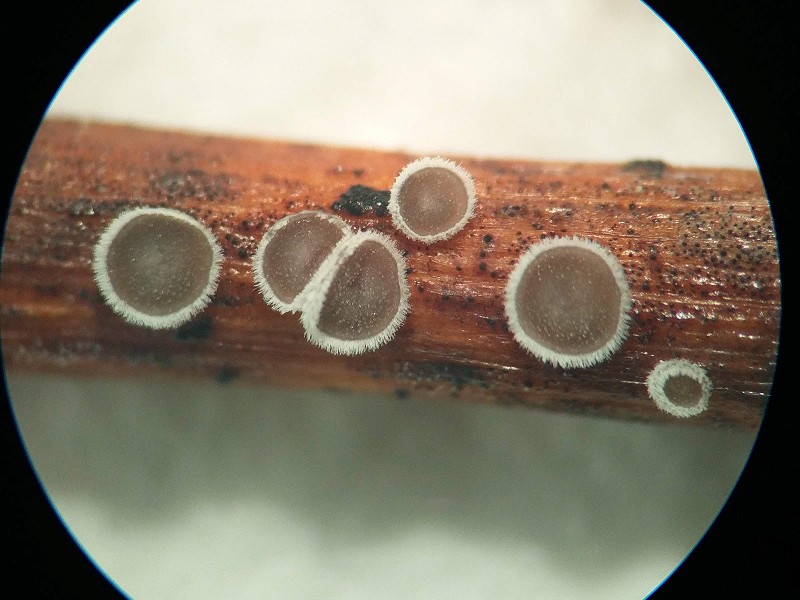
The thin stems in the Fennel's upper reaches were most intriguing, being covered in a smattering of tiny fuzzy-looking specks. So some of these were saved from the garden waste bin and came into the house with me. I popped them in a box with some damp kitchen roll and waited to see what would happen.

Here's one of those stems after it's moistened up a bit. You might just be able to make out those fascinating specks?

Another hour or two passed, while I figured out how to change a light bulb in the stereomicroscope.
It was worth it, because these aren't just any old specks. They are in fact beautiful soft grey cup funguses fringed with crystal-white hairs.

At the highest level of magnification, I could just make out some tiny square clusters of dots – a telltale sign that what I'm looking at here is a fungus which holds its spores out on prongs [sterigmata]: it's a basidiomycete.

I think what I've got here might be Lachnella alboviolascens; but there may be similar species and I haven't yet managed to track down a key.
The authors of 'Fungi of Temperate Europe' describe Lachnella as "a genus of dessication-tolerant cyphelloids... In dry weather the fruit bodies close and form small, hairy balls." You can actually see this in action under the microscope – these photos were taken over the course of about 15 minutes.

Those weren't the only interesting specks on the Fennel.

The thick stems were covered in tiny black bumps which – taking a lead from 'Ellis & Ellis' – I think might be Leptosphaeria libanotis, with a "depressed-globose" shape.


I can't work out if the even-tinier specks shown here [TOP] with the Lachnella for scale [BOTTOM] is a baby version of the Lachnella, or something different. Might need to get the slide microscope out...

Anyway, I think we've established why the garden's such a mess. And maybe messy's just fine for funguses.
_________________________________________________________________________________________
So, thanks to Clare for today's contribution to the diary and for tidying up the vegetable patch (although she did abandon that job pretty quick when she found the fungi and spent the next few hours staring down a microscope).
I thought you'd enjoy the insight into the sort of fascinating conversations we're having now we're locked in together 24 hours a day, every day.
You can read all of Clare's mycological adventures on her blog 'Misidentifying Fungi' (here)
Where you'll sometimes find her looking at much bigger fungi that sometimes look like this...


Comments
A fascinating insight, thanks Clare, I hope you are keeping well.
14 Apr 2020 09:36:00
Thank you Clare…absolutely fascinating !! great work you two !!
14 Apr 2020 09:55:00
Thank you Clare for that fascinating insight into a micro world. Fungi are amazing so varied.
14 Apr 2020 10:55:00
Fascinating Clare. Thank you. Maybe you will find some other fungi lurking in the area. I think I know the Fungi in the top picture. The Fly Agaric. I have them appear in my garden each Autumn, but not in the same places. Some years they are under trees and at other times they in unexpected open areas of the garden. Is it because in the past there were trees where there are no trees present now, or is there a different reason for that ?
14 Apr 2020 13:32:00
Amazing photos Clare. It’s not all about dormice and foxes and pretty birds!
14 Apr 2020 17:04:00
Wow! Science really is interesting. Why do you think it grew on there? How do you take the photo under the microscope and get it so clear?
14 Apr 2020 18:24:00
@Ginny-Vic: Fungi grow almost everywhere on our planet and are adapted to release nutrients from many many different sources. The fungi I found here are species which are particularly found on dead herbaceous material – dead twigs and stems – and help to recycle this organic material. Fungi produce a great quantity of tiny spores, in the hope that at least one will land somewhere favourable to it carrying on its life cycle. I imagine that these dead fennel stems were colonised from spores carried here in the air – but I don’t now enough about the life cycles of these particular species to be sure.
15 Apr 2020 11:37:53
@Christine Dafter: Yes, that’s the one: Fly Agaric. You’re right that it typically grows with trees as it is a mycorrhizal species which grows symbiotically with certain tree species including pine and birch. If you’ve seen it further out in the open, it might be that the tree roots or fungal hyphae are extending out towards these open areas. Or, as you say, because it developed when there were trees present.
15 Apr 2020 11:39:06