
Corona Wildlife Diary: Day Twenty
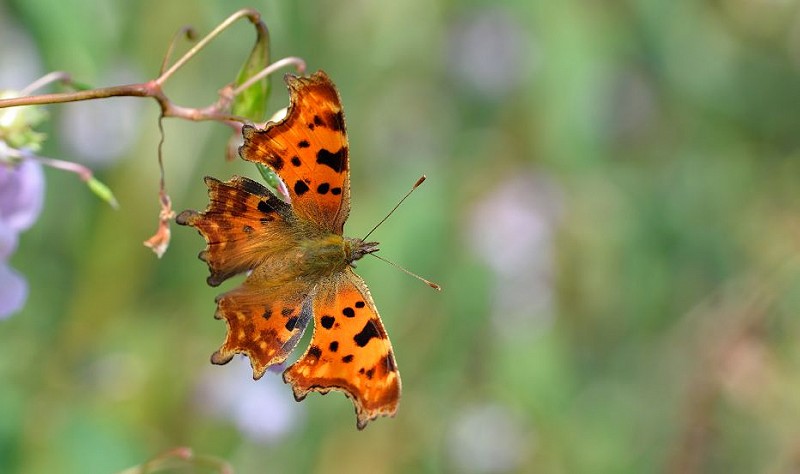
As the world shuts down around us the uplifting role that wildlife plays in our lives becomes more vital than ever. So, for my own sanity as much as anything, I’m going to keep a daily diary of what I find around my garden. Photograph the wildlife you can see from your window or in your garden and post your pictures on the ‘Sussex Wildlife Trust Nature Table’ page.
Day Twenty
April 6th 2020 – Michael Blencowe was out in his garden and saw a Comma butterfly.
He hadn’t seen one since November so it put a smile on his face.
April 6th 1860 – Montague Blaker was out in Southover Grange in Lewes when he saw a Comma butterfly.
Nobody had seen one in Sussex for about 40 years.
I can only assume he was so excited he cartwheeled naked down Lewes High Street.

(The Comma feeding on the willow today)
April 6th is a red-letter day for a beautiful orange butterfly.
160 years ago today the Comma returned to Sussex. It appears so punctually in our gardens each spring that its hard to think of a time when this butterfly was probably extinct in our county.
I've been confined to my house and garden for twenty days now. So I thought I'd pause today and insert a Comma into the middle of this prison sentence.
The comma is one ragged looking butterfly – it is unlike any other British species. With its jagged-edged wings it looks like it’s been dragged through a hedge backwards. But this angular attire is perfect for a butterfly that spends the winter hidden amongst dark dead leaves. Its crinkle-cut wings are dark underneath and when it closes them it blends with the background and the Comma chameleon vanishes.

(Spot the Comma. Love this great photo by Vince Massimo)
These dark underwings contrast with the vibrant orange upperwings which glow like the fiery furnaces of hell. In France the butterfly’s devilish good looks have earned it the name Robert Le Diable – Robert the Devil.

The butterfly’s wings maybe dramatic above but they're grammatical below . The centre of their dark underwings is punctured by a punctuation mark – a small silver comma that gives the butterfly its English name.

(The Comma with its comma)
In America a similar looking butterfly has another piece of punctuation on its underwings which has earned it the enigmatic name the Question Mark. I always mention this piece of trivia when I’m leading my butterfly walks and people always think I’m winding them up. But now I get the chance to prove it.

(A Question Mark photographed in Virgina U.S.A. by Judy Gallagher,)
(Admittedly when I then tell them there’s another butterfly called the semi-colon I am winding them up).
Many, many years ago the Comma was widespread across Sussex. Its caterpillars munched on the leaves of Common Hop plants and out in the fields hop pickers knew it as the ‘silver bug’ or ‘hop cat’. As England’s hop industry declined the Comma declined with it and new techniques of bine-burning and washing the hops with insecticides had a catastrophic effect on the butterfly. Sometime around 1820 the comma had mysteriously vanished from most of England and lugubrious lepidopterists mourned ‘the butterfly of our youth has left us for good and all’.
And so, 160 years ago today in 1860, the Comma’s triumphant return to the Sussex stage started with Montague Blaker’s encounter at Southover Grange. Over the next 70 years it remained extremely rare in Sussex until the 1930’s when an increase in Comma sightings marked the start of the butterfly’s reconquest of England. This time ‘round, with hardly any hops left to munch, the Comma grasped the Common Nettle as the main food plant for its caterpillar. By switching foodplants and hopping from hops to nettles the butterfly’s future was assured. In the Comma’s long history in Sussex it had paused and then continued. Today this Comeback King is common throughout the county.

(Comma photographed by Mark Monk-Terry)
Look out for them this week and let me know if you see one in the comments below or on the Sussex Wildlife Trust Nature Table Facebook page.
Comments
We also had our first comma, beautiful deep orange, in garden today and first orange-tip.
06 Apr 2020 12:15:00
I saw our first comma in our Lewes garden about a week ago. Plus brimstone, orange-tip and peacock. The peacock sunbathes on the same flower pot all day every day.
06 Apr 2020 13:42:00
How did that happen?…………..not 2 minutes after my Big Bird Watch yesterday morning, a beautiful Comma Butterfly landed on a shrub. Stopping to warm itself in the sunshine. My husband took a lovely picture, but not being a technophob I am not sure how to get it onto the Nature Table Page. Even worse was to come…..on wandering out into the garden this morning two Goldfinches were together hopping over the grass. They obviously didn’t get the message to turn up yesterday, so sadly, cannot add them to my list. Keep blogging Michael. Just Great.
06 Apr 2020 16:18:00
No Comma for us yet, but we have had an orange tip, a large white and a holly blue. We’ll keep looking for the comma.
07 Apr 2020 14:13:00
I saw our first comma at my back garden winton Bournemouth BH9 1NN & took photo
07 Apr 2020 19:31:00
Loving these diaries. Thanks for doing them. Saw my first comma on march 27th up here near Mayfield.
08 Apr 2020 16:28:00
I don’t think I’ve ever seen a comma. I had no idea about the punctuation marks! This is fascinating! I’ve also never been on a butterfly walk. I really want to do this now.
09 Apr 2020 21:50:00
Comma spotted in our garden adjacent to Horsham St Mary’s cemetery on the 9th of April. Much enjoying your diary.
11 Apr 2020 15:47:00