
Corona Wildlife Diary: Day Thirty
With the world shut down around us the uplifting role that wildlife plays in our lives becomes more vital than ever. So, for my own sanity as much as anything, I’m going to keep a daily diary of what I find around my garden. Photograph the wildlife you can see from your window or in your garden and post your pictures on the ‘Sussex Wildlife Trust Nature TableSussex Wildlife Trust Nature Table’ page.
Day Thirty
Thirty days. I've stopped reading the news because it's not really telling me anything new anymore. And, Donald Trump. So, if they do decide to let us back out, can someone message me and let me know otherwise I'll be sat in this bungalow for years like one of those soldiers still hiding out in the jungle believing that the Vietnam war is still on?
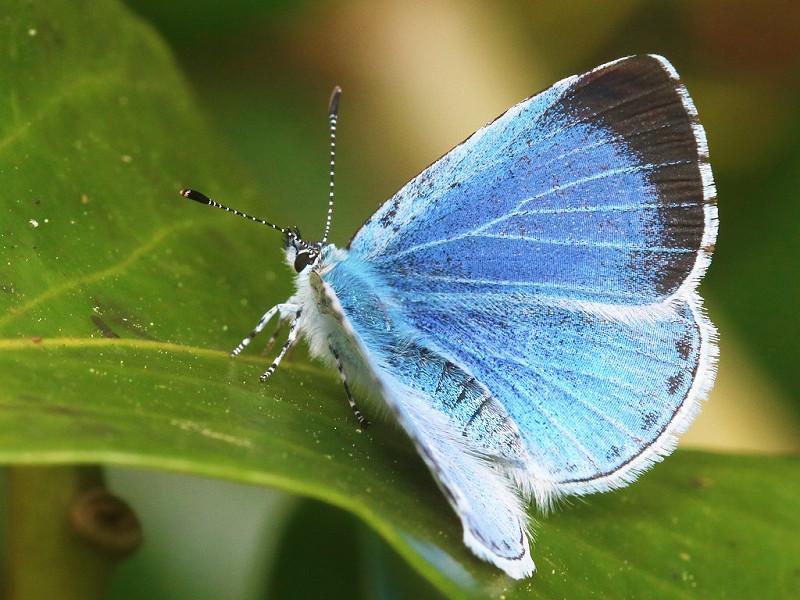
I do have some news for you though. I saw my first Holly Blue butterfly yesterday afternoon.
There are seven ‘blue’ butterfly species resident in Sussex, but during a global viral pandemic your chances of seeing them all are limited. Many of these 'blues' only survive in specialised habitats, such as chalk grassland or heathland, so they may be out of reach if you are quarantined in a two-bedroom terraced house in Haywards Heath for six months.
However, there are two ‘blues’ that are within reach of all of us during these challenging times. The Common Blue (Polyommatus icarus) lives up to its name. It primarily feeds on Common Bird's-foot-trefoil (Lotus corniculatus) and subsequently can be found in gardens, meadows and verges where this plant grows. But for many of us struggling through this Covid-19 pandemic an even commoner 'blue' will be the Holly Blue (Celastrina argiolus).

(Holly Blue photo by Nigel Kemp)
The Holly Blue is a true garden butterfly and the urban areas of Sussex (where most of us find ourselves at the moment) are the perfect habitat for this species. It's here that the Holly Blue finds abundant shelter and pockets of warmth amongst our territorial terrain of fences and walls. Crucially its larval foodplants, Holly (Ilex aquifolium) and Ivy (Hedera Helix) are abundant in our residential landscape.
The Holly Blue will have spent the wet winter of 2019/2020 in the pupal stage and will be emerging around about now as part of the year’s first brood (April-June). They will feed, meet and mate and the female will search our towns for suitable egg-laying sites. In the spring they lay eggs mostly on Holly. The caterpillars munch on the flowerbuds, pupate and produce a second brood (July-September) which emerges in the summer. Females from this brood will mainly lay on an alternative foodplant: Ivy. In some years a small third brood flies in October.
While other blues which are strictly confined to their communities like humans during a pandemic, the Holly Blue breaks all the restrictions and roams around our towns like some carefree super-spreader. You’ll most likely see it jittering around in the treetops where you’ll look up and glimpse its silvery grey underwings (unless you’re confined to a 6th storey flat in Hove where you’ll be looking down on the vivid blue of the upperwings). If it settles on a leaf, and you are lucky to get up close, you’ll see these silvery underwings are freckled with delicate black spots.

(Holly Blue photo by Neil Fletcher)
The butterfly’s population is intimately tied to a parasite – Listrodomus nycthemerus which exclusively parasitises the Holly Blue. This ichneumon wasp uses a slender ovipositor to lay eggs into the Holly Blue’s caterpillar. The wasp’s larvae feed and develop inside the caterpillar and an adult wasp emerges from the butterfly’s chrysalis. The result is a ‘boom and bust’ population cycle for the Holly Blue. The increase in the butterfly’s population is shadowed by that of the wasp until, when the wasp numbers reach their peak, the Holly Blue’s parasitised population is overwhelmed and spectacularly crashes. The wasp then has nothing to parasitise in subsequent years so, after shooting itself in one of its six feet, its population crashes too. This respite gives any remaining Holly Blues the chance to restock themselves…and the cycle starts again. This is why in some years you’ll see lots of Holly Blues whereas in other years you're left wondering "Where have they all gone?"
My friend told me the other night that the amount of time she is spending looking at exponential graphs has increased exponentially. So here's a more interesting graph I've drawn just for her

Perhaps we'll be seeing similar graphs to illustrate the Human / Coronavirus situation from now on.
One thing’s for certain, there will be a lot of Holly Blues flying around the empty streets of Sussex in 2020 thinking to themselves “Where have they all gone?”.
Comments
I find it amazing that you can relate so much wildlife to the world. Maybe in the future it will be used in history classes as a witness source of what happened? I have also bought some seed bombs to sprinkle in my garden to see if I can get more bees and butterflies. I will look out for blue butterflies if it grows!
16 Apr 2020 08:42:00
Fascinating stuff again, pretty sure I just saw one, it was certainly a blue butterfly.
16 Apr 2020 10:45:00
Beat you to it on the holly blues! Ours have been out and about for the past few days :-)
16 Apr 2020 20:48:00
I have seen two blue butterflies this week. One was on a local footpath and the other in our garden on the edge of Burgess Hill. This is a first in our garden and I felt privileged that it chose to flutter past me to land on a nearby leaf.
Loving your daily diaries Michael.
24 Apr 2020 16:00:00