
Corona Wildlife Diary: Day Sixty-two
Day Sixty-two.
Well, it's two months today since I started this diary.
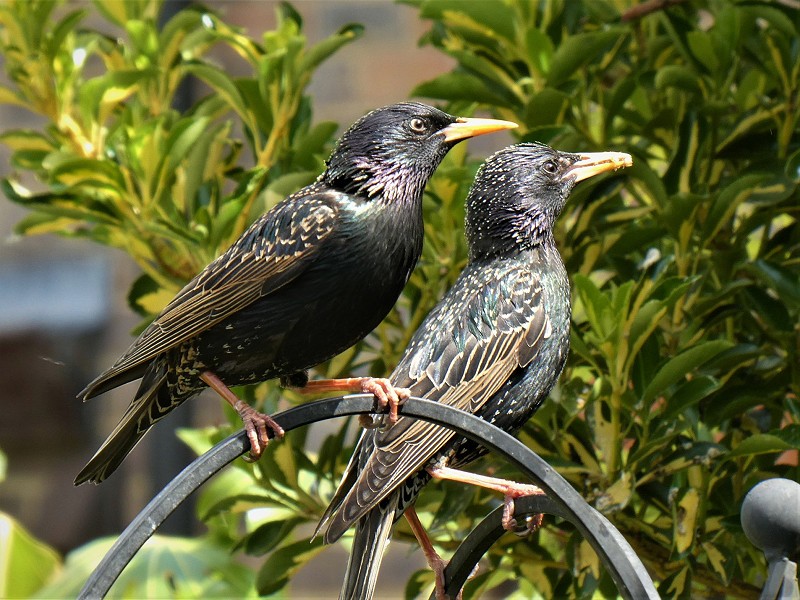
Yesterday, during the bird race, I watched some noisy young Starlings, just out of the nest, taking their first uneasy flights. Their parents were probably still building their nests when I started writing this diary on 18 March. Four or five eggs would have been laid at the start of April. It takes about two weeks before those eggs hatch and then about three weeks before the young birds leave the nest and now I'm watching that new generation of Starlings take to the air. In the time it's taken my local Starlings to raise a family, I've barely left my house.

Photo: Sarah Bonnôt-Tijhaar
After the bird race, I sat for a while watching the Starlings repeatedly flying from the garden to the TV aerial and my thoughts drifted to the world beyond the cul-de-sac and to a time when we could travel freely around the planet. A little bit of California Dreaming.
Late last year I was on holiday and cruising along Highway One on the foggy Pacific coast of California and passed a sign pointing to Bodega Bay.

According to my guidebook, this quaint coastal community is notorious for being the location for a most sinister film: ‘The Birds’ (1963). So, I took a quick detour. These days Bodega Bay is all organic coffee, art galleries, surfer dudes and flip-flops. Alfred Hitchcock has long gone, but flocks of Tippi Hedren's co-stars still sit ominously perched on telegraph wires as if unaware that the portly director yelled “cut” 56 years ago. But unlike the American hummingbirds, phoebes and chickadees I had seen on my trip these particular birds looked reassuringly familiar to me.

They are
Sturnus vulgaris, the European Starling, the same species I watch in my garden or wheeling around Brighton’s West Pier in their dramatic amoeboid murmurations. The problem is that Starlings, like me, are out of place in America. They shouldn't be here and are considered an unwelcome pest. The reason that Starlings are here in America at all is all thanks to Henry IV.
Well, ‘Henry IV Part 1’ to be precise.
Allow me to re-enact the bizarre turn of events that led to Starlings becoming established in America. It's a tragedy in three acts.
Act I: London, 1597.
William Shakespeare scribbles the word ‘Starling’ in his epic tale of power and treachery. With that feathered flourish of his quill Shakespeare would unknowingly be the author of an ecological catastrophe that would play out until the present day.

Act II: New York, 1877.
Enter stage right Eugene Schieffelin, a New York socialite who would later be remembered as “an eccentric at best, a lunatic at worst”. He chaired the American Acclimatization Society, a group which, despite their nationalistic sounding name, were very keen to welcome foreigners. In fact their aim was to import animals of economic or cultural interest from the Old World to the New. Schieffelin, a big fan of Shakespeare, had a dream: to populate America with every bird mentioned in Shakespeare’s writings. And so the bard’s birds were boxed up in England and brought to New York where, along with Skylarks, Pied Wagtails, Bullfinches, Nightingales, Chaffinches and many more, they were ‘liberated’ into Central Park. The majority of them died. But the society persevered and on March 6, 1890, 60 Starlings (a bird mentioned only once by Shakespeare) were released in Central Park and they fared better. Much better. Today, there are around 200 million of them across the United States.

Photo: Sarah Bonnôt-Tijhaar
Act III: United States, present day.
The story of the Shakespearean motivation behind Schieffelin’s bird release may just be an urban legend but the legacy of his misguided American Acclimatization Society is very real. Today, European Starlings are found all across America and are widely vilified by Americans as aggressive pests that have destroyed precious ecosystems and turfed out native species. Which is pretty rich coming from a bunch of invasive Europeans who have been doing just that for the past few centuries. Meanwhile their current leader before he started recommending you inject disinfectant, has been busy dismantling environmental regulations that protect wildlife, the landscape and our planet. But sure, let’s blame the birds.
As Mr Shakespeare (almost) once wrote,
"The fault, dear Brutus, is not in our Starlings, / But in ourselves”.

Photo: Sarah Bonnôt-Tijhaar
Comments
Very, very informative
18 May 2020 10:43:00
I love California Dreaming but I haven’t heard this version before – I use to listen to a The Mamas and the Papas! It seems strange to take all the birds in the plays abroad? Why didn’t the birds just fly back? Was it too far or they didn’t know the way? Little starlings are so cute!
18 May 2020 12:27:00
Like Michael, I have been watching the young Starlings in my garden. With at least five broods we have plenty to watch which begs the question, how do the parents know which are their young? They all look and sound the same to me, yet the adults seem to be quite certain which are theirs.
Sadly we also have one that seems to be disabled, he just sits under our seed feeder and doesn’t seem to be fed. When I approach him he flies off, but he appears to be unable to stand or walk and I suspect he won’t be around for long.
Plenty of baby Sparrows also and one young Goldfinch
18 May 2020 16:54:00
I’ve been trying to come up with a word that describes the distinctive sound of young Starlings, so characteristic of this time of year. There doesn’t seem to be one. What would you suggest?
Michael: I was stood in the garden trying to do the same thing earlier. Fizzy? Buzzy? Fuzzy? Maybe we should invent a new word for it.18 May 2020 19:50:00
Great post, Michael. Most enjoyable. And the Starlings completely consume a fat cake in my feeder in 24 hrs!
19 May 2020 10:07:00