
Corona Wildlife Diary: Day Forty-nine
With the world shut down around us the uplifting role that wildlife plays in our lives becomes more vital than ever. So, for my own sanity as much as anything, I’m going to keep a daily diary of what I find around my garden. Photograph the wildlife you can see from your window or in your garden and post your pictures on the ‘Sussex Wildlife Trust Nature Table’ page.
Day Forty-nine
Picture this.
15 June 2012. A suburban Sussex cul-de-sac. A 'FOR SALE' sign hangs outside a bungalow. Three figures, a smartly dressed estate agent, my wife and I, are stood in the back garden staring at a pond.
Me: "Is it me... or is that pond shaped like a..."
Estate agent: "No. It definitely is shaped like a..."
Wife: "What would possess someone to build a pond that shape?"

Estate agent: "It looks even more impressive when it's turned on".
My wife and I stare at the estate agent. The estate agent disappears into the greenhouse, flicks a switch and a water fountain the pond springs to life, sending a jet of water high into the air.
We both stare silently at the pond for a few seconds, then look back to the bungalow, then turn to the estate agent and say simultaneously "We'll take it".
I've told the story many times of how this unusually-shaped pond clinched the deal when we bought our bungalow. But it's not the only vulgar thing you'll find lurking in the garden though.
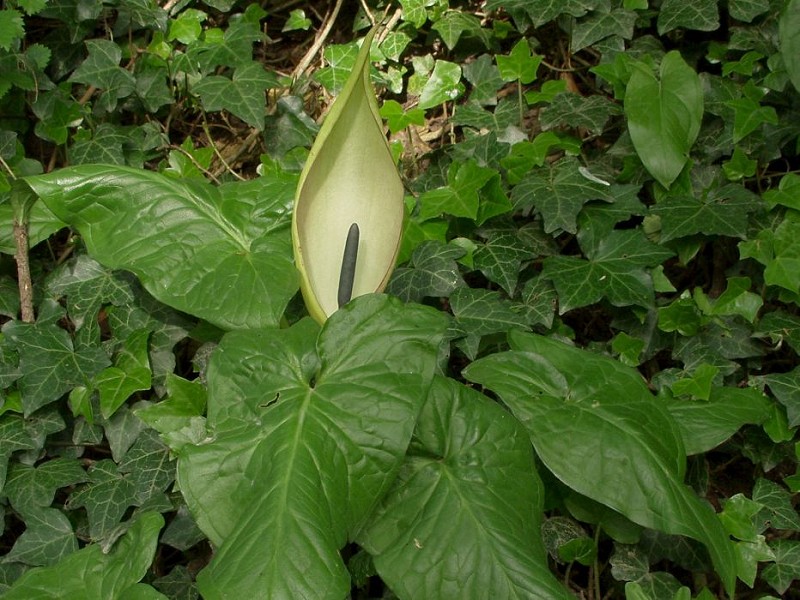
Arum maculatum is the most dangerous plant in the British Isles. I'm not referring to its highly toxic berries. No, this wicked plant possesses the power of suggestion. It's a plant that can steer the most pure-thinking botanist down the path to innuendo and obscenity, like a tiny hybrid of Benny Hill and a Triffid hiding under the hedgerow.

(My Arum maculatum lurking by the compost bin)
Each spring a most bizarre plant appears in our countryside. Above shiny, speckled, trowel-shaped leaves arises a pale hood (the spathe). This hood cloaks a purple poker-shaped flower-head (the spadix) a stinking beacon which gives off that sweet smell of decay so irresistible to insects. Flies are hypnotically drawn into the plant and are imprisoned by stiff bristles forcing them deep inside the hood. Here in the plants dark depth's they unwittingly pollinate the plant's female flowers. After this pollination the male flowers develop, coating the insects with their pollen. Finally the guard bristles, which have held the flies in their jail cell start to wilt, releasing their prisoners to who buzz off the pollinate another plant.
In the autumn, the pale hood drops to reveal the fertilised female flowers which have now developed into striking orange and red berries; a poisonous, lumpy lollypop.

(Photo by Neil Fletcher)
It is a complicated and convoluted pollination process - but it works perfectly. What is even more fascinating than this entire performance is the huge array of common colloquial names that have been given to this plant. A few refer to its unusual appearance; ‘Parson-in-the-Pulpit’, ‘Solider-in-the-Sentry-Box’ – but it seems that most people when they are confronted with the plant see something altogether more obscene.
Over the centuries botanists have stared at this floral Rorschach test and have likened the appearance of the spathe and spadix to human male and female genitalia.
The plant has earned itself a lewd lexicon of local names. ‘Mens & Womens’, ‘Adam & Eve’, ‘Cows & Bulls’ - names which have all given rise to its most commonly known title; ‘Lords & Ladies’.
I wonder how many people use this name not knowing that they have been lured in by the plant’s vulgar charms? There are plenty of other ‘colourful’ titles for this plant too – some so vulgar that I dare not put them in a high-brow, erudite blog such as this (although Willy Lily is my favourite).

(Photo by Dave Kilbey)
I’m just proud that I haven’t been perverted by this plant. I’ve always referred to it as Cuckoo Pint. – a wonderful evocative name, recalling the proud, lustful cry of the spring cuckoo and pint which means, well, I’m not sure. Strangely I’ve always pronounced it as ‘pint’ to rhyme with ‘squint’ not pint as in ‘of Harveys’. I wonder why?
Ah, here it is. “Pint. An abbreviation of the Old English word 'Pintel' which means:


Comments
I learn more and more each day. But its the feeling of learning French swear words on a field trip.
05 May 2020 09:23:00
The opening of this would make an excellent episode of Midsummer Murders! Have you ever considered teaming up with them and doing some script writing? Also, I can’t believe this has waited until day 49! What else do you have in store for us? I’m so pleased to read this because yesterday I made a washing up bowl pond with support from the Lancing help desk. I even used my spirit level. Can’t wait to buy some bulrushes or something and for it to rain and fill up. I am hoping for a few frogs! Are the berries poisonous to everything or can animals eat them?
05 May 2020 11:30:00
Made me laugh! I too have this in my garden and call it cuckoo pint or lords and ladies. I had no idea what the origins of these names were but am now suitably enlightened. Thank you.
05 May 2020 14:47:00
The leaves are highly toxic too (full of oxalic acid) and are sometimes mistaken for wild garlic by foragers.
05 May 2020 22:26:00
Thank you for leading me to this, Michael. I’m loving it. Day 49 made me laugh too….
06 May 2020 06:18:00
Great story Michael. Changing the subject, there was a ring necked parakeet in the garden yesterday using the bird bath and feeders. I found out this morning they are really quite common in the SE but never seen one in Ovingdean before.
06 May 2020 08:26:00
Oooh err Mrs! Thanks Michael!
06 May 2020 09:25:00