
Corona Wildlife Diary: Day Fifty-eight
This weekend's Back Garden Bird Race will be Sunday 17 May (10-11).
All the information, rules, I.D guides, downloadable phone app and t-shirts are on the Bird Race website here
Day Fifty-eight
There comes a time in everyone’s life when they tire of the fleeting distractions and amusements that our modern society has to offer. That day came to me at the age of five. So I became a naturalist and discovered an alternative universe of endless fascination and wonder. While my peers sat indoors with their Action Men and Ataris, I’d be found on some desolate, windswept estuary scanning the mudflats with my binoculars. But, brothers and sisters, I have a confession: I fell into a life of sin. My humble local ramblings turned into an obsession and soon I was travelling all over Britain just to get my fix of rarer and rarer species. But then… I saw the light.

My first encounter with a moth trap was a religious revelation. I remember flicking the power switch and standing bathed in that blinding Mercury vapour glow, baptised by the bulb, as moths swirled like cherubs around me. Next morning I raced down to the trap at 5am, as excited as a child on Christmas Day, and opened my box of surprises. Pink elephants, carpets, brocades, tigers and emeralds. A fantastic wealth of wildlife. I was immediately converted. Why travel to watch wildlife when, through the magic of a moth trap, you can let the wildlife come to you? A strange new world was revealed every evening right there in my own back garden. It’s a thrill which has never left me.

We all know that moths are attracted to light. We’ve all seen them battering against the bedroom window or flying laps around a lightbulb. Yet we don’t know why they do this – there are many theories. It bugs me, but if the moths ever start talking, it’s going to be the first thing I ask them. This attraction can be exploited by naturalists to allow them to study moths. Moth traps have many designs (but they’re basically a bulb, funnel and bucket) and are packed with egg boxes, offering a cosy one night’s accommodation for the moths, which can be identified, recorded and released unharmed the following day.

There are different types of trap you can use. Robinson traps are the most effective but the most expensive. Skinner traps are a great way to start and are cheaper or, if you're nifty with a saw, can be built yourself. Or you can design your own trap. The Blencowe Mothmatic 2000 was made from an old storebox, an upside-down lampshade and plywood. I had to buy the electrics, but it worked pretty well.
There are other ways of getting closer to some amazing moths - use a white sheet, a torch or simply leave an outside light on. Here's a piece I wrote for Springwatch years ago (here)
For the first year, my neighbour assumed my nocturnal light signals were attempting to call occupants of interplanetary craft (and she seemed to find the fact that I was trapping moths even more eccentric). I’ve travelled with my trap all across Sussex lighting up our remote coombes and woodlands like Las Vegas (which sometimes also attracts passing ravers in search of a wild night out).

(Not sure if these people are wayward ravers or just attending one of my public moth trap sessions)
So, for those of you who may not be familiar with how a moth trap works, here's a short guide to setting one up.
I usually choose the corner of the garden where there is a bit of shelter

...then I lay down a white sheet. This makes it easier to see moths which land near the trap so the first rule of moth trapping is never stand on the white sheet. Any sheet will do. This one came straight off the bed.

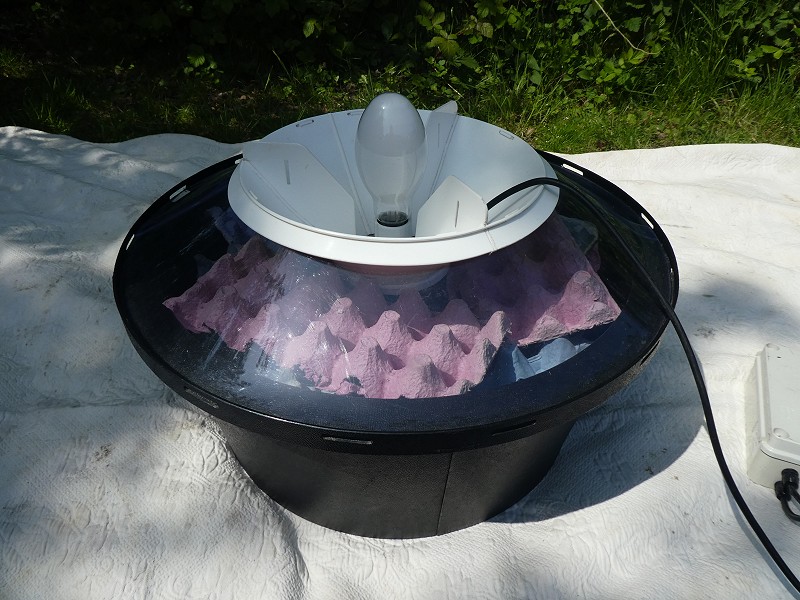
I'm going to be using my Robinson design moth trap tonight. It's basically a bucket

...with a see-through perspex collar.

The unit on top is a funnel with a light bulb.

This is a mercury vapour bulb. They are extremely bright and you will either have to have very understanding neighbours or despise them so much that you take great pleasure in keeping them awake at night. You can use less powerful Actinic bulbs, which are more neighbour-friendly.

The deal is that the moths fly towards the light and down the funnel. We put a load of egg boxes inside the trap. This gives the moths somewhere to settle and makes it easier to study them in the morning. (I was reading that there's been an egg box shortage during the pandemic. That's because I have them all).

Then you layer the egg boxes inside the trap

...and you're ready to go.

Oh, I almost forgot. I worry that early birds may get out of bed before me and eat any moths on the sheet. So I put down Sam the snake to scare them off.

The trap's all set. I'll turn it on tonight as it gets dark. Check back in tomorrow to see what was flying around in the garden at night.
Comments
Sam the snake scared me! Is he the one from the pond? OMG you’ve been on Springwatch? I had no idea you were so famous! I looked in the shop for a Blencowe Mothmatic 2000 but they must have sold out. I might try this with my disco light instead. Also, did you paint the egg boxes? They are such pretty colours. I will defo be checking back in tomorrow. Also Bird Race T-Shirt!!!!! Brilliant idea! I really want to buy one but the shop links are broken. ☹️I will try again tomorrow. I’m defo stocking up on bird food ready! 🦅 Hooray! 😀
14 May 2020 13:03:00
Just checked the links and they seem to be working fine – so you should be able to choose your t-shirt design / colour and order one. Thanks for your support!
https://sussexwildlifetrust.teemill.co.uk/collection/back-garden-bird-race/
14 May 2020 14:04:00
I just bought a Skinner trap with double actinic bulbs (20w each) white polypropylene because the Robinson traps I’ve seen are a bit large for our little garden. Also, our neighbour is kindly doing some lockdown shopping for us so I definitely want to respect him and his family. Is there any particular way to lay the egg boxes in this trap (internal space is restricted by the sloping top clear perspex sheets) please? I obsess about geometric patterns in 3 dimensions but I’m pretty sure the moths don’t mind. Vertical or horizontal stacking is another choice and this may affect moth catch – this bit is a serious question please.
These cold clear nights have not been conducive for mothing though. Likewise I have yet to record a single bat over our garden yet. Our little garden backs onto fields so it may be down to the impoverished wildlife in our agricultural landscape rather than the weather. I don’t blame farmers though – they are facing up to the challenge of feeding an ever burgeoning human population.
14 May 2020 23:05:00
Michael’s enthusiasm is infectious, if you get the chance when normality returns, Michael gives the best nature talks in Sussex (or anywhere) – humerous, fast paced and very informative. I bought this actinic moth trap a few weeks ago (mains operated) and it has increased the number of moths. I used to get good numbers round my balcony light but this has increased them and the light is not intrusive: https://www.watdon.co.uk/acatalog/E7592-40W-heath-trap-mains-operated.html
18 May 2020 09:25:00
Hi,
Is your Robinson trap a commercially available one or home made?. If it’s home made would love to know where you sourced that bucket/tub, transparent collar and funnel please.
Thanks
09 Aug 2022 22:06:00
Sussex Wildlife Trust:
Hi Andy. A variety of moth traps are available here
https://www.angleps.com/shop-all/moth-traps