
Carved in stone
The turf-covered shingle ridges of Castle Farm and Castle Water, near Rye, are too inhospitable for oak trees but all the same there’s a small clump of them just south of Camber Castle itself. Few of the walkers who enjoy the open sky and wildlife of Rye Harbour Nature Reserve notice this rounded copse however, let alone comprehend its significance.
He had joined the RAF in 1936 so was already an experienced pilot by the time the Battle of Britain began and had already been in two engagements with the Luftwaffe that afternoon. Once the morning rain had cleared, Hamilton led A Flight of 85 squadron against enemy aircraft over Maidstone before flying south to attack a huge mass of 300 bombers and fighters crossing the coast at Hastings. Back at base, Hamilton hurriedly wrote up his combat reports – you can find them in the National Archive – before scrambling again in the early evening.
Once more, his section intercepted a large formation of bombers, but when it became apparent that they had been lured towards a far superior fighter escort, the Hurricanes were recalled. Two aircraft failed to return, one of them Hamilton’s which had plunged into the old storm ridges of Winchelsea Beach. His body lies in the cemetery at Hawkinge. For more detail visit our webpage by clicking here.
That first oak, planted in a hollow to avoid the ever-present wind and to give its roots closer access to the water table, has survived and even multiplied over the years as acorns were thrown north-eastwards by the prevailing wind. Four trees now form a green dome close to Castle Water but until now have constituted a memorial stirring little recollection even though they form part of a historic landscape which bears the relics of military campaigns from the fourteenth to the twentieth centuries.
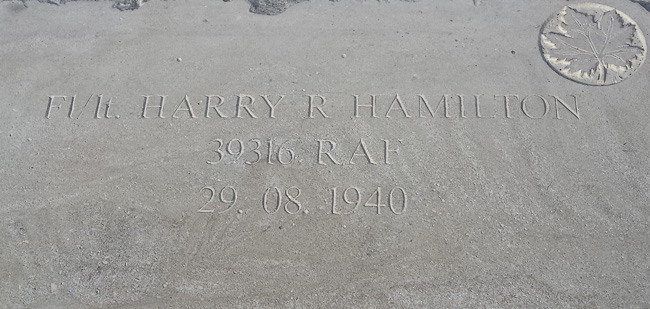
To revive awareness of this brave pilot’s fate, the Friends of Rye Harbour Nature Reserve have, this year, called on the joint expertise of aviation museums, and historians to install an unmissable carved stone close to the “Hamilton’s Oaks” - as we have started to call them. The Environment Agency kindly donated and transported the block, which was once part of the ill-fated Smeaton’s Harbour. Into this, local stonemason James Tomlinson has carved Harry R Hamilton’s name, rank, number and date of death, along with the Canadian maple leaf.
Frank Langrish arranged for the finished work to be trundled into position just east of the oaks and on Battle of Britain Day, September 15th 2016, it was dedicated by the Revd Canon David Frost before a group of those who had helped to bring this project to fruition and members of the Royal British Legion. Wreaths were laid by the RAF/RBL, the Battle of Britain Historical Society and the Shoreham Aircraft Museum. A Canadian wreath was laid by Hugh Sutton (lower photo), son of the man who’d planted the first tree, thus completing a task begun seventy-six years ago by ensuring that Hamilton’s name will now not be forgotten.


Words by Cliff Dean, Chair of the Friends of Rye Harbour Nature Reserve
Photos by James Tomlinson