
Big flocks and loners
By Ronnie Reed
Volunteer
January has reached into her hat and pulled out heavy grey, rain laden skies with curtains of black clouds sitting on the crest of the
January has given us rain; sliding off the Downs, running down paths, pouring down banks, oozing across tarmac, filling ditches, swelling rivers and then she has thrown in wind; tugging at the guy ropes of the hills, sweeping across open grassland, crashing through woodland, threatening windows and doors.
Grey days, indoor days, in front of the fire days, read a good-book days, lack of Vitamin D days.
But also days for putting on the wellingtons, pulling on the waterproofs and getting out despite the weather. A good time to check out the bird life. The birds are definitely out there even if we aren’t!
Imagine a field, wet and sticky with white chalky soil, sloping gently down to a muddy track and a hedgerow threading its way along the path. There are brambles, splashes of red where the last rose hips dance in the wind, and black, bare tangled hawthorn and blackthorn bushes. Dotted along the hedge are tall ash and sycamores, their leafless arms stark against the grey backdrop.
Suddenly, the ash tree in the middle explodes and lifts into the sky as dozens of rooks take wing, spanning out on all sides, filling the late afternoon with their raucous cries. They rise, gain height; fan out and with slow flaps of the wing fill the sky. They drift on the wind, turning and wheeling through the grey air, move into the distance following the line of the hedgerow and then slowly they drop one by one into the outstretched arms of another tree, fidget and then settle as silence falls once more across the field.
The rooks disturb their neighbours. A flock of woodpigeons, their soft blue-grey plumage blending with the bare dark grey-green winter branches in which they are perched, take off in a flurry of frantic, clumsy wing beats that lift them out of the trees to head across open sky and fields towards the next stand of trees.
The flock of fieldfares silhouetted against the sky in the top branches of the trees further along the hedgerow pick up on the commotion and are gone in a second, white rumps flashing as they disappear.
In the distance a cloud of starlings wheel and turn along the headland of the field; synchronized aerial stunts on a grand scale.
The dense bramble, hawthorn and blackthorn provide cover for smaller flocks of birds. Great tits rub shoulders with their blue tit cousins as they hop from branch to branch. They share the undergrowth with chaffinches and noisy sparrows. Guests come and go: travelling bands of acrobatic black and white long tailed tits flitting from bush to bush, and brightly coloured flocks of gold finches with their striking red faces and a flash of gold on their wings.
And then there are the loners; the robin that declares his territorial rights from the top of a hawthorn bush and the tiny, tipped-up-tailed wren that flashes across the path and disappears into the dense undergrowth at the bottom of the hedge. As daylight fades, a solitary thrush pours its song into the quiet afternoon and a startled blackbird gives a cry of alarm. It is echoed by the yaffling call of a green woodpecker bobbing across the field.
Above, somewhere in the grey clouds a buzzard mews to its mate.
Follow the field over the rise to where it drops away to the flooded meadows that lie alongside the river and there are flocks of seabirds driven inland by storms. Black-headed gulls stand stiffly head into the wind. They have lost their distinctive summer black hoods for dark smudges just above and below their eyes. They take wing briefly, moving as one and then settle once more onto the grass. Their movement disturbs a smaller flock of grazing lapwings. Smartly dressed in black and white they take flight, wheel and turn gracefully with the wind and then drop once more to the ground.
Beside the ditch that runs across the water meadows, a family of mallards strut backwards and forwards and around each other. A pair of moorhens bolt across the grass, legs flaying behind and disappear into a clump of reeds.
Here too there are loners; the grey stooped, shoulder hunched heron that stands in the middle of the field and his foreign cousin the little egret that picks his way carefully along the river bank at low tide, and the long throated cormorant that appears and disappears as he swims downstream.
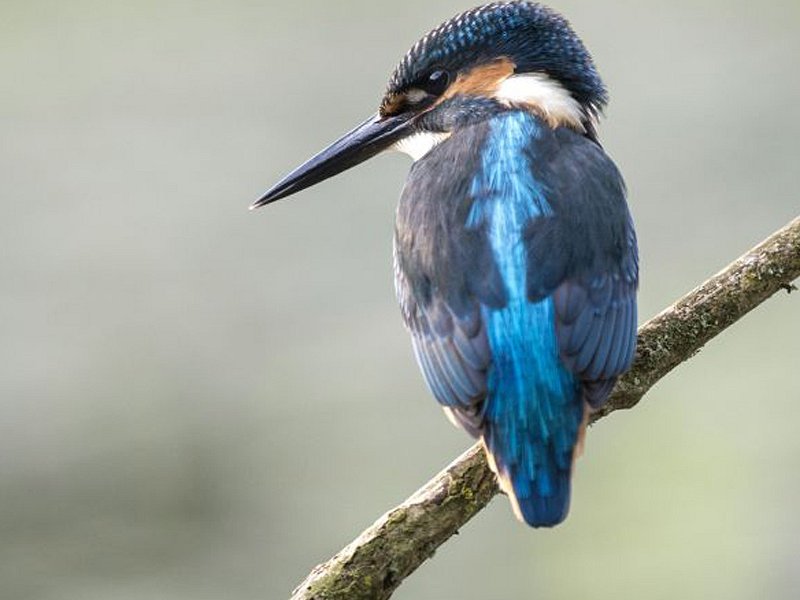
And then occasionally and briefly there can be a moment of magic, a flash of brilliant blue gone before the watcher realises, as a lone kingfisher darts across the river.
Do you really want to stay indoors?