
Between a rock and a hard place with John Cooper
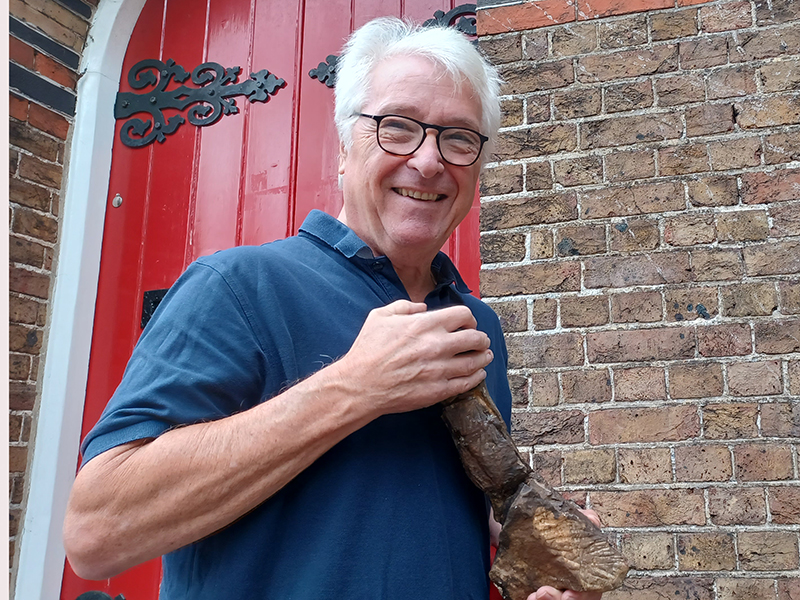
We talk to John Cooper, Emeritus Keeper of Natural Sciences at the Booth Museum of Natural History
Why is geodiversity important?
It gives us levels of understanding about where we came from. Humans tend to look at things through a human lifespan, so we judge things that happen as catastrophes if they impact a generation. For example, we can't grasp how long a million years is. When I give talks, I challenge people to guess how long a million seconds is. Children and adults guess very differently - but nobody gets it right. Geology is a philosophical subject. Nothing happens in front of your eyes. Except volcanoes erupting!
*answer below
Tells us about your lifetime love of geology and your work at the Booth Museum
I did a degree in Geology and a postgraduate diploma in Museum Studies at Leicester University, spent a year teaching on VSO in Nigeria, then returned to Leicester to work in the Earth Sciences Section of Leicestershire Museums Service.
In 1981, I moved south to take up the position of Keeper of Geology at the Booth Museum of Natural History and held that role for almost 35 years. The role evolved of course, but it did include a lot of museum admin. Now I've retired, I volunteer, which means I can just do the bits I like.
But geology was my first love, inspired as a boy searching for treasures along the shoreline of Holderness in East Yorkshire with fossils being my favourite finds. The Booth Museum was a satisfying route to convey my enthusiasms; teaching, exhibition, research, community work, and identification services, which all become part and parcel of a curator’s day to day work, as well as historic and scientific studies based on the collections.
The geological collections in the Booth Museum are excellent and form the core for a wide community of people interested in geology. A few of the best items from the collections include excellent Chalk fossils, dinosaur bones, superb crystals and minerals.
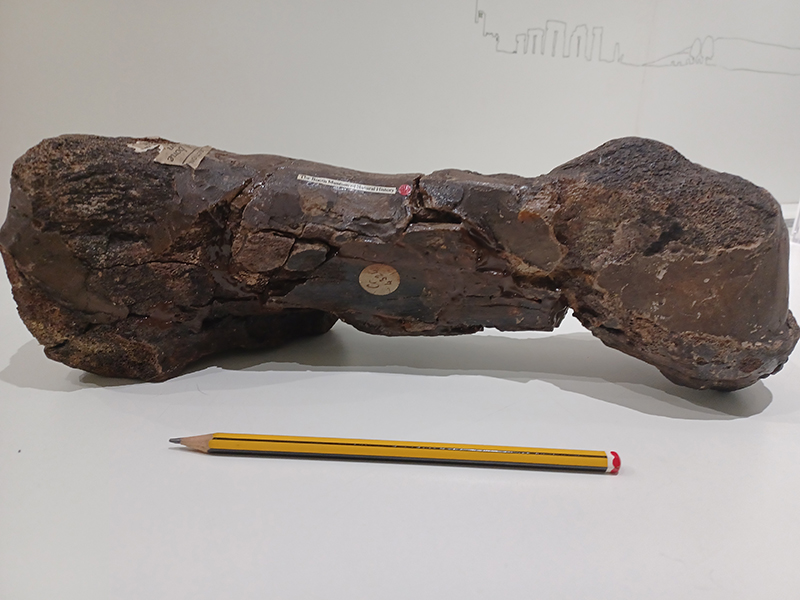
I established the Brighton and Hove Geological Society in 1984, still going strong, began major research into our holdings of dinosaur bones found at the very dawn of dinosaur discoveries, as well as exploring the wider geological and historical context across Sussex. This dinosaur research led to publications about these early collections – made by George Bax Holmes (1803-1887) of Horsham - and one of his specimens – a toe-bone some 35 centimetres long remains my favourite fossil [below] having induced gasps of incredulity from audiences young and old for many years. I even took it on The Big Breakfast show once. It took some doing, bringing it back on the train (the bone isn't heavy, but the protective case is very heavy).
Why is it so important?
A geological curator's interest in local geology enhances the geological collections which mostly reflect local rocks. And since it is the rocks all around us that greatly influence fauna and flora as well as underpinning human development from its first days, it helps to understand not only the rocks themselves but also the deeper Earth structures. Thus, it is the Chalk which controls the Chalk downland habitats and in turn, its chemistry controls the plant and animal species which inhabit them. So as a geologist in the Booth Museum from where already data on species distribution and special knowledge flowed to augment Sussex biodiversity, it was only natural that the rather newer concept of geodiversity should also make an appearance.
In practice, geological conservation required knowledge of where in the County geology could be seen and so the Museum began to collect, with volunteer assistance, information about the state and status of locations – quarries, riverbanks, sea cliffs etc, where raw geology could be seen. Such information is valuable to many groups of people – teachers, planners, special interest groups, etc. In the end we had about 7000 sites recorded from published sources – an invaluable resource.
Through a nationwide initiative called Regionally Important Geological and Geomorphological Sites (RIGS) we began to identify those sites of greatest importance, identifying in all some 127 sites of significance.
Tell us about your involvement with Sussex Wildlife Trust and the Sussex Geodiversity Partnership
I served on the Council of the Sussex Wildlife Trust, offering my services to widen the role of the Earth sciences in its deliberations. The Trust began to recognise more fully reserves which had a significant geological component and soon acquired its first reserve with exceptional geological features – *Marehill Quarry, Pulborough. The Trust continues to embrace the earth sciences in its values.
Geological conservation has significant differences to biodiversity and so a band of geologists have continued to further its cause, keeping it within the broad umbrella of wildlife conservation but separately managed. Hence the Sussex RIGS Panel became the Sussex Geodiversity Partnership in 2011, with the aim of promoting and protecting geodiversity in East and West Sussex and the city of Brighton and Hove.
On Thursday 6 October, International Geodiversity Day, the Sussex Geodiversity Partnership is launching our new and improved website link here
*11 and a half days
** An abandoned sandstone mining site, not open to the public, but of great interest to geologists