
Beginning Birdwatching at Rye Harbour Nature Reserve
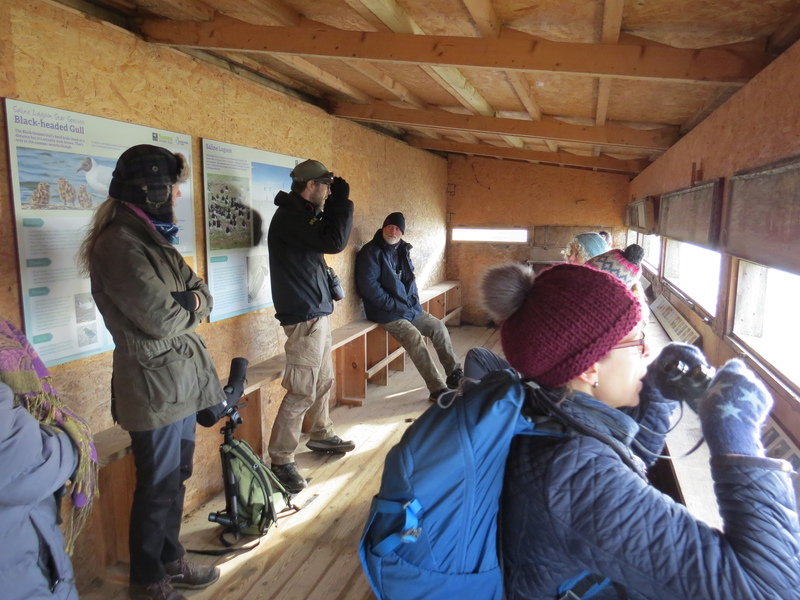
Guided walks are a frequent treat here at Rye Harbour Nature Reserve but our Beginning Birdwatching walk, led by James Duncan, is a new walk for this season. Kathy Crowther joined the first walk, to find out more.
The first walk took place on 17th November, after two days of ferocious wind and rain, here at Rye Harbour Nature Reserve. Although the walk was fully pre-booked, we were worried the weather would lead to low numbers on the day but the morning turned out considerably drier, even sunny at times, so most of the would-be birders who had booked places came along, creating a well-attended and very enthusiastic group.
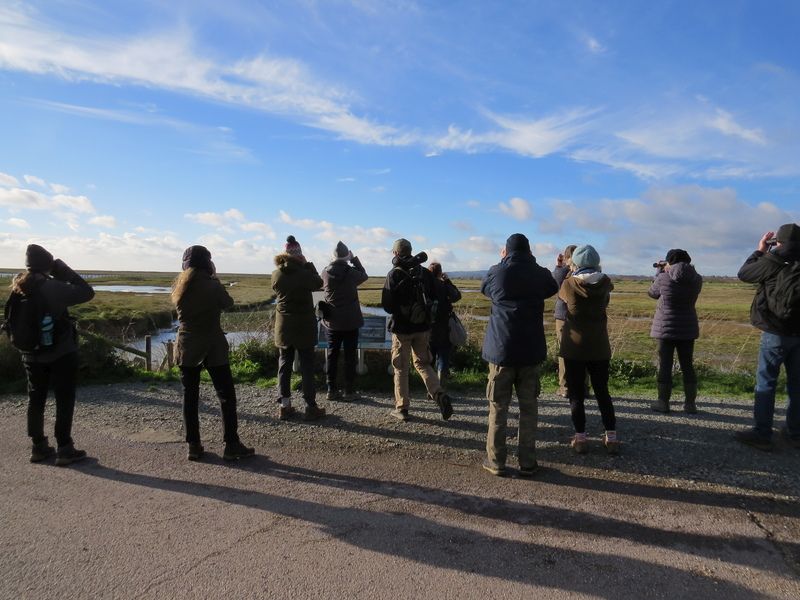
Binoculars in hand
Activity began from inside the Discovery Centre, with James introducing himself and loaning out binoculars to those wishing to enhance their bird-spotting experience. Our first tutorial then took place directly outside the Discovery Centre, with a Little Egret in the saltmarsh obligingly providing a focal point for binocular training. James gave easy to follow instructions on setting up the binoculars, to help people familiarise with different models or to adjust borrowed binoculars to suit their own vision. James then offered hints and tips on getting the most out of a pair of binoculars – for comfortable, effective use and for spotting and studying birds.
Getting going at the Gooders Hide
Then, full of expectation and anticipation, we all walked along the path to the first stop, the Gooders Hide. Here, James gave a few details on the number of native bird species in the UK and how this is boosted across every year by the vast numbers of migrant birds visiting – including the many who stop off at Rye Harbour Nature Reserve, either to over-winter or to feed as they pass through. Then, a quick pop-quiz on what’s tricky about birdwatching – general consensus being that they’re fast and they don’t stay still - showed that many of us are aware of exactly why we find it hard to identify what we’re seeing! This also set a challenge for James, to help us overcome these difficulties.
And he certainly tried, starting with useful tricks about what else to be aware of beyond the bird itself, such as comparative size with other birds, the habitat the bird is in and whether it’s a season when we’d expect to see the species on the reserve. Then of course the actual bird – its posture, size, notable colours and useful tips on which parts of the bird’s anatomy to study closely for distinguishing features. At this stage, we were all putting those binoculars into practice to identify the differences between ducks – Mallard and Wigeon on the saltmarsh close to the hide, whilst the Brent Geese in the far distance offered good examples for discerning features of distant birds on the water, to help with identification. The presence of Redshank also gave us good practice, although the fantastically fast-moving Meadow Pipit was a challenge too far for most of us.
Walking into the wind
Then it was off to the next hide, but with a couple of stops on the way to scope the saltmarsh areas, with Golden Plover and Lapwing in flight. At the end of the main strip, there was the opportunity to scope the harbour mouth, with James explaining the differences between the Herring Gull and Great Black-Backed Gulls, which had a visible presence around the harbour.
This part of the walk was incredibly windy but, as James observed ‘it’s a shame about the fierce wind, but tempestuous weather is rarely a rarity at Rye Harbour Nature Reserve!’ In fact, at that moment the wind was helpful for our task as a Little Egret, making slow progress overhead against the wind, gave us below it a good chance to study its yellow legs, a good feature to help with their identification.
Ducks at the Denny Hide
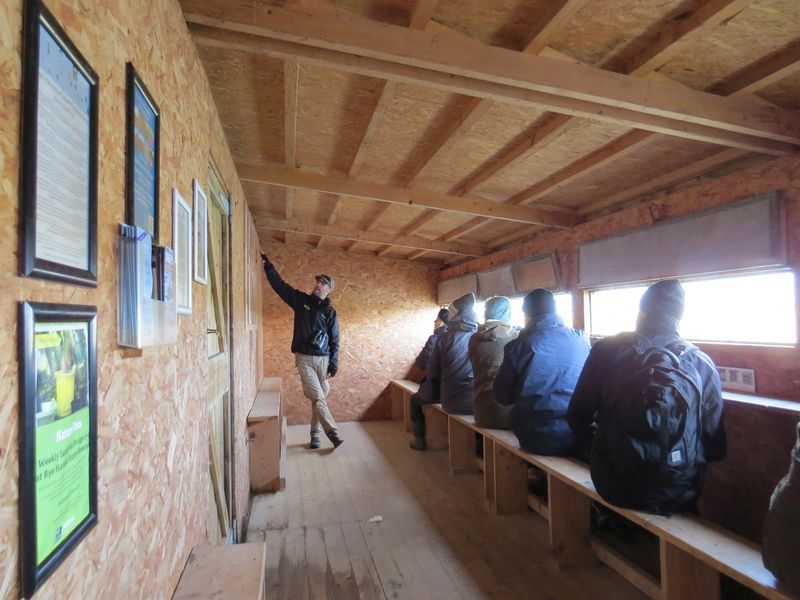
Next stop was the Denny Hide, where the close presence of a small Shoveler flock gave James the opportunity to describe the further challenge of identifying not just the species, but whether it’s the male or female in view. With Tufted Duck also alongside, James was able to teach us about using duck activity - dabbling or diving – to help with identification.
Lapwing were also very present, and it was good to be able to distinguish and identify these, both at rest on the little islands and flying around the hide area. Cormorant, Brent Geese and Coot offered useful extra practice for identifying birds at a distance, whilst a pair of Little Grebe gave us practice in speed-scoping to spot something special before it disappears under the water.
Practising at the Parkes Hide
From here, it was into the Parkes Hide, where a Little Grebe, immediately close to the hide, gave great practice in seeing more of this little bird, with an animated discussion about ‘expected’ size having an impact on precise identification. This moved us smoothly into a bit more identification practice, with the interpretation mural and bird species graphics on the walls of the hide providing useful prompts for discussion and for a quick game of ‘spot the difference’ between Black-headed Gull and Mediterranean Gull.
The final stretch and some superb spotting
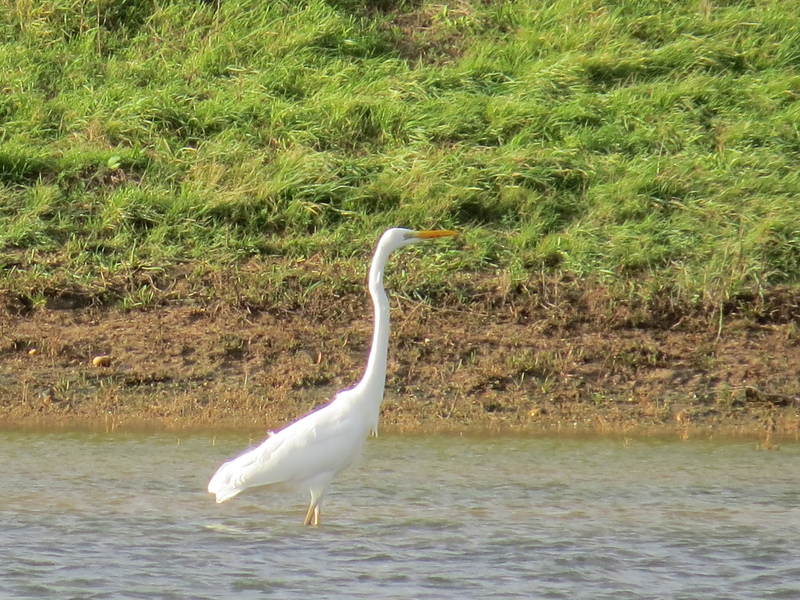
The last stretch of the walk led us back to the Discovery Centre, but not before being treated to an air display from flocking Golden Plover and Lapwing, giving James the chance to explain the differences between the two species, when in flight. Then, an unexpected surprise as one of the group spotted a Great White Egret, in an upright posture, paddling along on the far side of a saltmarsh. Having started our birdwatching walk with a hunched over Little Egret, this gave us the chance for a direct comparison and another ‘spot the difference’ challenge.
Then, a final treat as a flock of approximately forty to fifty Curlew took to the air. James had earlier helped the group to identify these with the tip ‘it calls its own name’ and this was perfectly demonstrated as flock took flight.
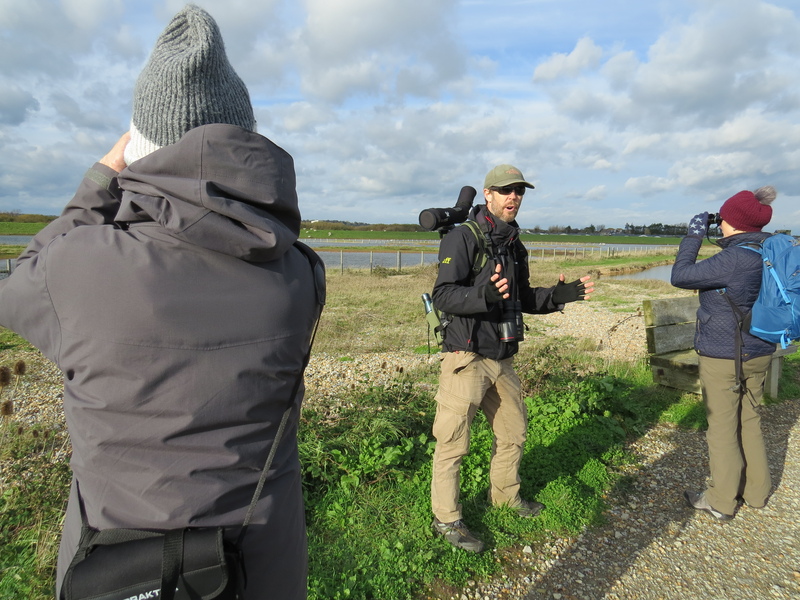
Beginning Birdwatching with James
As the walk finished, one member of the group, who has newly moved into the Rye Harbour area, said with delight: ‘James’s birdwatching course was fantastic and has given me the confidence to really start identifying birds.’
This was good news for James, who shared afterwards that this is exactly what he wanted to accomplish: ‘Hopefully new skills in identification were learnt and everybody left feeling a tad more confident in knowing just what it was they were seeing. Roll on the next one in December!’
There certainly will be another chance to begin birdwatching with James on 16th December 2022. These walks are currently free thanks to the National Lottery Heritage Fund. Please check on the Sussex Wildlife Trust events page for more information.