
Badger baby boom
By Charlotte Owen
WildCall Officer
Badgers have spent the last couple of months mostly underground. They don’t hibernate but do spend a lot of time asleep in their setts, emerging occasionally to forage but otherwise surviving on fat reserves laid down last autumn. Now that their long winter snooze is over, badgers are busily spring cleaning their setts: digging out old soil and replacing dirty bedding with fresh grass, leaves and moss. Sett maintenance is a constant chore but badgers pay particular attention to hygiene at this time of year as they prepare for new arrivals.
Females deliberately give birth in winter so that their cubs will emerge from the sett when the weather is mild and invertebrate food is plentiful. This maximises the time they can spend eating, growing and putting on fat to survive the following winter. Badgers can mate at any time of the year and pregnancy lasts around seven weeks – so how do they time their litters so accurately? Females employ a reproductive strategy known as delayed implantation. After mating, fertilised eggs remain dormant within the womb and don’t start to develop until triggered by a surge of reproductive hormones in early winter. For most badger mums, this results in a February due-date.
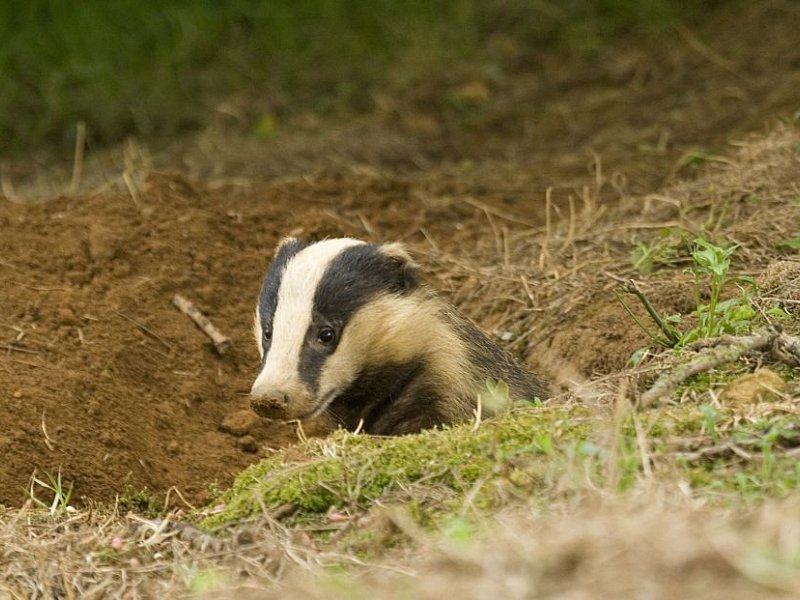
Expectant mothers prepare a special nursery chamber with a deep layer of soft bedding. Between one and five cubs are born, around 12 cm long and with thin coats of silver hair and faint black facial stripes. They open their eyes at five weeks but remain underground for the first two months of their lives, fully dependent on their mother for milk, warmth and protection. During this time, they’ll start exploring the sett’s tunnels and chambers, gradually venturing towards the entrance and eventually emerging above ground for the first time in late April or early May. Their first steps are tentative and they stay close to the familiar comforts of home, under the careful supervision of their mother. As their confidence grows they will start emerging earlier, staying out longer and venturing further into their new surroundings, learning how to forage in between the important business of playing chase and wrestling with their siblings.
Don’t miss the opportunity to go badger watching with Sussex Wildlife Trust this year in April and May. Our badger watching courses are led by professional wildlife photographer David Plummer. Visit www.sussexwildlifetrust.org.uk/whatson for times, costs and availability.
Comments
Do you ever give talks on badgers to local societies??
Could you let me know? Thank you.
03 Mar 2017 16:06:17