
An amphibian awakening
By Kerry Williams
Communications Officer - Conservation
It’s February, and we’re on the cusp of an amphibian awakening. After a winter in hibernation, frogs, toads and newts will start to emerge. If you have a pond, you may have already noticed spawn starting to appear. But who left it there?
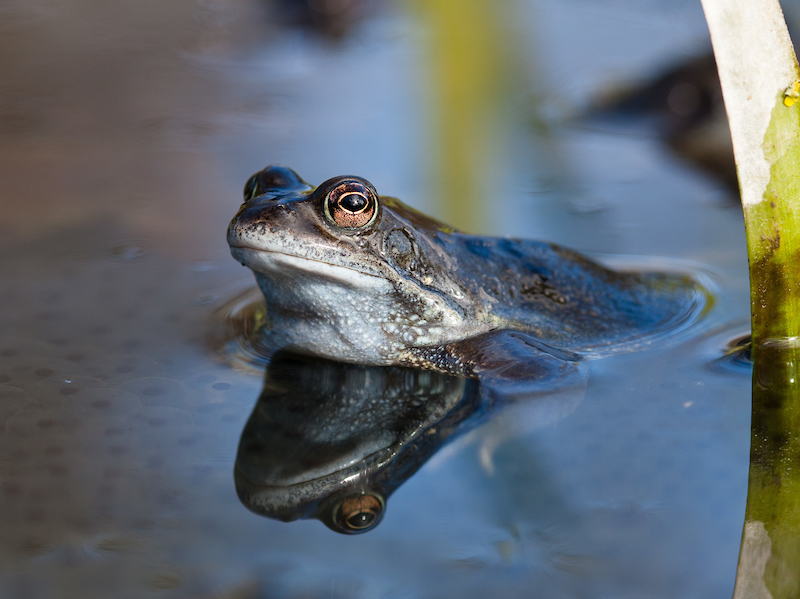
Common Frog
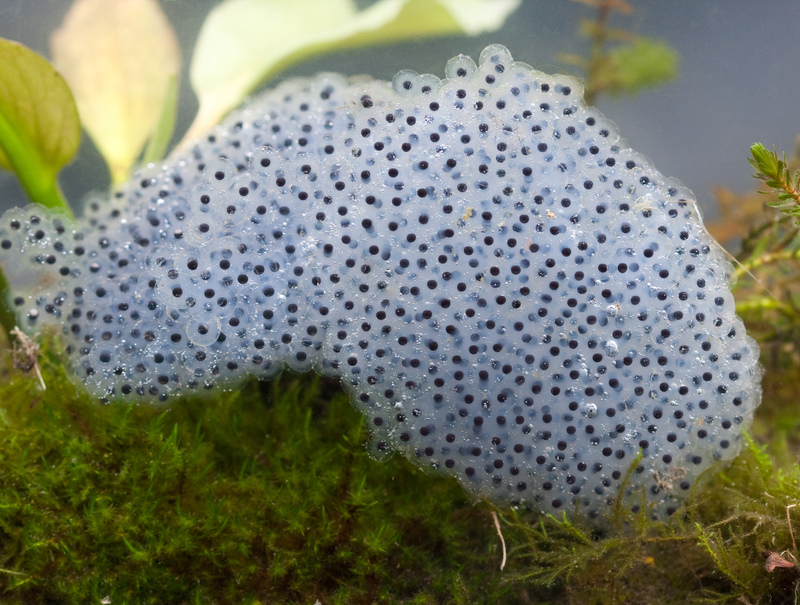
Common Frogs (pictured above) lay their eggs in rafts of spawn, usually in shallow water, and often in abundance! Thousands are laid each year, but with tadpoles being a tasty snack for so many other pond and garden dwellers, many do not make it to adulthood. Aside from breeding in ponds in spring, Common Frogs spend much of their time feeding in woodlands, gardens, grasslands and hedgerows. Common Frogs can vary in colour; greens, yellows and browns, and can be identified by their dark ‘mask’ around the eyes.
Common Toad
Around February, Common Toads set off on mass migrations back to breeding ponds after wintering in safe shelters such as log piles. With olive-brown bumpy skin, it’s important to keep an eye out for these unfortunately rock-shaped guys whilst driving, as migration paths often cross roads.

Toad spawn is laid in long chains, draped over plants and deeper into the water. Toad tadpoles are toxic to predators, so are often found alongside fish, unlike their froggy cousins. Another notable difference is rather than jumping, toads walk.

Marsh Frog
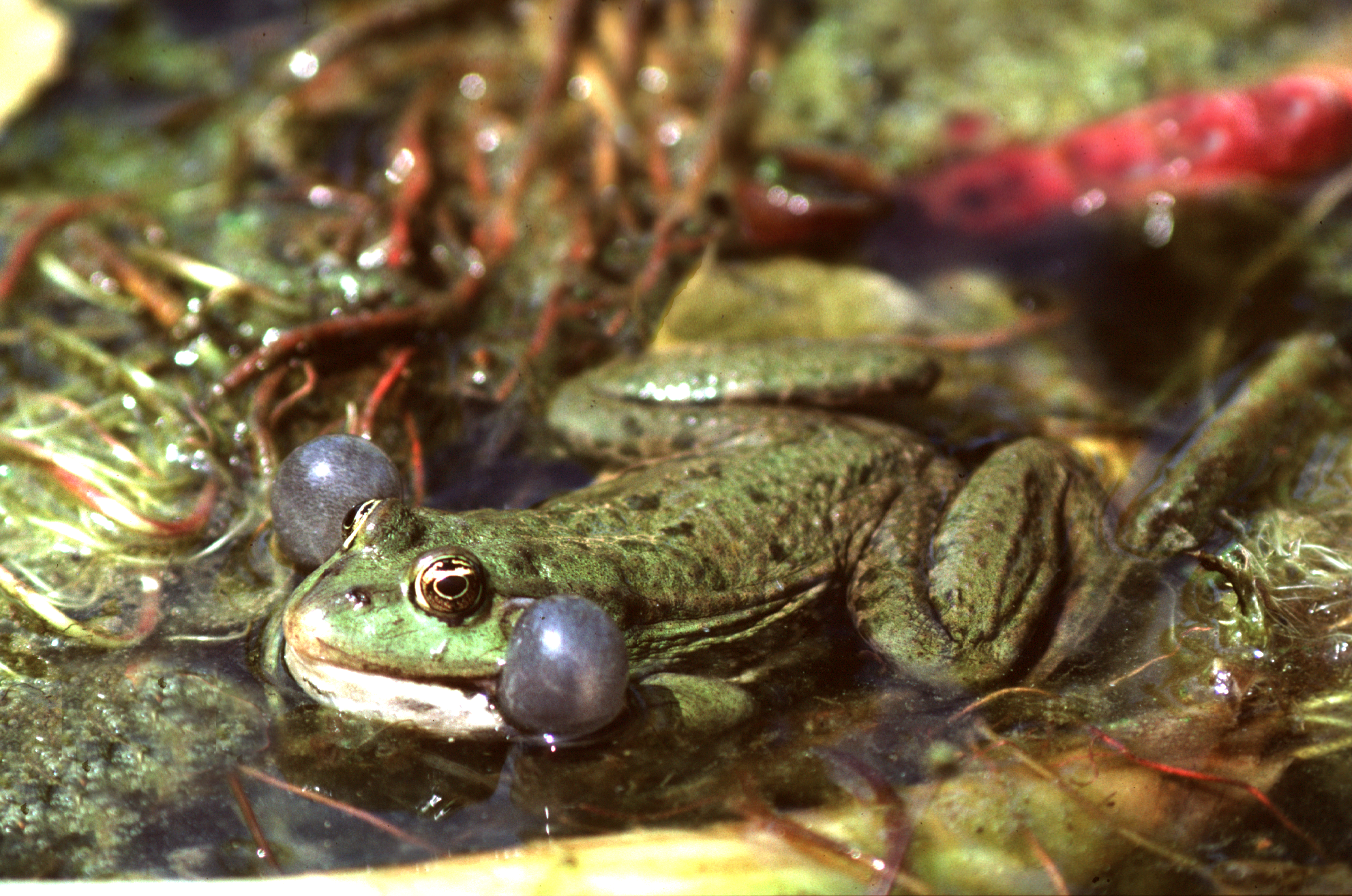
This non-native species is larger than our Common Frog, and a distinctive bright green. Released into Kent in the 1930s, Marsh Frogs travelled into East Sussex, where they can be found in ponds, wetlands, and even in brackish salty waters. A more water-based species than the Common, Marsh Frogs stay close to their eggs after laying them in small batches, attached to plants, underwater. Male Marsh Frogs can be heard from some distance in the spring and summer, cackling away in chorus by inflating vocal sacs in their throats.
Natterjack Toad
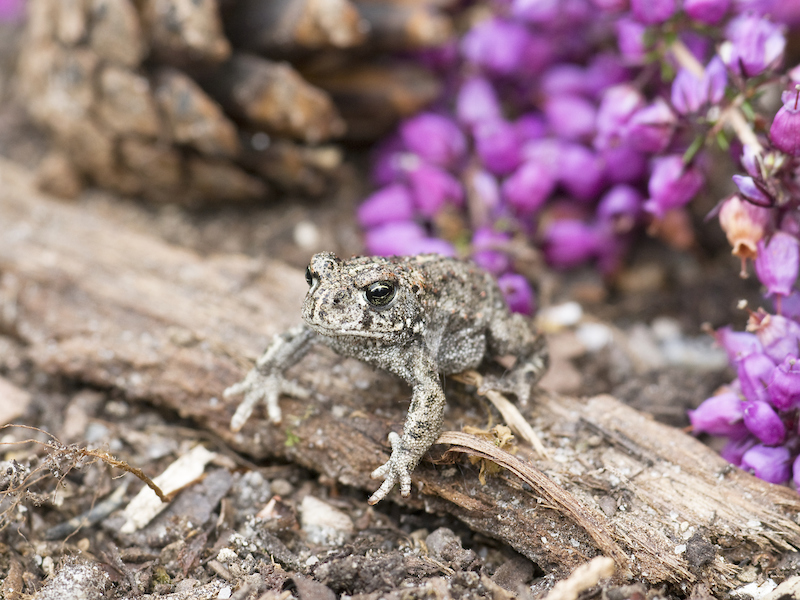
The smaller Natterjack Toad is rare in the UK, found only in a few coastal locations in sand dunes, heath and marsh, and not currently in Sussex. Not hopping or walking, but running, these speedy creatures have a distinguishing yellow go-faster stripe down their back. Spawn is laid in strings under the water, and one clutch can hold up to 7,500 eggs.
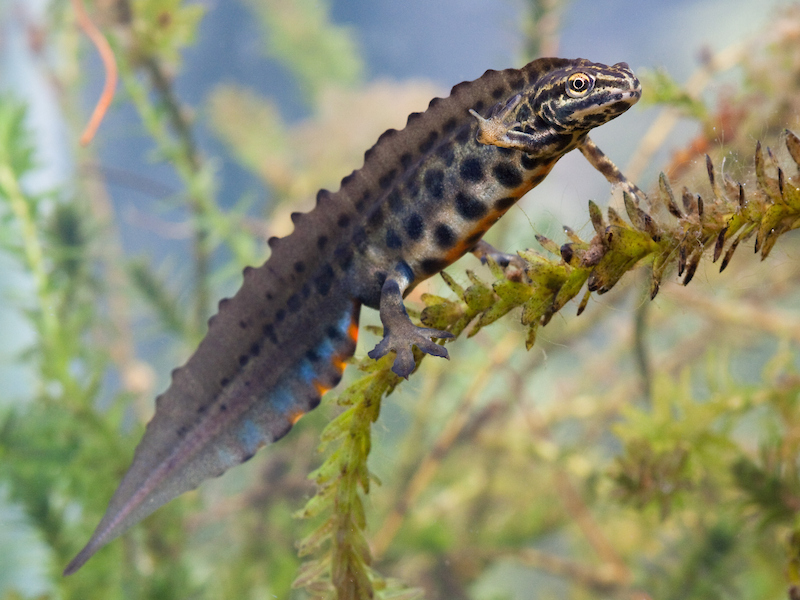
Smooth Newt
Also known as the Common Newt, this species is found throughout the country and is the most likely newt to find in your pond. Like all newts, Smooth Newts lay individual eggs on leaves of pond plants, rather than large groups of spawn like frogs or toads. Alongside a diet of caterpillars, worms, insects and molluscs, Smooth Newts are a predator of tadpoles. Smooth Newts have orange bellies and are covered with black spots, with males sporting a thin crest down their back in the breeding season.
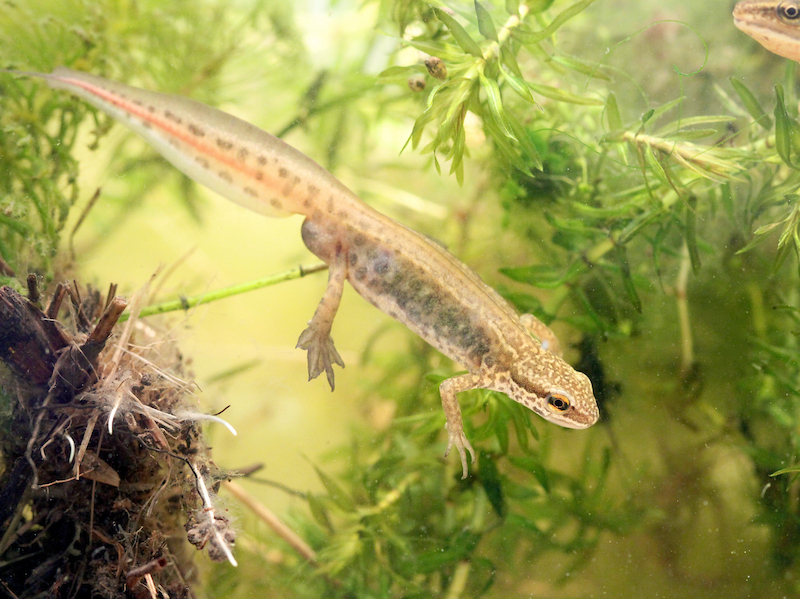
Palmate Newt
Tricky to distinguish from the Smooth Newt, the Palmate Newt prefers shallow pools on acidic soils. In the breeding season, male Palmates develop black webbing on their hind feet, resembling a palm; hence their name. Although similar to the Smooth Newt, Palmate Newts are lighter peach-yellow colour underneath, with spots on the belly but not on the throat.
Great Crested Newt
Not content with their fabulous crest, males conduct a courtship dance in the breeding season to attract females, standing on their front legs and waving their tail around. As with other newts, Great Crested Newts have spotted bellies, each one different to the next, like a fingerprint. This species can be identified by its size; at up to 17cm long the Great Crested Newt is our largest newt species. The eggs are white, differing from the Smooth and Palmate Newts more grey coloured eggs.

Sussex Wildlife Trust receive many queries on spawn every year. Is the habitat right? Will it develop properly? And in these times of seasonal shifts, what can you do to give our amphibian friends a helping hand? Find our FAQs here.
This post was first published in February 2025, and updated with images of Common Frog and Common Toad spawn in February 2026.
Comments
What a lovely and informative article! We have a very small water trough in our garden, but it’s sufficient to attract a lot of frogs,most of which have overwintered in the damp,wind and weather-proof places we’ve made sure are available for them to inhabit. It’s just wonderful when they come back in the spring. We often find them sheltering under leafy, canopy plants in summer, at the back if the borders, bear the walls, so that they don’t dry out! Can’t wait to see them again.
27 Feb 2025 11:27:00
I love every one of them…we have a moat nearby and can hear them but I don’t know what sort of frogs they are. Thank you
27 Feb 2025 11:41:00
Love this! Thank you!!!
27 Feb 2025 12:03:00
Very interesting, and very well presented. Well done.
27 Feb 2025 12:45:00
Thanks Kerry. Really informative.
David
27 Feb 2025 12:48:00
We have what we consider to be a fairly attractive option for amphibians: a 2msq pond 1m deep in the middle with a ‘beach’ and plants …. ‘but’ we’re in Saltdean ….. is there much amphibian life up here, and do we have to just wait (4 years now) for it to arrive, or can we ‘help’ the process?
27 Feb 2025 12:49:00
Sussex Wildlife Trust:
Hi Julian, the pond is a great start! A few things you can do: Ensure there is enough cover in the pond for shelter, and also enough access to sunlight. Avoid using pesticides in the garden. Try to keep pets away from the pond if you have them. Consider making other areas of your garden wild, such as leaving the grass to grow longer. Check the accessibility to the garden - perhaps cut some holes in fences to allow wildlife access. Good luck!
Love this info. Just ID’d a marsh frog in my
Pond xx
27 Feb 2025 13:22:00
I am thrilled to bit to have frog spawn in my 2 year old pond. How do I stop the corvids eating the tadpoles? I am in West Sussex.
27 Feb 2025 13:24:00
Sussex Wildlife Trust:
Hi Christine, unfortunately tadpoles are a regular snack for lots of garden predators. You could ensure there is a bit of vegetation cover in the pond for tadpoles to shelter under - although be wary of also leaving enough sunlight for them to access! We do not recommend using wire on ponds as this can trap wildlife.
This is so informative. I have a tiny pond in my garden but it manages to attract many frogs which I have actively encouraged by building log pile and leaving leaf litter against the walls and fences. They are a joy to have in the garden. I love watching the development of the frog spawn into tadpoles and eventually to frogs. It is magical.
27 Feb 2025 14:31:00
Here at Gillridge Barn we have photoograpphed the GCN. We are still however having trouble with people trying to destroy the landscape in this part of the A.O.N.B so it is good to see you showing what they look like.
27 Feb 2025 16:33:00
Over the years, what was once an absolute mass of toads crossing the farm road in spring here in Chailey, has now completely vanished! At lambing time we would walk to the sheds to avoid running the toads over! I still find the odd one as you would expect but the masses searching out the ponds have gone. Any idea why? – thanks
27 Feb 2025 17:53:00
Sussex Wildlife Trust:
Hi Anthony, unfortunately this is a common story. Climate change and habitat loss have contributed to a significant decline in many British wildlife species, including our amphibians. As Toad migration routes often cross roads, an increase in vehicle use and busier roads has also contributed to the problem. You can encourage Toads onto your land by creating healthy pond habitats, and seeing if there is anything you can do to make those routes more accessible for the Toads.
It was very interesting to read and I’ll definitely pass the knowledge on. 😀
27 Feb 2025 18:18:00
Great info
27 Feb 2025 19:54:00
Very usefull. Il Lerner alot
27 Feb 2025 20:08:00
Yep, a few days ago mounds of frog spawn appeared in my pond. Let’s see if any survive to adulthood!
28 Feb 2025 09:04:00
Frog spawn has arrived both in my home pond and in my allotment pond. Happy days!
28 Feb 2025 09:08:00
Thank you for posting this really useful brief summary of amphibians.
28 Feb 2025 09:49:00
Great summaries – welcomed. and thank you.
28 Feb 2025 11:35:00
Love your photos teaching us about our birds bees and now frogs etc.l have all three newts in my pond but now the heron comes regularly andthe ducks and lone gander are not enough of a good deterrent so l don’t often see frogs and toads very often. Thank you for your emails, they are much appreciated.
28 Feb 2025 15:42:00
Very usefull. Il Lerner alot
28 Feb 2025 17:43:00
Thank you this was very interesting.
28 Feb 2025 20:23:00
I have a lot of frog spawn in my pond now after the sunshıne 2 days ago. They are the common frogs. Unfortunately they are right near the path where the birds can get at the tadpoles as they hatch. Any ideas how to protect them?
28 Feb 2025 20:32:00
Sussex Wildlife Trust:
Hi Jackie, unfortunately tadpoles are a regular snack for lots of garden predators. You could ensure there is a bit of vegetation cover in the pond for tadpoles to shelter under - although be wary of also leaving enough sunlight for them to access! We do not recommend using wire on ponds as this can trap wildlife.
Thank you, very interesting
28 Feb 2025 21:00:00
Great article. thank you very much.
01 Mar 2025 15:12:00
We had a great talk the other week about frogs, toads, newts etc at Horsham Horticulture two weeks ago and there was a great slide about how to make a pond thats friendly for all.
Any chance of the details so my brother can do his pond right from scratch.
03 Mar 2025 09:43:00
Sussex Wildlife Trust:
Hi Jane. Take a look here https://sussexwildlifetrust.or...
good outline. Thankyou
03 Mar 2025 20:06:00
We created a wildlife pond when we moved house in 2018. We also created a half submerged rockery at one end. Frogs love it and we have a massiive amount of spawn right now and still growing. We think we have newts living in there also
07 Mar 2025 21:01:00
I have a small wildlife pond in the garden.
I look out around this time of year for Mr froggy to do his deed !
This year he has exceeded himself lol, unless there are a few girlfriend in there with him I have about 20 dollops of spawn. most in the middle of the pond & some at the edge.
I pop out regulary, to watch him move about in the pond, though not sure if its Him or Her keeping an eye on the brood .
I amazes me, how many do survive.
Last year I had Baby Newts in there too. Not sure if they are still about now.
The pond is so interesting to see what is lerking in there & keeps me amused for ages .
08 Mar 2025 08:11:00
Thank you for sharing these wonderful photos. And I leant a lot about amphibians too!
10 Mar 2025 20:15:00
Always most interesting. We have a small pond in the garden and would love to encourage frogs and newts.
13 Mar 2025 08:13:00
Photo confirmation of great crested newt population on my property which backs onto a large old brick making clay pit.
14 Nov 2025 11:06:00
Sussex Wildlife Trust:
Hi Linda, the best way to record wildlife sightings like this with us is via the iRecord website or app: https://irecord.org.uk/. Information uploaded here is shared with the Sussex Biodiversity Records Centre, who hold species data for the county, and who we work closely with.
Should I remove newts if there is frog / toad spawn in my pond?
26 Feb 2026 11:23:00
Sussex Wildlife Trust:
Hi Paul - you should not remove the newts or transfer them elsewhere. We generally do not advise relocating amphibians to other ponds as they can transfer diseases, and can also upset the ecosystem of the new environment. Moving them could also just make space for other newts to move in anyway! Newts may well predate the frog tadpoles, but this is part of the natural ecosystem of the pond, and one of the reasons that spawn is so numerous. To help the tadpoles, you could create some areas of shelter, such as rocky areas, or vegetation, for them to hide from predators.
I’m pretty sure there are one of two female frogs living in out tiny pond all year round, but come mid to late February the pond fills with 25 or more adult frogs and the spawn begins to appear. My question is, how are the female’s eggs fertilized, and why so many frogs in one small pond? Once their mission is accomplished, they all disappear until the following year. This is only the 4th year we have observed this, as the pond is relatively new. By the way, the pond is below our bedroom window, and the sounds at night that the frogs make are fantastic!
26 Feb 2026 11:59:00
Sussex Wildlife Trust:
Hi Paul. Great to hear you have so many frogs! During the frog mating season, you may have seen male frogs on the backs of females - this encourages females to expel eggs which are then fertilised by the male, before being released into the water in the form of spawn. It is quite normal for large numbers of amphibians to congregate en masse in early spring - gathering in these numbers can provide strength in numbers against predators, and also allows for lots of spawn to be produced at the same time. Lots of the spawn will be predated, so again, this en masse approach can give at least some of the spawn the best chance of survival.
I have a life-long interest in these creatures, started by my Dad who always built a pond wherever we lived. A few years ago I did a amphibians survey for the Freshwater Habitats Trust and one of the key identifying features that I found useful with Great Crested Newts was the white flash on the tail.
26 Feb 2026 12:19:00
A good read. We have an abundance of frog spawn, male and female frogs, at least 3 newts in our pond, a hive of activity.
26 Feb 2026 15:16:00
Very interesting to hear about all the amphibians around at the moment or soon will be. Last year, frog spawn turned up in my little pond but I’m afraid all was eaten by newts! I think this time I might put some of the spawn in a bowl – if it does happen again, which I hope.
01 Mar 2026 18:11:00
Thank you for explaining the differences between frogs and toads, my children have been asking so this is really helpful.
02 Mar 2026 06:48:00
Very interesting to hear about all the amphibians around at the moment or soon will be. Last year, frog spawn turned up in my little pond but I’m afraid all was eaten by newts! I think this time I might put some of the spawn in a bowl – if it does happen again, which I hope.
02 Mar 2026 10:19:00
Thank you for explaining the differences between frogs and toads, my children have been asking so this is really helpful.
02 Mar 2026 18:28:00
Thank you so much for this useful guide. I sometimes find frogs or toads on my allotment. Now I will look more carefully to try to identify them 🙏🙏
03 Mar 2026 07:58:00
I have a common frog in my garden in Hastings, I get one every few years, there are no ponds or water ways nearby and little prospect of it finding habitat for hibernation.
Is there a location near Hastings where I could relocate the frog. Cute as it is, I don’t think it’ll do well in the hot, dry conditions
17 Aug 2026 05:32:00
Sussex Wildlife Trust:
Hi James. There are no services which would relocate amphibians from gardens to elsewhere, and the frog would likely make its way back even if there were! They tend to return to the same place each year. You could provide alternative habitat for hibernation by creating piles of logs or stones, and making sure there is shade in the garden where possible. The frog and other wildlife would also benefit from a shallow dish of water, or even a sunken small 'pond' - just a washing up tub with water in perhaps, to provide some much needed hydration in this heat.