
All about feathers
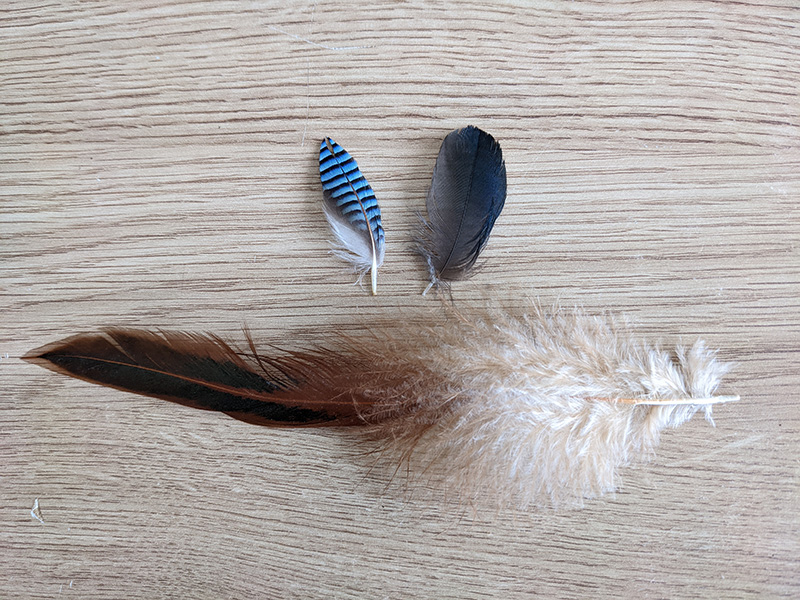
By Charlotte Owen
WildCall Officer
What is a feather?
Feathers are the defining features of birds: only birds have them (though they first evolved millions of years ago on their dinosaur ancestors) and feathers are the most complex structures to be found on the skin of any vertebrate.
A feather is “a keratinous outgrowth of the skin of birds that is highly modified for the purposes of flight, insulation, and display.”
Feathers are made out of a protein called keratin (specifically beta-keratin), which is the same protein found in human hair and fingernails.
Feathers come in a huge variety of forms, each with a unique structure and function, but there are two main types: plumulaceous and pennaceous.
Plumulaceous feathers (think plumes) are the downy feathers, which look fluffy and soft and would be absolutely no use for flying. Instead they function a bit like thermal underwear and keep the bird warm by trapping a layer of air against the skin. When it’s cold, birds deliberately fluff up their downy feathers to trap additional air and improve their insulation to keep warm.
All other feathers are pennaceous feathers (think pen, and it’s the kind of feather you might make a quill out of). These have the typical feather shape with a stiff, flat structure arranged on a central shaft (though some also have a downy plumaceous section right at the base). The hollow section of the shaft at the base of the feather, where it would attach to the bird, is called the quill or calamus. The main feather structure, which grows out of the central shaft, is called the vane and it is made up of hundreds of individual barbs. If you’ve ever picked up a feather and smoothed it back into shape, you’ll have noticed how the individual barbs can zip together, and this is because there are thousands of tiny hooks (barbicels) that interlock a bit like Velcro. This zipping action is vital, as it maintains the feather’s structure and windproof/waterproof qualities. When birds preen, they’re essentially zipping up their feathers to keep them in top condition, and can also apply an oil from their preen gland to help keep them waterproof.
Feathers can also be categorised based on where they are found on the bird’s body:
- Wing feathers (remiges) generate the thrust and lift required for flight, and you can identify a wing feather by its off-centre shaft: there’s more feather on one side than the other, with the narrow side about ¼ the width of the wider side. The narrow side is the leading edge and the shorter, stiffer barbs help minimise any bending and twisting of the feather during flight. Flight feathers are further sub-divided into primaries (which generate thrust) and secondaries (which generate lift) depending on their position along the wing. Unlike other feathers, wing feathers are attached to bone rather than skin.
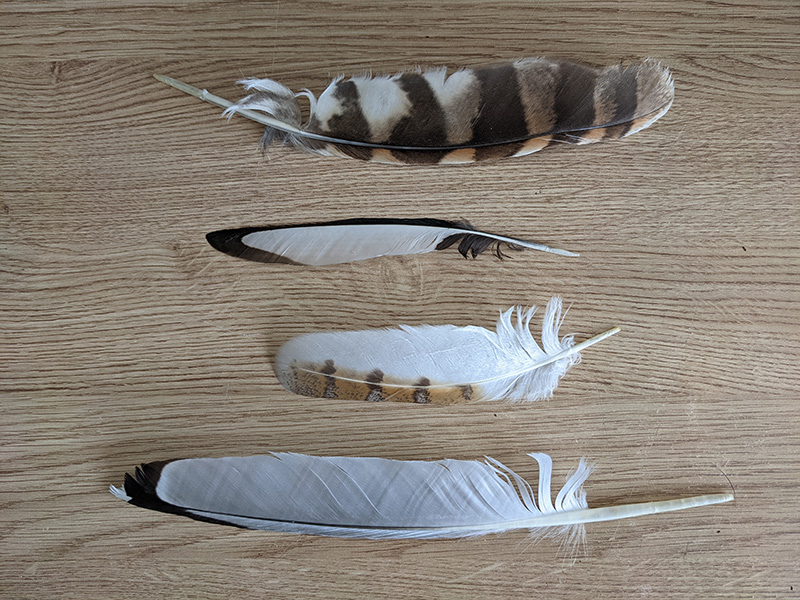
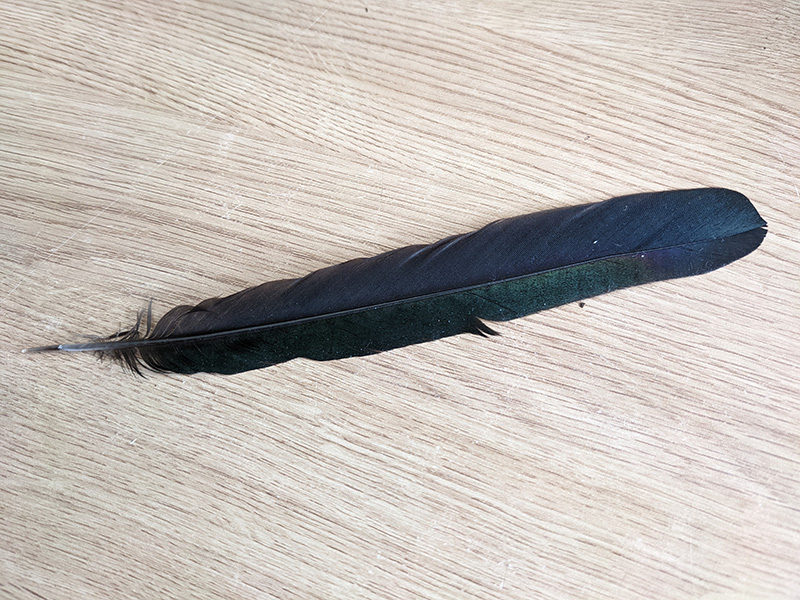
Wing feathers - Tawny Owl, Magpie, Barn Owl & Herring Gull - Tail feathers (retrices) have the same interlocking structure as wing feathers but are more symmetrical. They allow the bird to steer, a bit like a rudder, and there are usually six pairs of feather on the tail. The two central tail feathers are the most symmetrical and the only ones that attach to bone.
Magpie tail feather - Contour feathers are the bird’s outer coat. They are generally smaller and shorter, with a waterproof tip and a fluffy base. They overlap so closely that only the tips are exposed, and this is why water rolls off a bird’s back. These feathers also help contour the bird’s body, so that is streamlined. Contour feathers on the wing (aka coverts) help to create an effective aerofoil – the same shape as an aeroplane wing – to maximise flight efficiency. Contour feathers also provide colour and pattern, which may help to camouflage the bird with its surroundings or show off its bright plumage to a mate.
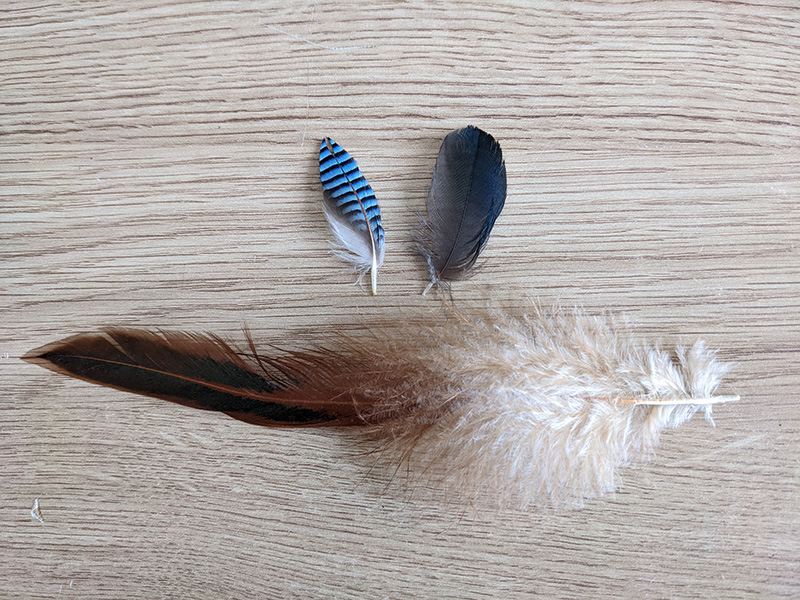
Contour feather - Jay, Magpie & Pheasant - Semiplumes are fluffy under-feathers with a central shaft, providing slightly more structure than down and providing further insulation.
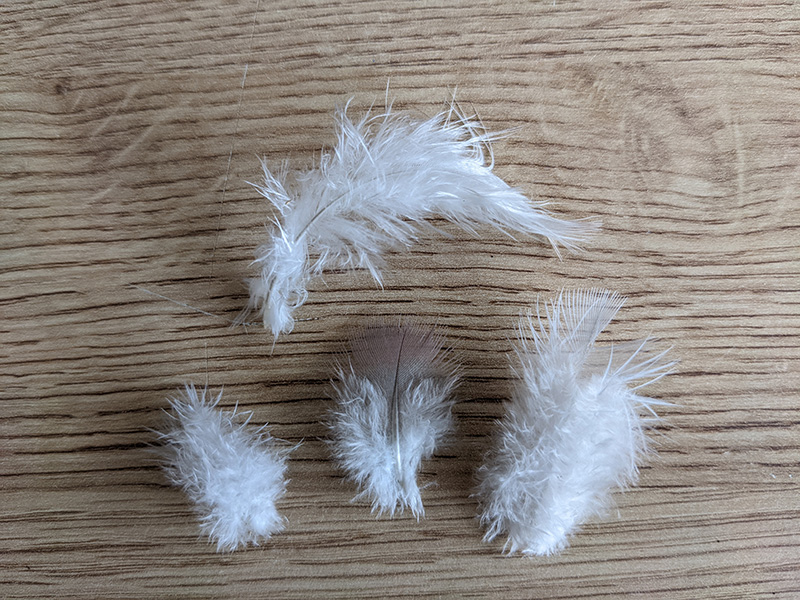
Wood pigeon semiplumes and down - Filoplumes are the bird-equivalent of whiskers and are used to sense the position of the contour feathers.
- Bristles are the simplest form of feather, and look like a central shaft without any barbs. They’re usually found on the head and can protect the eyes and face.