
A less than black and white look at Magpies
By James Duncan
Wilder Communities Officer
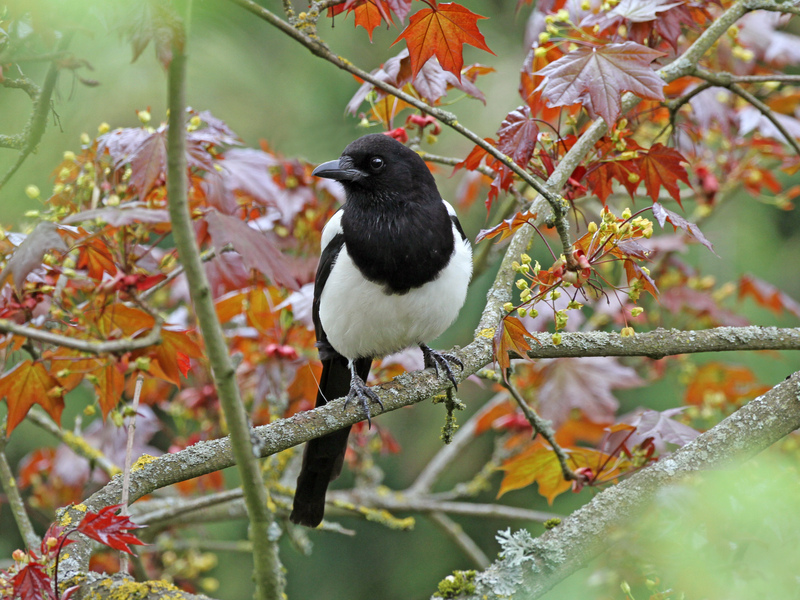
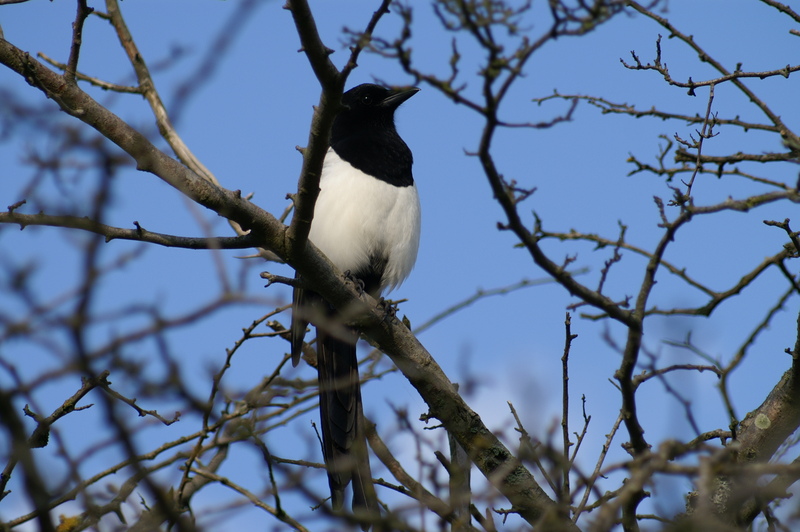
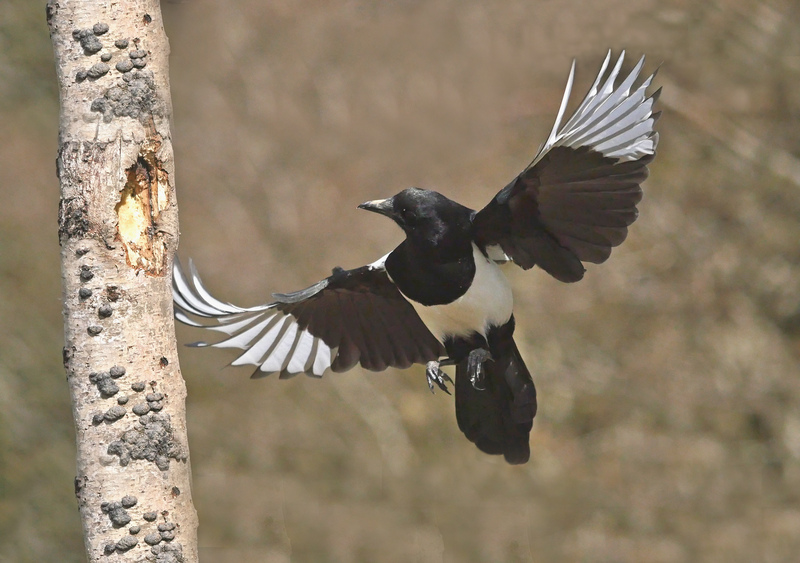
The Magpie. Perhaps our most maligned and controversial avian species. Though many other birds are, like the Magpie, deeply embedded in our folklore, it's fair to say that few of them have their own rhyme (“One for sorrow…”). The Magpie (Pica pica) has been the source of a bewildering variety of superstitions and, whilst some cultures see them as ominous, to others they are a sign of good fortune. However viewed, these raucous, playful, mischievous characters are highly intelligent members of the crow family (Corvidae) - their lengthy tail, clattering calls and besuited appearance make them hard to miss. At a distance, they appear to be wholly black and white, but, when they catch the light, their resplendent wings and tail shimmer with iridescent green, blue and purple.
Why are they so contentious? They're certainly a voracious and highly opportunistic omnivore, taking pretty much any food they find. Up until the mid-19th century, their presence was actively encouraged as they feast on insect and rodent crop pests. However, since their diet also includes eggs, nestlings, fledglings and even adult birds (of smaller species), they became the foe of gamekeepers. Cue a sustained campaign of eradication (with the offer of “a tanner a tail”). It's only since the First World War that numbers have roughly doubled, the most dramatic rise being between the mid-1960s to 1990s (though it's worth noting that Magpies continue to be controlled in many areas across the UK).
Though people have perceived an increase in Magpies over the last few decades, this isn't the case. Data from the BTO (British Trust for Ornithology) indicates that, over the last twenty-five years, their population index has stabilised, even showing a small decline. This points to the Magpie population reaching an ecological equilibrium within an intensively farmed and modern suburban landscape. The relative stability of this population compared with declining trends in other birds (over a quarter of our familiar British birds are red-listed species of conservation concern) may have only served only to highlight the Magpie's conspicuousness. Current numbers show around 610,000 breeding territories. Interestingly, several woodland (and indeed garden) bird species have bucked the national trend and increased in number since 1970 - Long-tailed Tit, Great Tit, Wren, Chiffchaff, Goldfinch, Nuthatch, Blackcap and Great-spotted Woodpecker.
Whereas woodland species may be benefitting from increased feeding opportunities in gardens, what has prompted the rise in Magpies during the twentieth century? Though we haven’t empirical evidence to show the ecological drivers of this change, it’s assumed to be linked to human activity. Along with a declining persecution of corvids, a boom in game shooting has had a huge impact on our countryside: placing forty-three million non-native Pheasants, removing apex predators and dumping surplus grain on the landscape, do not make for a delicate ecological balance. (In fact, pheasants make up the greatest biomass of 'wild' birds in Britain.) Add to this the increased roadkill on our heaving road network, and Magpies (amongst other corvids) certainly benefit from this substantial food source. Having said that, the Magpie's generalist ecology means they continue to prosper across all manner of habitats, whether farmed or urban.
As a family, the crows are thought to have originated some time in the Paleogene, around sixty million years ago and, after intense diversification, Magpies may have evolved from a Crow-like ancestor about twenty million years ago. Hence they've existed for an awfully long time in Britain as mesopredators within a complex food chain. As to today’s perception of Magpies, and shooting estates aside, their taste for young birds remains key. Also, as a predator the Magpie tends to be highly visible - whilst rampant predation occurs at every trophic level, most of us just don't see much of it happening on a day-to-day basis. When we do, sentiment is inevitable: it’s that human response to seeing their prey - “our garden birds” - taken, that divides opinion. But it makes little evolutionary sense for a predator to actually reduce its prey species significantly. So, let’s look at a Magpie diet. Around 80% is invertebrate based, and most of the rest is carrion, acorns, grains, fruits, berries and small mammals. Small birds make up only around 2% of their typical diet, a tiny component, almost all taken within the breeding season to feed their own young.
Professor Tim Birkhead’s study over fifteen years points to these conclusions about Magpie predation: (a) with increasing Magpie density, nine of eleven common songbird species studied on farmland and woodland (in rural England) showed no change in nest mortality. At the same time, two species showed significantly reduced nest mortality as Magpies became more abundant! (b) Nest mortality of all studied songbird species was not related to Magpie density. (c) Songbird populations either increased more, or decreased less, in areas where Magpie density was higher.
The RSPB also commissioned a BTO study that reviewed thirty-five years of bird monitoring records, and "songbird numbers were no different in places where there were many Magpies from where there are few." It found no evidence that increased numbers of Magpies have caused declines in songbirds. Rather that "availability of food and suitable nesting sites are probably the main factors limiting songbird populations." Truthfully, the issue is complex and perhaps localised, specifically in areas where we've have already piled pressure on songbirds through our own actions, such as removing or damaging hedgerows plus extensive use of insecticides. It would seem that amongst these more pressing environmental concerns, and contrary to people's fears, magpies have had little detectable effect on either songbird breeding success or population levels in rural environments.
Surprisingly, a Magpie’s brain size in relation to its body mass seems to equal that of both the great apes and marine cetaceans, and it is not much less than in humans. They are known to utilise tools, and in urban settings they use chances to showcase skills such as exploiting those 'anti-bird' spikes to protect their nests - an amusing irony. They are superb mimics, even able to imitate human speech. Thought to be highly advanced traits of intelligence, “play” and hunting teamwork also feature in the Magpie repertoire. Most bird species have more than one mate, but Magpies typically mate for life. They tend to hang around in raucous teenage gangs before they pair up, echoing human social dynamics. They're also known to grieve for their own kind, forming large aggregations whilst calling - a sort of 'funeral' if you will. In these respects, they are just like us. Perhaps we should not be so quick to judge these complex birds.
Unfortunately for the Magpie, its revival in fortune coincided with declines in a whole host of other bird species, and so seemed to show a concrete connection. Come springtime, both national press and social media often repeat the same old rhetoric, that overwhelming Magpie predation has led to songbird losses and consequently that they should be controlled. It could well be argued that this response takes little account of ecological factors but says a lot about human psychology: once a scapegoat, always a scapegoat. Our most vilified bird therefore provides an easy target - but to what end? Our single most important focus should be to make our natural environments more resilient through ensuring that predator-prey relationships remain balanced. They become unbalanced when we persecute species and fragment or destroy their habitats. Humans have a long history of demonising, oppressing and ultimately eliminating predators. As we continue to drive our metaphorical bulldozer through the earth's biosphere, we're the ones who need to change our habits, not the Magpies.
Comments
Thank you, James, for this thoughtful and balanced report on magpies, they are so often the villains and good to see that everything is so much more complex, of course!
10 Sep 2024 12:01:00
It’s great to read such a balanced and informative view of Magpies. I love to watch them and their relatives in tge Crow family foraging near my home. Always intelligent and resourceful. Thank you for putting the records straight for those who automatically believe their bad press.
12 Sep 2024 11:14:00
Really interesting and informative thank you!
12 Sep 2024 11:16:00
Excellent article! I have always been a fan and defender of magpies, along with all things in nature, and was very heartened to read your blog.
12 Sep 2024 11:45:00
Sussex Wildlife Trust:
Thank you Paul
Thank you for this most interesting article. The magpies in my area of Horsham regularly steal and eat eggs, but usually pigeons’ eggs so I forgive them. They are very noisy when they nest close to my home.
12 Sep 2024 12:06:00
I have a regular family of young magpies up to eight every year with their parents looking for anything they can eat, I personally think they are beautiful Birds and are much maligned , I love their plumage that glistens in the sun, and the way the younger Birds play with each other, the world would be a sadder place without them!
12 Sep 2024 12:11:00
I totally agree. I found your blog very interesting. I have on numerous occasions in the past, released captured magpies from gamekeepers traps before they’ve been killed.
12 Sep 2024 12:12:00
A good article about Magpies. Thanks.
12 Sep 2024 12:12:00
I was always superstitious of magpies saying, One for happiness two for joy.
Now I smile when I see them and say thank you as Rosie is now 28. 🍀🙏
12 Sep 2024 12:24:00
Very interesting and balanced article. I must say the I’ve been one of those disliking magpies, although their plumage is amazing and their intelligence amongst corvids noticeable. Watching them regularly decapitating smaller birds which they’d carried to a tree outside my classroom (and I’ve been 19 years retired now) did not endear me to them and I had to pull the blinds down because my pupils became so distressed and distracted. It’s good to hear the opposite point of view. Thank you!
12 Sep 2024 14:30:00
Interesting article, thank you, Slow Worms also seem to take a hammering in the Spring, and there I suspect the Magpie is only interested in the heart, as the rest of the corpse seems often left behind. I have also observed a Magpie making multiple trips to cache chips, discarded from the local kebab van, in a cranny on the neighbour’s roof, for later retrieval.
12 Sep 2024 14:58:00
Very interesting and thought provoking article
12 Sep 2024 17:35:00
I love my maggies. They love the puppy mix I leave out for the gulls and the foxes. So nice not to hear them not being vilified. I think they are the closest we have in Britain, to parrots as their colours are amazing.
12 Sep 2024 23:43:00
What an interesting article. I certainly have been worried about the impact of magpies on the smaller birds in our garden, especially in the spring. It is really useful to see the whole picture regarding magpies and feels good to be able to enjoy them rather than dread them.
13 Sep 2024 05:38:00
Hi James, your article on Magpies was fascinating giving a very fair and balanced view. We have a lot of Magpies in our garden and have been quick to blame them for a lack of other species of bird but clearly not the case. I’ll be looking at them with more respect now particularly as they are so intelligent. In fact, they are probably more intelligent than humans as we seem intent on destroying our planet, our home whereas Magpies and the rest of the natural world seems to realise that balance is the key so that we can live in harmony. Catch up soon. Cheers Nick
13 Sep 2024 06:57:00
A great article hitting the nail on the head, humans are and have been the problem of natural world decline. We however don’t want to admit so continue mindless destruction, generally only in the name of profit. Ad the article states, we need to change, but globally not just in the UK, not sure we are intelligent enough to do this?????
13 Sep 2024 08:00:00
That was absolutely fascinating, James, thank you. It has opened my eyes and somewhat changed my opinion of Magpies which I frequently get in my garden. They do, indeed, have a striking attire of feathers! My ‘little bird’ population supplies them with a constant supply of seeds they choose to discard from the feeders! I did spot a Woodpigeon facing up to a Magpie recently below the feeders and the Magpie backed off!
13 Sep 2024 19:56:00
Thank you so much for. This beautifully written, eloquent piece. I read that trees should have rights equivalent to human rights. All life should have rights, including magpies. It is humans who have done the most harm. Count me out, of course.
I’m passing your piece on. Wonderful stuff 🙏🙏
15 Sep 2024 01:34:00
Thanks for such a great read. I’ve always been a bit obsessed with Magpies, some would say they are like my spirit animal! After reading this I just feel even more respect and appreciation for them. I really enjoyed your tone in this blog.
Magpies rule!
15 Sep 2024 20:28:00
It would be interesting to know what effect Magpies have on our reptile population, though Pheasants probably have an equal or even greater impact on our reptiles.
17 Sep 2024 16:01:00
Sussex Wildlife Trust:
Hi David. Whilst Magpies do clearly predate reptiles, they're not alone in this - a multitude of others do too, including other Corvids, Herons, Storks, Birds of Prey and as mentioned, the simply outrageous volume of Pheasants. There's no evidence to suggest that any reasonable percentage of Magpie diet comprises reptiles. As is so often the case, the reptiles and amphibians face a huge number of threats, the most significant of which are fragmentation and loss of suitable breeding habitat, where ponds, dunes, heathlands and hedgerows are replaced by human habitat, plus the continuing use of pesticides through agricultural intensification.
Loved this piece. Am a strong advocate for these birds and always salute a lone magpie, hoping they will be reunited with their mate. Have experienced their grieving. One of my cats either killed or brought an injured maggie into the garden who subsequently died. What I presume was their mate used to land on the house opposite and caw in our direction daily for over a month. for over
06 Mar 2025 10:11:00
We have a pair if Magpies nesting in the large birch tree in our garden. We love to hear them chattering away to one another, having a conversation just like humans. They are highly intelligent birds and there is no way we would chase them from our garden.
30 Apr 2025 10:06:00
Sussex Wildlife Trust:
Lovely to hear
A very interesting and useful comment on the magpie. Certainly one pair, and possibly two, seem to have taken residence around the block of flats where I live
help smiling on seeing them.
Yours sincerely, Maureen Sterling
31 Aug 2025 19:01:00
Excellent thank you, very informative
25 Sep 2025 17:19:00
Hoorah, I can now freely admit to loving Magpies and defend them with studied proof they are not the evil harbingers of greed and death that many around me believe.
07 Jan 2026 14:31:00
Thank you for this excellent article, wonderful to read. Informing & educating us on these Beautiful birds. As an Aussie I know well the Aussie Magpies who I just Love so much & now I have found the British Magpies who although quite different they also need love & support from us, so we do not lose them. I am so grateful for your wonderful article
02 Jul 2026 13:47:00
I love Magpies ! Every morning ( weather permitting ) I scatter meal worms on my patio table and 1 -3 0f these amazing birds join me, whilst I slurp my morning coffee.
Although some birds no longer visit my garden, house sparrow, dunock, wren, robin, blackbird numbers either remain stable or show a slight increase. despite an increase in magpies.
13 Jul 2026 06:11:00