
A hop, skip and a jump - celebrating a Leap Year

Matt Rich
Ranger - Rye Harbour Nature Reserve
Did you know that it takes 365.25 days for Earth to orbit the Sun? To keep our calendar year on track, an extra day is added to February every four years – making it a leap year. We thought we'd celebrate some hopping, skipping and jumping species.
Walking through a meadow on a warm summer’s day, hearing the constant humming and drone of various insects is a sound that brings a massive smile to my face. Walking through the grasses, little creatures are seen flinging themselves far and wide to escape the huge two-legged creature that have just disturbed them.
In the bustling ecosystem of insects, crickets and grasshoppers stand out as fascinating creatures renowned for their remarkable jumping and hopping abilities. These small insects belong to the order Orthoptera and play crucial roles in maintaining the balance of various ecosystems. Crickets have a varied diet feeding on insect larvae, aphids, flowers, seeds, leaves, fruit, and grasses. Grasshoppers mostly eat leaves, but also flowers, stems and seeds. They’re both also a valuable food source for a wide range of animals.
Let's delve into the incredible world of these agile creatures and explore the mechanics behind their extraordinary leaps. Jumping is an essential part of the daily lives of crickets and grasshoppers, allowing them to evade predators, locate food and communicate with potential mates. Their hind legs, specifically adapted for powerful jumps, are equipped with robust muscles and a unique joint called the femoro-tibial joint, allowing for swift and efficient movements. When a cricket or grasshopper prepares to jump, these muscles contract rapidly, storing energy in their legs like a coiled spring.
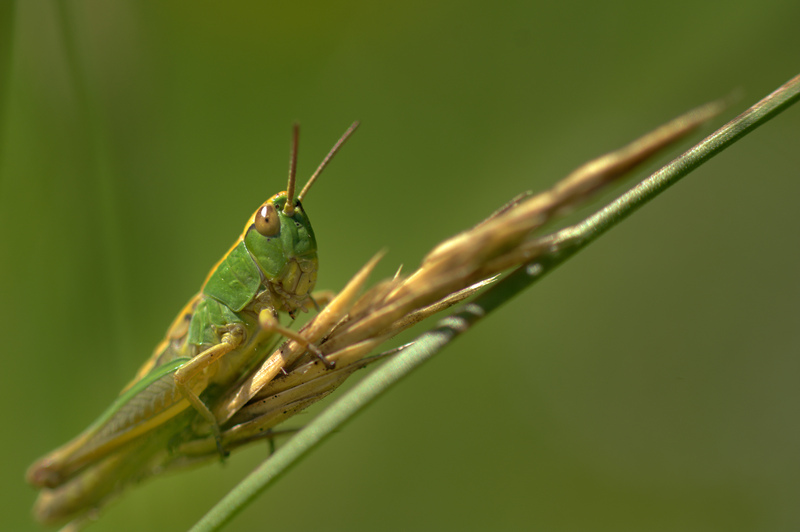
The release of stored energy propels these insects into the air, creating a trajectory that can span several times their body length. Grasshoppers, in particular, are renowned for their exceptional jumping capabilities, with some species able to cover distances of up to 20 times their body length in a single leap. This impressive skill is attributed to the highly developed hind legs, which act as powerful catapults when engaged.
While crickets and grasshoppers share similarities in their jumping mechanisms, there are distinctions in their preferred habitats and behaviours. Crickets, often found in damp environments like grasslands and meadows, tend to exhibit shorter and more controlled jumps compared to their grasshopper counterparts. Grasshoppers, on the other hand, are commonly associated with drier regions and open fields, where their long, powerful jumps aid in escaping from potential threats.
The world of crickets and grasshoppers is filled with awe-inspiring feats of jumping and hopping. Their remarkable adaptations, from powerful hind legs to intricate jumping mechanisms, showcase the marvels of nature's engineering. As we observe these tiny creatures in action, we gain a deeper appreciation for the intricate dance that unfolds in the microcosms of our natural world.
Comments
Crickets, eg Field, Wood, Scaly, Mole crickets and a few alien ones, are quite rare in the UK, but Bush-crickets and allies, species that used to be known as Long-horned Grasshoppers, are fairly common. Bush-crickets aren’t crickets and it’s unfortunate they haven’t a more appropriate name.
Although grasshoppers apparently make spectacular leaps, most use their wings as well to aid the distance and speed of travel and stability. Compare the clumsy jump of the usually brachypterous (short winged) female Meadow Grasshopper with that of others. Also it doesn’t appear to be widely known that grasshoppers and longer winged bush-crickets can fly.
If you’re young you ought to be able to hear grasshoppers, but unfortunately we all lose hearing ability as we age. A bat detector can be an aid, but is not as good as ears!
01 Mar 2024 10:34:00