
A guide to garden amphibians: frogs, toads and newts

By Charlotte Owen
WildCall Officer
Amphibians have the best of both worlds, spending part of their lives in water and part on land. To achieve this, they undergo a miraculous metamorphosis to complete their fascinating lifecycles.
All amphibians start life in the water. Their jelly-like eggs must stay wet to survive, and they hatch into aquatic larvae better known as tadpoles. These little wrigglers have gills, just like fish, which allow them to breathe underwater. As they grow, the tadpoles develop legs and lungs, shed their tails and leave their ponds as miniature adults. It can take several years for them to fully mature, when they will return to the water and spawn the next generation.
Who’s who?
Common Frog Rana temporaria
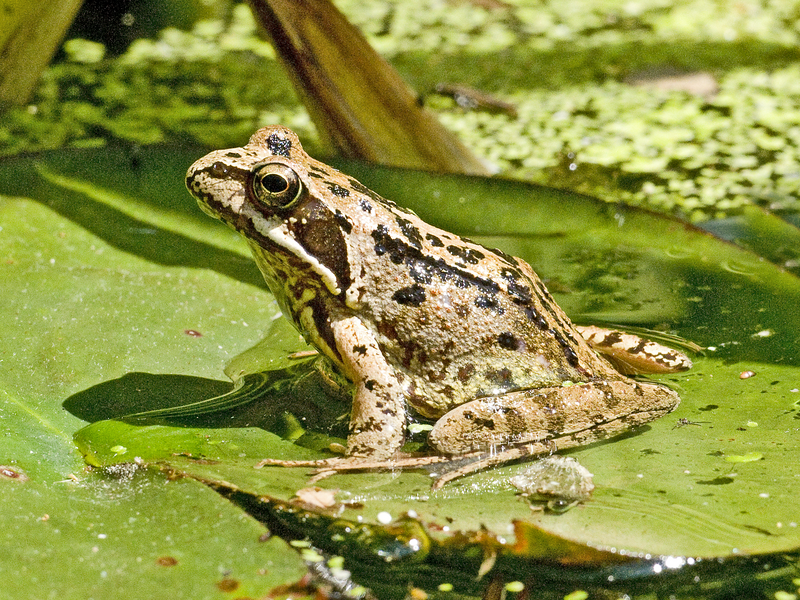
The most likely garden visitor. Frogs have smooth, moist skin; a dark mask behind the eye; very long back legs covered in dark bands; and webbed toes. They hop rather than walk and can make huge leaps. Females are larger than males. Usually found in damp places. Overall, a streamlined, athletic appearance.
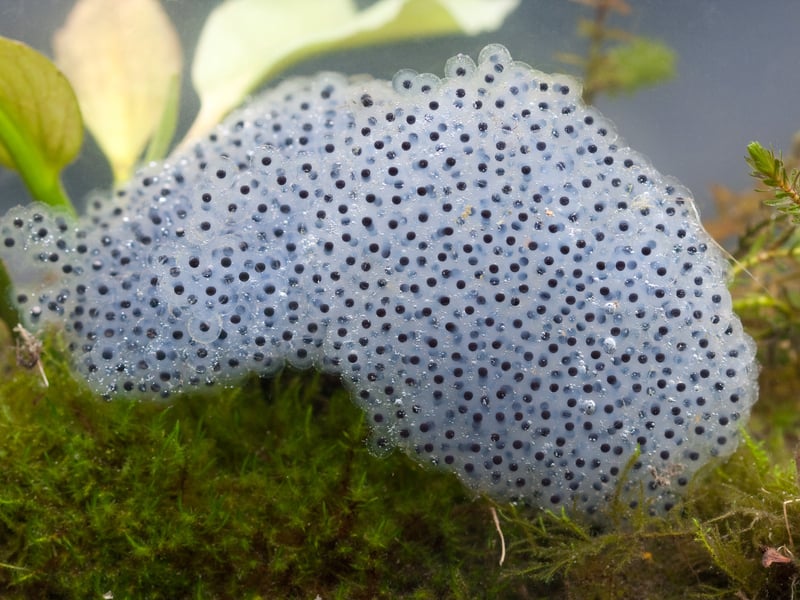
Eggs: Frogspawn is laid in clumps, sometimes in vast amounts, and usually in shallow water. Each egg looks like a tiny jelly marble with a black dot at the centre.
Tadpoles: Newly-hatched Frog tadpoles are black, often swarming in warm, shallow water. As they grow they turn greenish-brown with golden freckles and swim individually. Back legs grow first, then front.
Did you know? A female Frog may lay up to 4,000 eggs in a single spring breeding season!
Common Toad Bufo bufo
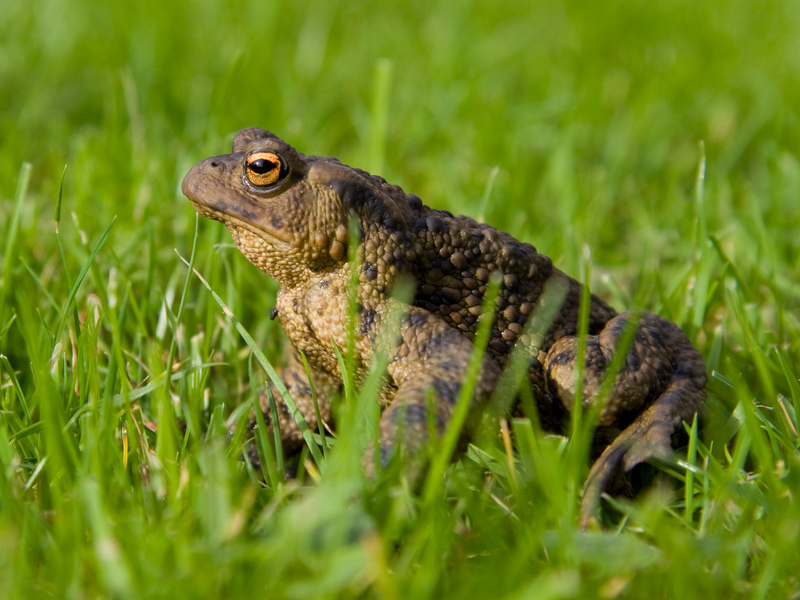
Toads have relatively dry, bumpy skin and can tolerate drier conditions. Their hind legs are much shorter and toes are not webbed. Toads walk rather than hop. Females are larger than males. Overall, a squat and stocky appearance.
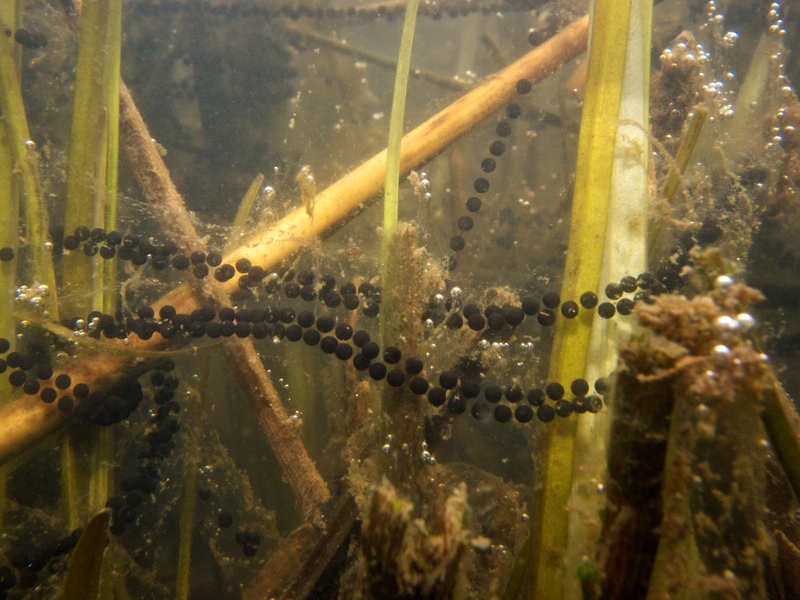
Eggs: Laid in long strings, often wrapped around pond weed and other underwater plants, and usually in deeper water.
Tadpoles: Chunkier than Frog tadpoles, they remain black as they develop and will often swim together in shoals. Back legs grow first, then front.
Did you know? Toads will migrate several kilometres to reach their ancestral breeding ponds
Smooth Newt Lissotriton vulgaris
Also known as the Common Newt, this is the one most often found in garden ponds, sometimes in very large numbers. Males are covered with dark ‘leopard’ spots and develop a crest along their backs during the spring breeding season, with an orange belly. Females are usually smaller and a plain, uniform brown with a creamy underside and speckled chin; they do not have a crest. Smooth Newts grow to about 10 cm in length.
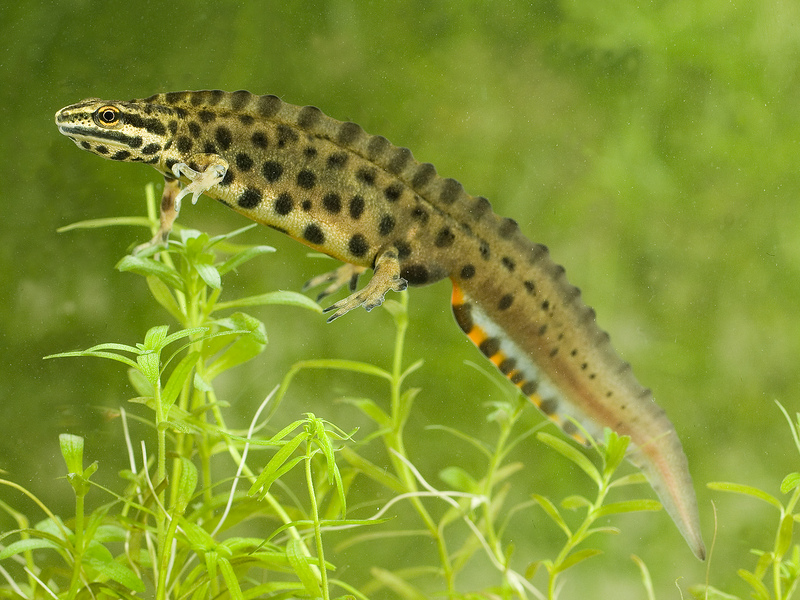
Eggs: Tiny (3mm diameter) with a brown nucleus inside a clear jelly shell. Individual eggs are laid on underwater plants, usually with the leaves folded over to hide them. It may take 10 minutes for a female to lay and wrap a single egg, and she may lay 200 eggs in total.
Tadpoles: Can be distinguished from Frog or Toad tadpoles by their distinctive feathery gills. Front legs grow first, then back.
Did you know? Newts reach maturity at about three years old but can live for up to twelve years.
Palmate Newt Lissotriton helveticus
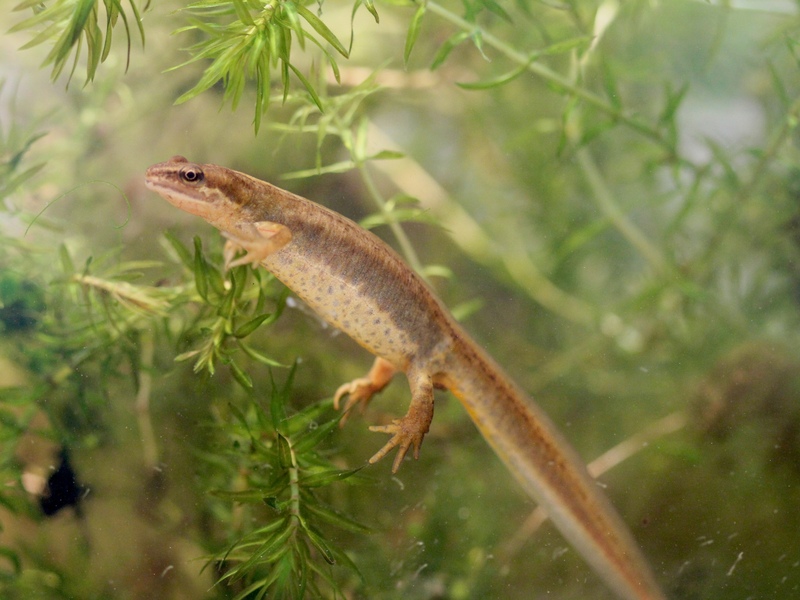
Our smallest newts tend to prefer shallow pools on acidic soils (heathland) but do turn up in gardens too. Males have distinctive black, webbed hind feet that can look more like a diver’s flippers; their tail ends in a hair-thin filament about 5mm long; and the breeding crest is barely visible. Females are larger and look almost identical to Common Newt females, except that their chins do not have speckles.
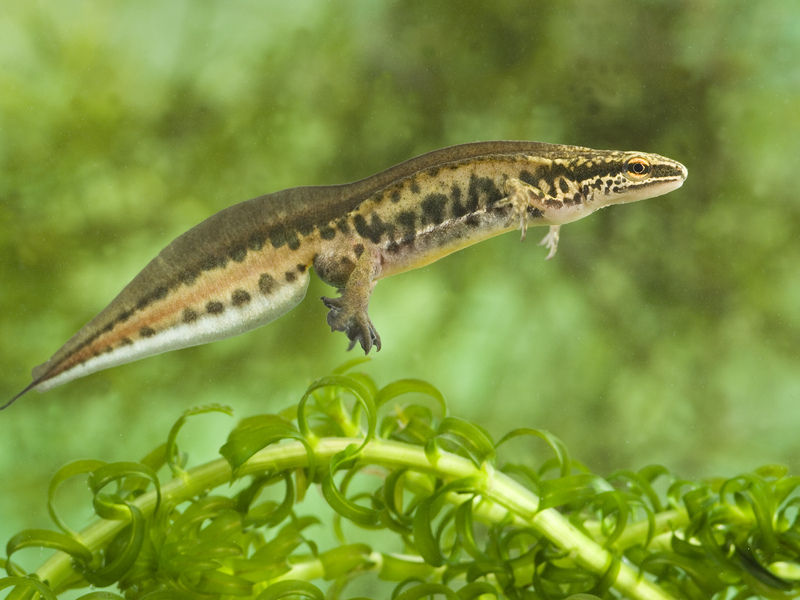
Eggs: virtually identical to Smooth Newt
Tadpoles: virtually identical to Smooth Newt
Did you know? The Palmate Newt is named after the male’s webbed back feet, a feature unique to the species.
Great Crested Newt Triturus cristatus
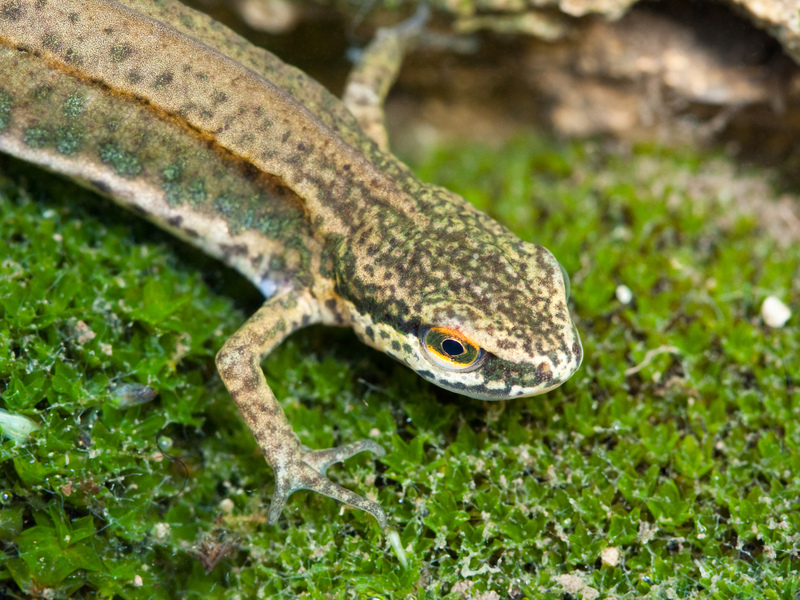
The largest of the newt species (up to 18 cm in length) is also the rarest and the most heavily protected. The skin is very dark, almost black, with a granular texture that gives them a more reptilian appearance. Males develop a large, jagged crest during the breeding season with a striking orange belly, patterned with dark spots. Females are also orange underneath, with a narrow orange or yellow stripe on the underside of their tail.
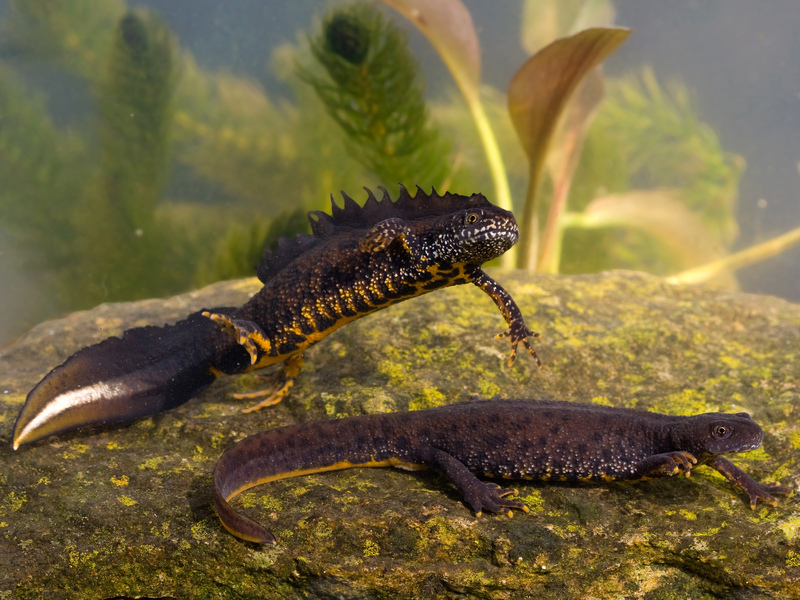
Eggs: Slightly larger at 4-5mm diameter, with a distinctive white nucleus inside a clear jelly shell. Laid individually on underwater vegetation, usually at night.
Tadpoles: Slightly larger than other newt tadpoles, about 5mm when freshly hatched, with distinctive feathery gills. Front legs grow first, then back.
Did you know? Males perform an elaborate courtship dance to woo females
Comments
Hi i have had no frog spawn in my pond this year could you tell me reason why.
ANSWER Hard to say without knowing more – frog populations do fluctuate naturally and you may get lots of spawn one year and less the next. It all depends on survival rates, which can be strongly linked to the weather (e.g. if it gets very cold in winter or very dry in summer) as well as other factors such as habitat availability and connectivity – they are very terrestrial outside of the breeding season and need plenty of damp, shady areas to shelter, hunt and overwinter. There are also a number of diseases impacting frogs but if you haven’t seen any dead frogs in large numbers, there’s probably nothing to worry about.Yours I.J.Preston
26 Mar 2022 20:59:00
An interesting summary of the garden Amphibians.
06 Jun 2022 15:32:00
Last winter I found a small black frog in my rain barrel and put it into my garden pond, where I have 4 gold fish. Now my pond has many small black fish that show up clearly against the larger golden ones. The black ones do not seem to be tadpoles but have tales and fins like fish-what are they? will they turn into frogs?
07 Aug 2022 06:57:00
Sussex Wildlife Trust:
Fish will not turn into frogs, no. They are most likely baby goldfish!
We have had newts in the garden for going on 40yrs, a small pond for a fraction of that time. Last year both the frogs and newts seemed to disappear, but this year I am excited to say a good number of newts in the pond and one frog! Mobile phone took acceptable pictures under water which was fun.
29 May 2023 18:49:00
I have newts in my wildlife pond and also frog spawn. Will any of frog tadpoles survive with the newts in the pond? I have another pond but that has fish in.
17 Feb 2024 13:45:00
Sussex Wildlife Trust:
It's possible for some tadpoles to survive with newts. Tadpoles do suffer high predation rates, this is part of the reason that frog lay some many eggs. You can help by creating more hiding places in the pond. Plants, rocks, and logs all provide cover for tadpoles to escape predation
I have have reconstructed my fish pond at the bottom of my garden & made it smaller, there are no longer any fish in the pond. Over the winter the pond has filled with rain water after being empty, I now have some lovely tadpoles swimming around, I have today seen a fish in the pond how and from where i do not know. It is about 2 inches long is black with a silver underside. any idea what it could be? no legs so I don’t think its a newt? please reply to above if you can many thanks
20 Mar 2024 18:34:00
Sussex Wildlife Trust:
That is a mystery. Most likely is the fish was transported by a bird (duck / heron etc) this could happen as accidental with a small fish or fish eggs caught in feathers or within mud on feet etc. Flooding could be another option, if you have had a lot of rain, fish could be washed from a neighbours pond for example.
I have froglets in my garden – some are larger than others. Are female froglets larger than males right from when they change from tadpoles into frogs, or is the difference in size due to other factors?
18 Apr 2024 15:35:00
I have a wildlife pond which breeds frogs and common newts. I often see these adults around the garden in tubs of water and damp areas etc. Should I put them back into the pond?
16 Jul 2024 11:08:00
Sussex Wildlife Trust:
If the Frogs are unable to get out of the tubs themselves, then you can move them to the pond
Hi. I have been catering for wildlife in my garden for 20 years I think. I am lucky to say that in my simple garden pond a fiberglass garden pond sunk into the soil and surrounded with various native wild plants and a pile of logs and various natural wood bits. Old ceramic pots and stones plenty of hiding places for everything I have seen the various frogs newts and toads. The area they inhabit is about 12/12 with a medium pond in the middle. It is all natural no pumps or filters the water is clear and beautiful and teaming with life. Even leeches Various nymphs dragonfly etc and early in the year the pond is a heaving mass of spawning animals It is wonderful to see. I live in south wales The only thing I have not seen in the garden is the Ada and the grass snake But I keep looking the slow worms are plentiful it is wonderful. Nature finds a way. Always.
09 Sep 2024 19:47:00
Thanku so much for information on these wonderful creatures.
14 May 2025 18:58:00