
A Bundle of Winter Wrens
By Kerry Williams
Communications Officer - Conservation
Someone once told me if you think you’ve seen a mouse it’s probably a Wren. These diminutive brown birds make a habit of hopping about the undergrowth in stop-motion fashion, feeding on insects, spiders, and occasionally berries and seeds. Despite being the UK’s most numerous breeding bird, they can be inconspicuous.
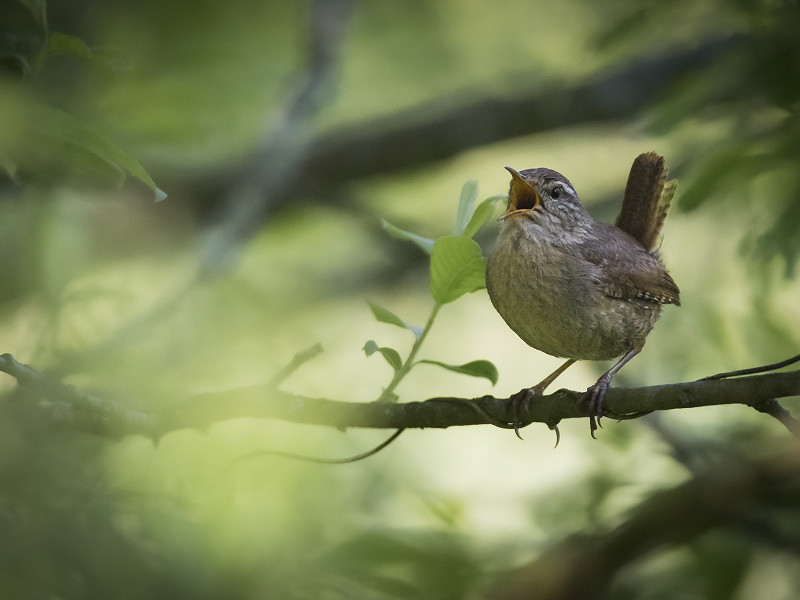
The similarity promptly ends when they open their mouth. Though weighing under 10g, the Wren’s voice is bold and loud; a long, high-pitched whistle and trill, cutting through crisp morning air and reaching above that of larger songsters. If you watch a Wren singing, you’ll notice the effort on its small body – beak wide and tail upturned.
Woodland understory is an ideal nesting habitat for Wrens, and males establish clear territories in early spring, using that powerful voice. They build five or even six nests to try and attract a female and will aggressively deter other males that dare approach.

However, when the chill of winter comes around, the male changes his tune. A balmy summer of successful shouting may have shown that a tiny body is no barrier to being heard, but it won’t help with heat loss on cold nights.
So, the male starts collecting bedfellows. Flitting out on short trips, he again utilises his song, letting females and other males know they are welcome to join him for a platonic sleepover, starting after dusk and ending before dawn.
“Oh, that stuff I said in spring? Water under the bridge.”
They gratefully accept, bundling into moss and leaf-lined woven grass, squidging tiny wings and bellies together to make room for just one more. Beaks in, bums out. Most consist of small gatherings, but records of dozens have been logged, and one count in the 1960s numbered 61 Wrens.

Not just super cute, the warmth-sharing of these communal roosts might be lifesaving. Although as anyone who shares a bed will know, there can be a waste of energy caused by the wriggling of others. Shuffling for space, preening, defecating in the roost; entirely unacceptable sleepover etiquette.
When warmer days thankfully return it’s back to spring rules, and the male begins to banish other males from the roost, cosy winter cuddles forgotten until the cold starts to nip around tiny feet once more.
Next time you hear a winter Wren having a good yell, be sympathetic. It’s survived the night, thank goodness, but it’s had a terrible night’s sleep.
Comments
Brilliant! What a lot I’ve learnt about one of my favourite birds.
22 Jan 2026 11:38:00
Thank you. I enjoyed the information together with added humour.
22 Jan 2026 11:39:00
What a great article, informative and funny.
Thanks. Christine
22 Jan 2026 11:41:00
What a beautifully written and delightful piece about wrens! I fell much better informed too…
22 Jan 2026 11:45:00
For 50 year we have had wrens in our garden which has lots of undergrowth . I was not aware of
their winter habit and I will download a copy of your article for my 12 year old grandson to take
to school. Hopefully others will find it as interesting as I have!
22 Jan 2026 11:51:00
Very interesting article regarding wrens
22 Jan 2026 11:52:00
Thank you. Lovely article. 61! The website is our new project supported by Somerset Wildlife Trust.
22 Jan 2026 11:53:00
So sweet as is all wild life . ♥️
22 Jan 2026 12:01:00
A very amusing and informative read! What an amazing little bird! I love the behaviour of the male! What a creep!😄 Then returns to a bully come the Spring! Thoroughly enjoyed reading about them!
22 Jan 2026 12:06:00
Often wondered how they coped on very cold weather. Article very informative.
22 Jan 2026 12:38:00
What constitutes a breeding bird? Surely all birds breed? I’m obviously not an ornithologist
22 Jan 2026 12:59:00
Sussex Wildlife Trust:
Hi David - good question! Often, and in the case of this article, the term 'breeding bird' refers to a species which breeds here (whether this be the UK, like the Wrens, or Sussex specifically), as opposed to a migrating bird which breeds elsewhere. In some cases, but less often, 'breeding bird' could refer to those birds that are paired up and nesting, vs still maturing birds who are too young to breed, those who haven't found a partner etc.
Thank you, made me chuckle!
22 Jan 2026 13:13:00
Lovely photos!
22 Jan 2026 13:15:00
Thank you for that. It made me feel so joyful!
22 Jan 2026 13:28:00
Lovely article – informative and cosy! Thank you.
22 Jan 2026 13:36:00
This fascinating information thank you
22 Jan 2026 14:08:00
Learnt lots about Jenny Wren. Thank you .
22 Jan 2026 14:10:00
Thanks for this illuminating and entertaining article on the wren, a bird I have long admired. So great to learn new things about wildlife!
22 Jan 2026 14:18:00
Fascinating … proof you learn something new every day! Thank you
22 Jan 2026 14:19:00
Fascinating insight into one of our most loved birds. Was aware of communal roosting but no idea song was different to invite others to join!
22 Jan 2026 14:22:00
I never knew about these sleepovers, what a lovely thing! Thanks for sharing it.
22 Jan 2026 14:30:00
Loved the Wren article
22 Jan 2026 14:30:00
Thank you so much I love that piece about Wrens, one of my favourite birds.
one has been appearing on our grand floor balcony and I wonder should I put a little nest out for it?
22 Jan 2026 14:42:00
Thank you, I love all birds and the tiny wren is always a pleasure to see. I’m so grateful for this information.
22 Jan 2026 14:43:00
An informative and amusing article, many more please!
22 Jan 2026 15:00:00
Really interesting information about wrens. They are such lovely birds .Thank you.
22 Jan 2026 15:13:00
Loved reading about the Wren and the seasonal sleepovers . If only there were more species of males happy to let bygones be bygones in the name of survival !
22 Jan 2026 15:16:00
I often wondered how birds stay warm in winter. Fascinating that wrens cuddle up to stay warm. Do sparrows also cuddle up in a shared nest in the cold winter months?
22 Jan 2026 15:26:00
Sussex Wildlife Trust:
Hi Marilyn. Sparrows huddle to conserve body heat. This will usually be in particularly sheltered locations, both natural and human-made (freqently in nest boxes). Many similar species will also fluff up their feathers by holding an insulating layer of warm air against their skin to help them stay warm.
Enjoyed the piece about Wrens. I didn’t know they often roosted together during winter.
22 Jan 2026 15:28:00
A delightful and informative article, Kerry, thank you, up to the high standards always set by the excellent and highly effective Sussex Wildlife Trust.
22 Jan 2026 15:31:00
Always loved them and thanks to your article l love them more. An excellent solution to cold winter nights.
22 Jan 2026 15:39:00
A great article to herald the Big Garden Bird Watch! Hope to see and a wren or two!!
22 Jan 2026 16:00:00
Love this, I didn’t know much about Wrens. I will look out for them
22 Jan 2026 16:03:00
Loved learning about them. I have had wrens in my garden for several years. High hedges all around the plot and I feed the birds regularly and see them ground feeding. Their song is clear and strong. Thank you for the information
22 Jan 2026 16:07:00
‘Keep your friends close, keep your enemies closer’!
22 Jan 2026 16:24:00
So interesting. I love these little cuties.
22 Jan 2026 16:32:00
Thank you. Very interesting. I didn’t realize that wrens are so numerous nor that they have ‘mass huddles’.
More such ‘potted biographies’ would be very welcome.
22 Jan 2026 16:34:00
What a lovely article! So interesting. I never knew the sweet little wren did this in winter. Thank you.
22 Jan 2026 17:05:00
How clever and amusing. We are not so different afterall.
But how are they not predates?
22 Jan 2026 17:17:00
Sussex Wildlife Trust:
Wrens make the most of their small stature, and squeeze into the places larger creatures (including most predators) can't reach! The strength of their song means they can sing while remaining well hidden too.
Delightful writing to enjoy on a damp January day I can almost feel their tiny heartbeats as they snuggle up together in their cosy moss lined nest
Thank you for such an interesting article!
22 Jan 2026 17:26:00
What survivors!
Any information about how the even smaller goldcrests survive the cold in winter?
22 Jan 2026 17:33:00
Sussex Wildlife Trust:
Hi Patricia. Goldcrests have an extremely high metabolic rate and feed constantly throughout daylight hours, cramming in as many calorioes as possible. They maintain a really high body temperature by burning their fat reserves overnight, at least 10-20% of their body weight. Overnight the metabolism is slowed down, the birds entering a state of mild torpor, whilst they frequently huddle to keep warm. Amazingly they are capable of surviving winters in much harsher environments, even Siberia where the temperatures may be lower than -40c.
Top piece Kerry. I have been trying to increase the amount of cover in my garden – with thickets, dead hedges and long grass. I have seen the odd wren but I think there are more out there. Thanks for the helpful descriptions of the calls and winter house sharing.
22 Jan 2026 17:39:00
Yet again you furnish me with facts I didn’t know- thank you!
22 Jan 2026 17:51:00
Oh what an amazing story! A very surprising but lovely story of how these dear little birds survive in hard times. Thank you for sharing.
22 Jan 2026 19:27:00
How interesting and informative is this feature. Thank you.
22 Jan 2026 20:00:00
Very interesting, thank you! I love to see wagtails roosting in winter months in trees near street lamps in my hometown. Dozens of them, silent and mostly unobserved, their presence only hinted at by the droppings beneath the trees.
22 Jan 2026 20:43:00
Loved the Wren article
22 Jan 2026 20:56:00
I’ve loved discovering about wrens. I’ve seen them scooting across the garden.
I thought what I heard in the afternoon was the cheeky robin waiting for some mealy worms that I take out with me – but maybe not.
Could I help with piles of moss – we’ve got loads, and we have feeders with not only a variety of food, but cat fur that the blue tits like.
I wonder if the wrens nest fairly low in all the bushes? Idid have an old large kettle in a hedge but the neighbour must have disposed of it. Would hanging baskets full of moss be useful as starter nests?
Thanks so much xx
22 Jan 2026 21:30:00
Sussex Wildlife Trust:
Hi Sylvia. Wrens have some similar vocalisations to Robins - usually a harder "tac" compared to the Robin's elasticated "tic." It's likely you'll be hearing both in your garden. Yes, Wrens nest everywhere - in almost any natural and even human-made environment, but usually close to the ground. The old kettle may well have proved to be perfect! Leaving moss-filled baskets out is a good idea and will no doubt prove useful to any to any female whilst she inspects nesting options.
What a brilliantly written article with interesting Winter facts about our much cherished Wren!
22 Jan 2026 23:15:00
I wasn’t aware of this even though they are one of my favourite birds.
This was a well written, informative and amusing piece which made me smile on a dark winter’s eve. Thank you.
22 Jan 2026 23:44:00
I am very privileged to have a beautiful wren in my garden all day every day
23 Jan 2026 07:27:00
I loved reading about the wren. We have several in our garden but they’re more often heard than seen! Love the idea of platonic sleepover winter communities!
23 Jan 2026 08:29:00
Thank you Kerry for a very readible article packed with information and humour!
23 Jan 2026 09:39:00
I see wrens in the undergrowth frequently. Are there nesting boxes or materials I can put out for them?
I thought they were quite rare when I was a child so love to see them.
23 Jan 2026 12:00:00
Sussex Wildlife Trust:
Hi Sylvia, Wrens nest in all sorts of places - in almost any natural and even human-made environment, but usually close to the ground. They may make use of any left items around the garden, whether offical nest box or otherwise. A great thing to provide nesting material and spaces for birds and all wildlife is to not be overly tidy and leave your garden, or even some areas, a bit wild. Leaves, moss, fallen logs and 'messy' undergrowth are all fab spaces for wildlife.
Brilliant! I shall keep my eyes oopen for a “look see” when the weather improves
23 Jan 2026 12:19:00
I’m glad to hear of the community method of survival, as I have found a frozen wren that looked like it just fell out the sky or a tree.
The calorie use as in a winter forage could have been a lost gamble, or it was too late or kicked out? But they need the insects that need our rough shabby trees leaning and fallen or standing dead. As a tree surgeon/ conservationist I wish we could accept the mess of nature and live a truly inclusive word.
23 Jan 2026 14:10:00
Fascinating information about such an active beautiful little bird. Thank you!
23 Jan 2026 15:15:00
They are a wonderful addition to all the birds that live in protected St Helens wood area of Hastings near where we live.
23 Jan 2026 15:42:00
Thank you so much for this – I didn’t know they huddled together in winter – smart move!
23 Jan 2026 17:27:00
This is wonderful: beautifully written, entertaining and informative.
23 Jan 2026 22:49:00
I have a tiny wren i notice flitting speedily about. She built a nest inside my chicken house last year but didnt stay in it long as i go in to clean it and collect eggs. I kept thr beautiful nest to show my grandchildfen
24 Jan 2026 06:55:00
Very interesting, thank you! I love to see wagtails roosting in winter months in trees near street lamps in my hometown. Dozens of them, silent and mostly unobserved, their presence only hinted at by the droppings beneath the trees.
24 Jan 2026 07:12:00
Very interesting and well written
24 Jan 2026 08:53:00
It’s so interesting ! Thank you ! So lovely to hear about wrens.
24 Jan 2026 10:25:00
They are a wonderful addition to all the birds that live in protected St Helens wood area of Hastings near where we live.
24 Jan 2026 12:06:00
A chime of wrens snuggled up for warmth.
That helps me sleep a little easier .
24 Jan 2026 15:04:00
Facts and fun. Excellent communication from Kerry!!
24 Jan 2026 17:12:00
Brilliant, thank you. Amusing and interesting – a great combination.
24 Jan 2026 18:14:00
Most numerous breeding bird? More than starlings or Gulls ??? I see a lot of both how are the numbers produced?
24 Jan 2026 18:21:00
Sussex Wildlife Trust:
Hi Ian, a good question. Despite their numbers Wrens are quite shy and well hidden away, so you're not the only one who is surprised by this fact! You can check out the BTO website for more information on breeding bird numbers in the UK - Wren | BTO.
Fascinating. I’d no idea wrens led such interesting lives – thank you for all the information.
24 Jan 2026 21:14:00
Delightful read on my favourite bird!
25 Jan 2026 08:14:00
I thoroughly enjoyed this informative article about the wren. They used to call me Jenny Wren at school, a very long time ago! I am always very pleased to see this little bird hopping about in our garden. Thankyou.
25 Jan 2026 09:32:00
Thank you for all that lovely information
25 Jan 2026 14:21:00
Wonderful little bird thanks for all that information
25 Jan 2026 22:13:00
I’m glad to hear of the community method of survival, as I have found a frozen wren that looked like it just fell out the sky or a tree.
The calorie use as in a winter forage could have been a lost gamble, or it was too late or kicked out? But they need the insects that need our rough shabby trees leaning and fallen or standing dead. As a tree surgeon/ conservationist I wish we could accept the mess of nature and live a truly inclusive word.
25 Jan 2026 23:04:00
Very interesting and very beautiful
26 Jan 2026 14:17:00
Many thanks for this fascinating information
27 Jan 2026 08:42:00
I loved this piece. It always gives me joy to see and hear these tiny birds. Just like mice they are very good hopping over the ground and then disappearing. They dive into a bush and you never can see where they come out.
I also wonder what other tiny birds like the gold crest and dartford warbler are doing in this wet winter?
27 Jan 2026 11:55:00
I’ve heard them sing loudly, but I didn’t know they nestle up together in cold weather. I often see them in our garden.
27 Jan 2026 17:14:00
loved learning more about this tiny songsters
28 Jan 2026 16:20:00
Lovely article and fascinating to hear about the cosy, nest-sharing winter wren behaviour 😊
31 Jan 2026 12:11:00
Great article – good mix of fact & fun – thank you .
31 Jan 2026 12:33:00
My grand daughters name is wren. She is amused and intrigued by these tiny birds
31 Jan 2026 14:00:00
What a brilliantly written piece. Warm and funny and full of information. Thank you so much
31 Jan 2026 18:52:00
Good composition. And informative
02 Feb 2026 12:52:00
I have had a pair breeding in last few years and i occasionally see them in my garden pots in the winter and spring.Wonderful little birds
06 Feb 2026 22:50:00
What a charming little film we do have wrens in our garden but not as many as 61!
07 Feb 2026 12:07:00
A great article to herald the Big Garden Bird Watch! Hope to see and a wren or two!!
07 Mar 2026 21:37:00
Awesome ☺️ Great article, and informative.
16 Mar 2026 18:49:00
We’ve had three wrens roasting in the eves of our out house all winter. Good news is they all seem fit and well. Bad news is we need to clean up the mess and weather proof the building. Will they all leave soon or will the dominant one stay and nest there. If they stay how close can we paint without driving them out?
17 Mar 2026 20:32:00
Sussex Wildlife Trust:
Whilst it was clearly a winter roost, nobody can really say whether one of the Wrens may choose it as a nest site. True masters of almost every UK habitat, Wrens will nest almost anywhere. If a nest is disrupted during breeding/nesting, it'll likely be abandoned at some point. So, if the house needs repair I'd be tempted to get going on it now as many species are already in the process of selecting/maintaining nest sites. However, male Wrens typically build multiple nest sites with which a female may choose from. Though Wrens are typically sedentary as a whole, staying relatively faithful to their home territory, we wouldn't be overly worried about the disturbance of a winter roost (now we're coming into spring) particularly if you have a good variation of suitable nesting habitat within your garden space.