
A brief guide to birdlistening

By Lev Parikian
Lev is a writer, conductor and birdwatcher. He has written six books. 'Into The Tangled Bank' was longlisted for the Wainwright Prize for Nature Writing in 2021.
Spring is here and the air is alive with birdsong. It’ll grow and intensify until a peak in early May, bringing with it an aural extravaganza that we sometimes think is designed solely to make humans happier.
That’s not why they do it, of course. The main purposes of birdsong are generally acknowledged to be advertising for a mate and claiming territory – it’s a happy coincidence that the sounds they make have a pleasing effect on the human psyche (although try telling that to the seaside dweller who’s harangued by squawking gulls from four o’clock every morning).
Mostly pleasing they may be, but bird sounds do present a problem for anyone wanting to identify a bird without seeing it. This, after all, is how we often experience them. A fleeting burst from the depths of the foliage – skrrr-tseee-djree-tsweep-flwee-wee-chiddly-wip – and that’s it. Perhaps an inconclusive glimpse of a brown tail before it dives into the depths, never to be seen again. And sorting out the skrrrs from the chiddly-wips is a sure recipe for confusion.
If you find the world of bird language bewildering, you’re not alone. Human ears struggle to identify birdsong. Nearly all of it occupies a fairly narrow aural niche, up in the higher reaches of our hearing. And birds generally don’t play tunes we can hum or imitate. Throw in the annoying facts that a lot of birds don’t just make one sound, and that they often all sing at the same time (especially at this time of year), and it quickly becomes a perplexing muddle.
To offer a smidgeon of assistance, here are a few of the commonest birds you’re likely to hear as spring gets going.
Robin
Garden familiars, Robins are one of the few songbirds to sing almost year-round. Their song consists of silvery, liquid flutings and ripplings, interspersed with short pauses between each phrase. Sometimes it’s a thin ribbon, sometimes it bubbles out and away, almost out of control. Each phrase is slightly different from the previous one, so try to lodge the sound of the voice – its timbre and register – in your head. What you’re listening for is the quality of the bird’s voice, not necessarily what it’s saying. It’s like the way you recognise your friend Susie’s voice, whether they’re saying ‘cup of tea?’ or ‘my grandmother's fish tank is full of loganberries’.
Robins also produce this alarm call if there is danger nearby:
And a nervous tik-ti-tik-tik call, often around dusk.
Blackbird
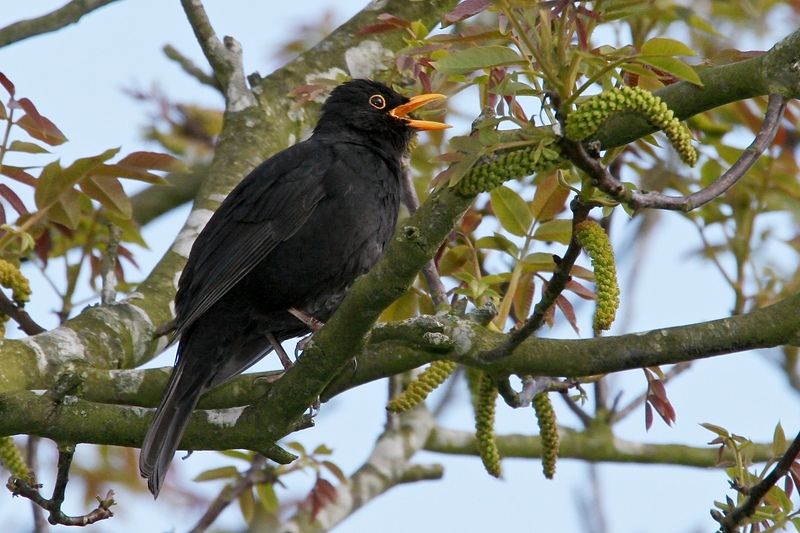
A favourite of many, the Blackbird’s rich and varied song is a famous early harbinger of spring. It’s similar to the Robin’s in one sense: each phrase is followed by a short gap, as if they’re allowing the significance of what they’ve just said to sink in.
But the timbre is different. A Robin’s voice is thinner and higher in pitch; the Blackbird’s is rich, mellow, mellifluous – as if it has a deeper throat. It also throws in a few squeaks and squawks here and there, while the Robin favours rippling, wispy variations.
Some birds repeat the same thing over and over and over and over and over again. They’re the pub bores of the bird world. But birds like the Robin and the Blackbird are the John Coltranes and Wynton Marsalises. You want to sit and listen all evening.
Here’s a Blackbird singing at dusk.
They also have a very distinctive emergency alarm call.
And a more low-key, but often very persistent, chipping alarm.
Great Tit
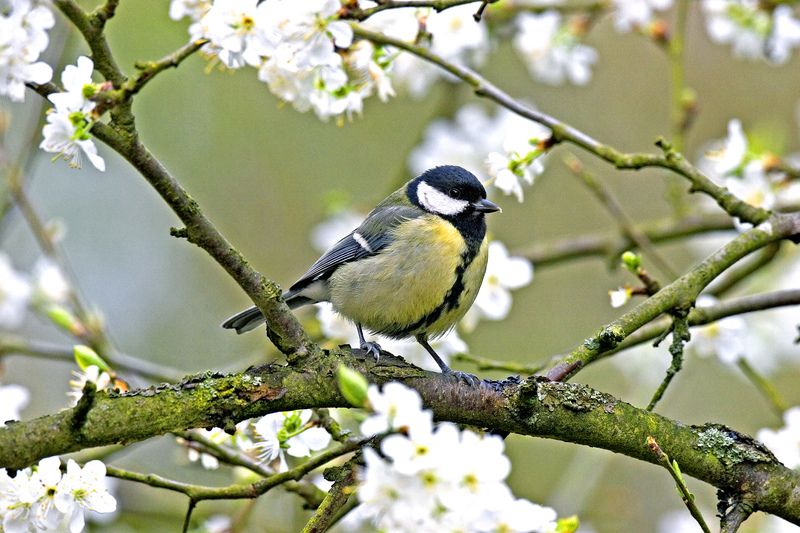
If Robins and Blackbirds are John Coltrane and Wynton Marsalis, Great Tits are Status Quo: purveyors of classic recognisable songs that have you nodding in recognition before you realise you’d like them to learn a few more chords.
The old-school way of remembering the Great Tit’s song is to imagine a child at the back of the class trying to attract attention: ‘Teacher! Teacher! Teacher!’
But beware: like Status Quo, they have numerous variations on the same formula, as here. Two notes, different rhythm (tea-tea-cher, if you like)
A good way to remember the Great Tit’s song is by its timbre. ‘Squeaky wheelbarrow’ is a good one. Even better, I think, is ‘tiny foot pump’.
A common feature of Great Tit sounds is that they generally veer towards the harsh and strident rather than the soft and soothing. Here are some alarm calls to demonstrate this.
There’s an old saying: 'If you don't know what it is, it's probably a Great Tit.’ And once you delve a bit into its various vocalisations you begin to realise how much of what you hear about the place is down to them. Here are two more chart-toppers to illustrate the point.
Blue Tit
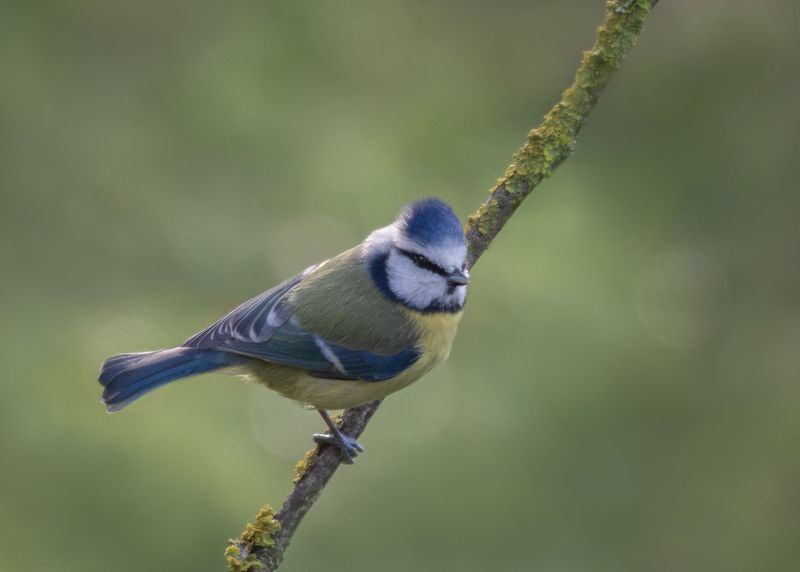
I think we get Blue Tits wrong. We tend to say ‘oh look, a blue tit’, almost in passing, when what we should be saying is ‘oh my GOD just look at that beautiful thing and it’s hanging UPSIDE DOWN from the feeder LOOK AT IT’.
Like the Great Tit, the Blue Tit is responsible for quite a few sounds, although its repertoire isn’t quite as varied. Here’s the song. Two (sometimes three) piercing 'tsreep's followed by a series of lower, faster notes with a softer tone.
And here is one of its calls, regularly heard from the depths of foliage – perhaps as a warning of danger, perhaps as a general comment on the state of the world. Who knows?
Wren
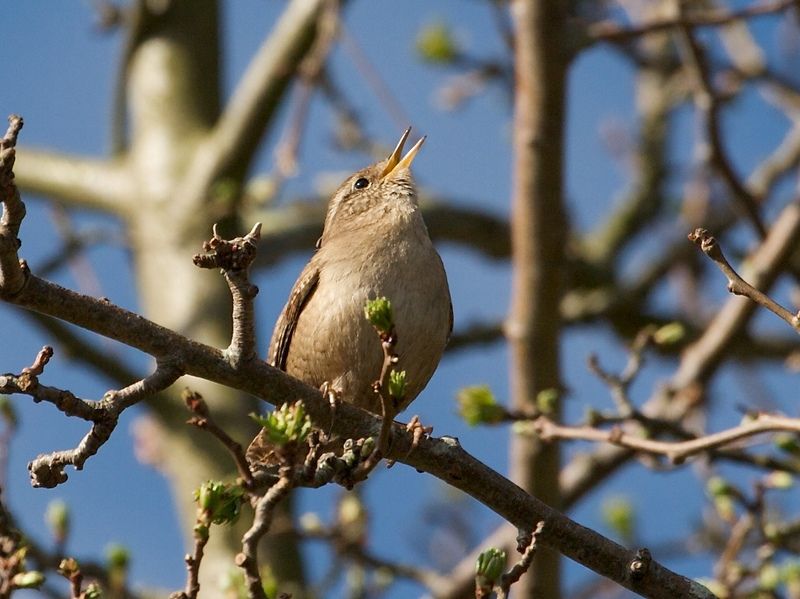
An encounter with a Wren might go like this.
You’re walking in your local park and the bush five yards ahead of you explodes with noise. Tsib-a-tsab-a-tsoo-diddy-dabble-iddy-wodda-tsipp-a-brrrr-tsip-tsip-tsip-tsip-tsip-tsip-tsip—tjop-tsrrrrrrrrrrrrrr—ts’tjupp-tjupp-tjupp-tjupp.
It is very very loud.
You look out for a chunky bird, something commensurate with the volume produced. Then a tiny brown whirr whizzes out in front of you and disappears into another bush on the other side of the path. That can't be it, surely? Such a tidgy thing, such a massive sound.
But it is, and it confirms it with another deafening outburst from low down in the hedge.
This is why I like to call the wren ‘Tiny Shouter’.
Listen out for the key elements:
– volume
– assorted jumble of tsib-a-tsabs and dibble-woddles (of varying length)
– the tsip-tsip-tsip thing
– the machine-gun trill
– the repeated tjupp-tjupp-tjupps, usually after the trill
Not to confuse things too much, but you're also likely to hear a Wren making this rattling alarm call.
If you’re completely new to birdsong identification, those five species will be more than enough to be going on with. If you’re eager for more, you can head here for a more complete look at the wonders of British birdsong.
And if it’s all rather overwhelming, welcome to the club, and don’t worry too much. Knowing things is all very well, but it’s the noticing that counts.
Lev's latest book, Taking Flight: The Evolutionary Story of Life on the Wing, will be published on 4th May.
Comments
wonderful – thanks so much for sharing could listen for hours x
20 Apr 2023 17:31:00
What a lovely way to kick off my Sunday! I hear a bird singing outside my window very early in the morning – I will try and guess what it is according to its song.
07 May 2023 08:11:00