
8 legs good. The amazing world of spiders

Matt Rich
Ranger, Rye Harbour Nature Reserve
Who doesn’t love an arachnid? A beautiful, eight-legged creature that gets rid of pests in your home and outside.
Spiders are some of the most adaptable creatures in the world, thriving in six out of the seven continents. There are more than 660 species in the UK and I’ve narrowed down a few of my favourites, each with their own super powers.
Zebra Jumping Spider (Salticus scenicus)
One of the 37 jumping spiders in the UK, this one has black-and-white stripes and measures 6-7mm. It can be found in a variety of habitats and loves sitting on man-made structures to warm up.
On a sunny morning in late summer, this tiny stripy spider was jumping in-between blades of grass and wildflowers looking for its next meal. It was carefully judging the distance between stems and using its silk to create an anchor before leaping.
They rely heavily on vision to locate food, having 360-degree, binocular, full colour vision. This makes it easier for them to judge distance and depth of field. If you spend some time watching one hunt in the long grass, you’ll more than likely get a good long staring competition from this spider.
It’s a very active hunter, always on the move and able to cover ground quickly by jumping. A change in blood pressure propels the spider forward up to 14 times its own body length.
I spent a good 30 minutes watching this one jump about and completely forgot about the huge area of Ashdown Forest around me. I was completely sucked into the small but amazing life of this spider and would highly recommend getting a pocket magnifying glass and watching them go.
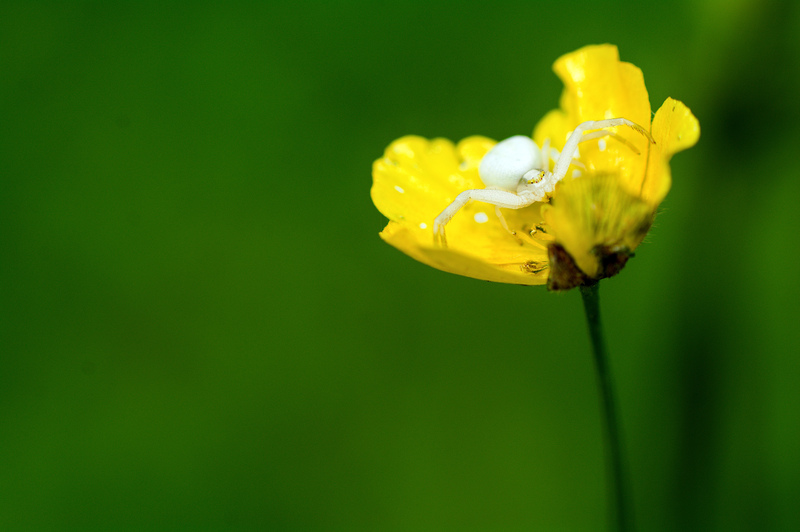
Flower Crab Spider (Misumena Vatia)
The most distinctive of 27 different types of crab spiders in the UK, this is a common species occurring in most flower meadows, gardens, fields – in fact anywhere in the south of the UK with available flowers for them to sit on. Males are smaller (3-4mm) and brown, and the females are colourful and bigger (9-11mm).
If medals were given out for patience and outfit changes, this spider would win gold.
It will find a suitable flower and sit there until an unsuspecting insect comes along to feed on the flower.
In the first picture you can see a spider that has recently got onto the yellow buttercup and clearly stands out. However, after several days it will change colour to match the yellow of the flower it sits on. This one can turn from yellow to white, while other Crab Spiders can turn purple/pink/yellow.
The colour change is used to hide from both their prey and predators. I find it very hard to spot these spiders, unless they have a big juicy fly.
The crab part of the name comes from the motion and structure of the spider’s body, with large front legs sprawled out like crab claws, ready to grab unsuspecting prey.
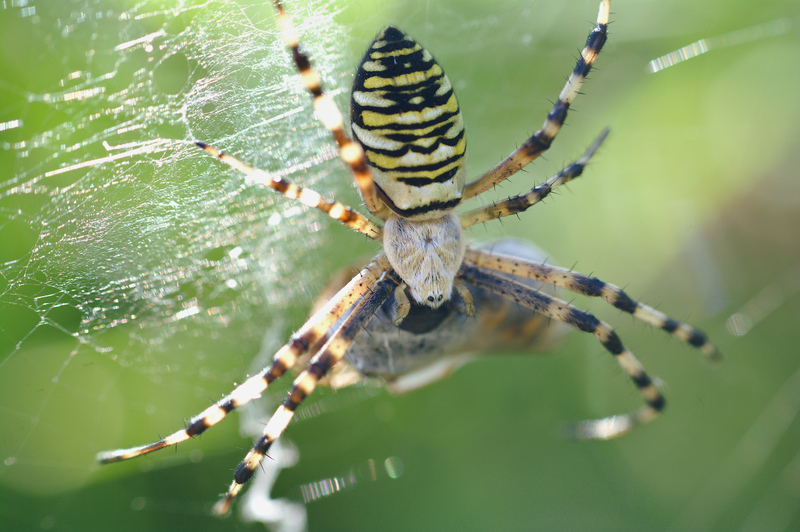
Wasp Spider (Argiope Bruennichi)
This is the third biggest spider in the UK, and for me the most spectacular. It’s easily recognisable with bold black and yellow stripes, like a wasp. Females dwarf the males with a size of 14–17mm and the males at 4–6mm.
They are found across the southern part of the UK, normally sitting in an orbed web with a zigzag pattern running through it. The zigzag becomes more distinctive as the spider gets older but the reason for this unusual pattern is not truly understood. It is believed to give the web more stability and attract insects to it.
When I first found one of these spiders, I was a bit worried it might be an exotic escape from someone’s home, it looked dangerous and something to avoid. However, I was amazed and truly excited to find out this is a British spider and is completely safe and not poisonous to humans.
I now feel privileged to be working at the place this spider was first recorded in the UK in 1922, when it was caught at Rye in East Sussex. I can just imagine how shocked that person must have been on first seeing this spider, compared to our normally bland species.
Comments
Brilliant and engaging writing.
Spiders are wonderful –
We learnt from this piece, even when the species were familiar.
Thank you for taking the time to share through your writing, Matt.
14 Nov 2023 21:25:00
I have an uneasy relationship with spiders, which I find little ‘spooky’, especially abroad when I don’t know which ones I encounter are dangerous. However, I enjoyed you descriptions and knowledge of the three species and shall look out for them next spring and summer!
02 Dec 2023 12:45:00
Thank you, I have long been fascinated by spiders but know so little about them. More please!
04 Dec 2023 16:16:00
It’s wonderful to get the Spiders perspective and many times I too have wondered at those fabulous variations their adaptations and site specific disguises and techniques for catching prey. I have to admit to being a little wary of some massive Raft spiders I encountered many moons ago but you have re enthused me and I shall spend more time just watching. Thank you for your knowledge and wonderful images both pictorial and verbal.
06 Dec 2023 18:14:00