

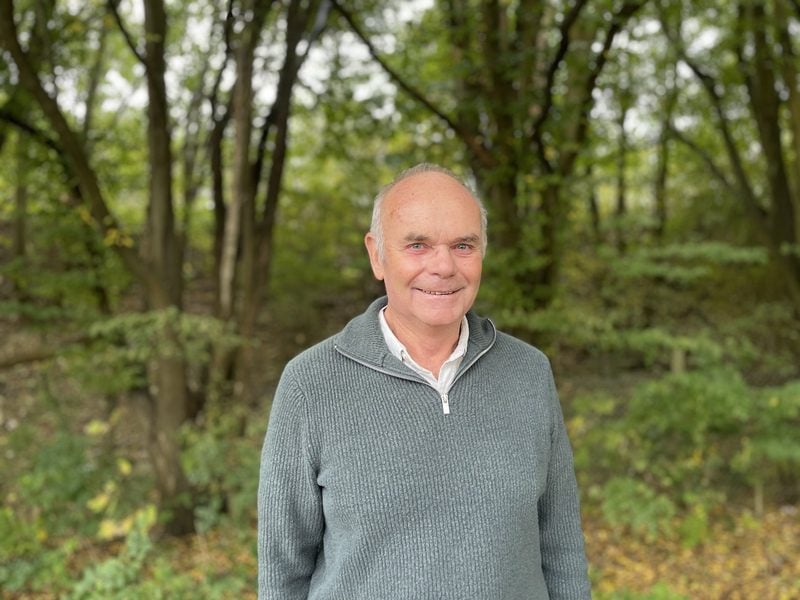
The Ouse and Adur Rivers Trust (OART) was formed in 2011 through the merger of the Sussex Ouse Conservation Society and the River Adur Conservation Society. The Director of OART, Peter King, joined as the first paid staff member at that time, and in the subsequent 14 years under his leadership, OART has been steadily growing in size. He has overseen the delivery of over 100 capital projects across the catchment, from large engineering schemes to realign and daylight sections of the river, creating wetlands or removing barriers, to smaller measures, such as in-channel habitat creation and natural flood management measures.
We caught up with him to find out more about him and OART.
Tell us a bit about yourself
Before joining the Ouse and Adur Rivers Trust, I volunteered for Sussex Wildlife Trust, mainly surveying for Water Voles and Otters, as well as undertaking mapping projects. Before that I researched the impacts of deforestation on geckos in Madagascar and ran a volunteer research programme on a private game reserve in South Africa.
Without the early career support of Sussex Wildlife Trust, especially [Nature Recovery Manager] Fran Southgate, I wouldn’t have got this job, so I feel a special affinity with the Trust.

How would you describe what OART does?
We deliver improvements to the freshwater and coastal ecosystems of the two rivers, by collecting and analysing data, then using this evidence base to enhance, restore, and create rivers and wetlands.
You do a lot of collaborative work?
We do! Part of our remit is hosting the Adur and Catchment Partnership, which brings together a range of organisations with a huge knowledge of the river system. So we can connect, collaborate, align our priorities, and coordinate funding approaches. We don’t need to compete with each other for the same goals.
Unfortunately, the problems and pressures on our rivers are complex, and it’s critical that we take a whole-systems approach to making improvements. To do this means we have to acknowledge strengths and weaknesses as organisations and work collaboratively to get the best outcome – there is no single organisation which can “fix” the rivers on their own. So most of what we do involves others.
This is particularly true of Sussex Wildlife Trust, who we’ve always enjoyed working with, through programmes such as the Adur Adaptation Project, and the Trust’s Wilder Ouse and Wilder Horsham District projects.

Tell us a bit about the rivers and how they differ from one another
The two rivers cover around 1000km2 of Sussex and are home to some really enigmatic species, such as Sea Trout and Sea Lamprey (only two known breeding populations in Sussex and one is on the Ouse – these are really amazing primitive fish with no jaws, gills or scales!).
Whilst the primary pressures on each river are pretty similar, and both have been subjected to significant historic modification and unsympathetic management, the landscapes in which they sit are very different and the interest in their health is also driven by different things.
The Ouse contains several protected sites in close proximity to the river, whereas the Adur only has one, right at the bottom in the estuary. The Ouse also contains a much higher amount of arable farming compared to the Adur Valley, which is primarily used for grazing. Most people think that the Ouse is different from the Adur due to the levels of abstraction from the river system but this isn’t actually the case. The River Adur also has significant river abstraction, but as it is not associated with public supply (water companies), it tends to be under the radar.
Generally you tend to hear negativity about rivers and their health, and obviously we’re all focused on making the bad bits better, but both these rivers contain large areas which are incredibly beautiful and in very good condition, and it’s important we get that message out as well.
What are you most proud of?
I’m really proud of the team we have at OART. They work incredibly hard, without a great deal of recognition or resource, to deliver our aims and objectives. Without this team, OART would be less impactful and the rivers would be in a worse state.
And I am proud of the amount of improvement we have delivered in the catchment. Highlights of this work are that around 10% of all the barriers in the river system have been removed or eased for fish, 36ha of wetland have been restored as a coordinated network to provide landscape connectivity, 34km of river restoration and six chalk stream projects have been completed and we’ve installed over 260 natural flood management measures.
None of this would be possible without a huge amount of support from a lot of different organisations and individuals, and I am really proud to be part of such a network of people delivering positive environmental change in Sussex.

Where is your favourite spot on either river?
I love all of both rivers, and the way they change almost daily. My favourite spots are in the upper reaches of the River Uck, where it feels untouched by humans and inspires what we are trying to do elsewhere. I also love the restored area of the Cockshut Stream near Lewes (although I am biased on this as this was a project I was intricately involved in the design of). I also have a soft spot for the Herring Stream on the Adur, which has some remarkable habitat on it as well.
Leave a Reply